
Daily Bible Devotionals
written by
Pastor Steve Wiggins
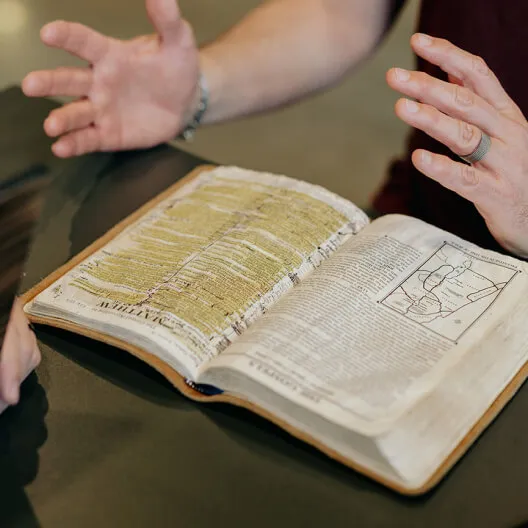


Daily Bible Devotionals


Ezekiel 5
“And you, son of man, take a sharp sword, take it as a barber’s razor, and pass it over your head and your beard; then take scales to weigh and divide the hair. You shall burn with fire one-third in the midst of the city when the days of the siege are finished; then you shall take one-third and strike around it with the sword, and one-third you shall scatter in the wind: I will draw out a sword after them. You shall also take a small number of them and bind them in the edge of your garment. Then take some of them again and throw them into the midst of the fire, and burn them in the fire. From there, a fire will go out into all the houses of Israel. Thus says the Lord God: ‘This is Jerusalem; I have set her in the midst of the nations and the countries all around her. She has rebelled against My judgments by doing wickedness more than the nations, and against My statutes more than the countries that are all around her; for they have refused My judgments, and they have not walked in My statutes.’” Ezekiel 5:1-6 (HCSB)
Those of us who get weary of what God asks us to do should remember what He asked the prophets to do in His name. Then, we should consider closely the words of Paul:
“Pursue love, and desire spiritual gifts, but especially that you may prophesy.” 1 Corinthians 14:1 (NKJV)
To imagine doing Ezekiel’s job for even a few days is difficult, but Ezekiel’s faithfulness shines in his willingness to do the same task every day for over a year! We might be called upon to perform many tasks that may be regarded as humdrum and others that might attract ridicule from an unbelieving world. But God calls us to be faithful, even if that means becoming fools on behalf of the Gospel.
“We are fools for Christ’s sake, but you are wise in Christ! We are weak, but you are strong! You are distinguished, but we are dishonored!” 1 Corinthians 4:10 (NKJV)
God hates sin. And how had His people sinned? They turned their backs on God and His covenant – a covenant in which the warnings that those who disobeyed it would incur its curses. (Deuteronomy 27, 28) Those who serve other gods are guilty of violating the purpose for which they were created. At the time of today’s chapter, Jerusalem’s destruction was only five years away, and it was the direct result of the people’s sin. In light of that harsh truth, we can appreciate God’s love for us and Jesus’ atoning sacrifice on our behalf.
“But God demonstrates His own love for us in this: While we were still sinners, Christ died for us.” Romans 5:8 (NIV)
As sure as the destruction of Jerusalem was prophesied and fulfilled with complete accuracy, so too will the prophecies of the Day of the Lord in the Book of Revelation come to pass. Will you choose to be a rebel or participate in the Remnant?
Ezekiel 3
"Then I came to the captives at Tel Abib, who dwelt by the River Chebar; and I sat where they sat, and remained there astonished among them seven days. Now it came to pass at the end of seven days that the word of the Lord came to me, saying, 'Son of man, I have made you a watchman for the house of Israel; therefore hear a word from My mouth, and give them warning from Me: When I say to the wicked, "You shall surely die," and you give him no warning, nor speak to warn the wicked from his wicked way, to save his life, that same wicked man shall die in his iniquity; but his blood I will require at your hand. Yet, if you warn the wicked, and he does not turn from his wickedness, nor from his wicked way, he shall die in his iniquity; but you have delivered your soul.'" Ezekiel 3:15-19 (NKJV)
They say everyone wants to be their own boss until they open their own small business! The same seems to be true of followers of God. We want to obey Him until He tells us to do something that makes us feel uncomfortable. Ezekiel knew what that felt like. In response to God's call on his life, Ezekiel nursed his anger for seven days.
And what was God's call on Ezekiel's life? To be the channel through which God's Word comes to a rebellious people. The expression, "the word of the Lord came to me," occurs fifty times in the book of Ezekiel. By this, we know that it is important to God that people walk with Him personally through His Word. As a matter of fact, Jesus was the personification of the Word of the Lord. (John 1) In essence, having a saving relationship with Jesus is a saving relationship with the Word-made flesh.
Why so few professing followers of Jesus read the Bible is beyond me! If God's Word is so important, perhaps the question for our generation should be, "How intently do we seek the Word of the Lord?"
There comes a time when we must stop thinking about how we feel and get on with doing what God wants us to do. God wanted Ezekiel to become a watchman. The duties of a watchman included standing on the city's ramparts, watching for the coming of invaders, and quickly blowing a trumpet to warn the entire city of the onset of danger. Ezekiel's commission contained a sign of God's continued favor for His covenant people. No matter how great their sin, He would not abandon them entirely. Even in Babylonian exile, God gave Israel a "town crier" to warn them of dangers and summon them to action.
As "watchman," Ezekiel's task lay in two directions: to the "wicked" and the "righteous." Under the ministry of the prophets, the people were called to true repentance and to return to God. The call to repentance focused on God's covenant with them. But the deeper message of Ezekiel's calling was not simply to return people to the covenant of God but to return them to the God of the covenant.
These daily devotionals exist primarily to return believers to an ongoing personal relationship with God through His Word. The hope is that people would discover what it means to really KNOW Him and that they would share Him with others.
Ezekiel 2
"The children are obstinate and hard-hearted. I am sending you to them and you must say to them: 'This is what the Lord God says'. Whether they listen or refuse to listen – for they are a rebellious house – they will know that a prophet has been among them. But you, son of man, do not be afraid of them or their words, though briars and thorns are beside you and you live among scorpions. Don't be afraid of their words or be discouraged by the look on their faces, for they are a rebellious house. But speak My words to them whether they listen or refuse to listen, for they are rebellious." Ezekiel 2:4-7 (HCSB)
There is a trend spreading through the Church these days where there is a high concern that we do not offend non-believers with the "potentially offensive" aspects of the Gospel. The goal of such a congregation would be to stress only the positive aspects of salvation (love, acceptance, forgiveness), hence making Jesus more "attractive."
"Potentially offensive" aspects of the Gospel would include mankind's sinful hopelessness in our natural state, the exclusivity of salvation through Jesus alone, or the absolute authority of Scripture. And it would extend into social items like sexual sin and abortion. The articulated reason many professing believers stay away from such topics is that they do not want to offend people and thus hinder non-believers from entering into a saving relationship with Jesus. The lingering unasked question in such circles is: When we don't share the whole truth, are people actually entering into a saving relationship with Jesus, or are they simply choosing a convenient Jesus-themed option?
Ezekiel was commanded to share the whole truth and nothing but the truth and not worry about his audience's response. We would do well to heed God's directive to Ezekiel because God's character is unchanging; He might as well be talking directly to us. In that, we can hang our faith on the old saying: If we humiliate God's Word for fear of offending our fellow man, we have offended God. Put simply: Be more concerned with your responsibility to God than man's repose to you.
We are not judged by men's response to the Gospel, only by our faithfulness to preach it. To most people, Jesus is a "Rock of offense" (1 Peter 2:8, Romans 9:33), but He is also the Rock of salvation for many others…us included. You never know who will receive the Gospel or how much they will cling to it. We only know that we are commanded to share it. We should also remember that prophets were not popular men. Not only did they have an unpopular message, but they also had the added charge of speaking primarily to the religious establishment! Still, Paul placed "prophecy" as the most precious gift, one that we can and should seek out.
"Pursue love and desire spiritual gifts, and above all that you may prophesy." 1 Corinthians 14:1 (HCSB)
As you read the Bible, pray that God will reveal His Word and give you the boldness to share it!
Ezekiel 1
“In the thirteenth year, in the fourth month, on the fifth day of the month, while I was among the exiles by the Chebar Canal, the heavens opened up and I saw visions of God. On the fifth day of the month – it was the year of king Jehoiachin’s exile – the Word of the Lord came directly to Ezekiel the priest, son of Buzi, in the land of the Chaldeans by the Chebar Canal. And the Lord’s hand was on him there.” Ezekiel 1:1-3 (HCSB)
Christianity is a religion of the Word. That is why I cannot trust any congregation or religious institution that does not esteem God’s Word and vigorously exhort its congregants to read it. That is why these Bible devotionals exist. In the Bible, God has revealed all that He requires of us to know concerning Himself, His plans, and purposes. Hundreds of thousands of words, written over 1,500 years by forty-some authors, underline that words are essential to our faith.
But in literature, a stubborn truth persists in making itself known: most people remember pictures better than words. Remember the old saying, “A picture paints a thousand words”? It is true. That is why the Bible’s writers, guided by the Holy Spirit, seasoned their words with vivid word pictures to help communicate something of the thoughts of God to the feeble minds of men. Ezekiel is full of word pictures!
G. K. Chesterton once wrote in a children’s picture book:
Stand up, and keep your childishness,
Read all the pedant’s creeds and strictures
But don’t believe in anything
That can’t be told in colored pictures!
The opening verse of Ezekiel’s book relates how, along with the text of Revelation, this prophecy is packed with intricate word sketches: “I saw visions of God.” Colored pictures abound throughout Ezekiel’s prophecy, but as we will soon see, the images are not Ezekiel’s but God’s. More importantly, these God-given pictures need interpreting. It is a message and not a picture that Ezekiel will be called to deliver to God’s people.
Most followers of Jesus have never read Ezekiel, figuring experts should explain such Scriptures. I say it’s time to grow up, do some thinking, and ask the Lord what He is trying to communicate to you personally. Understand that God gave His Word to share with individuals, not just scholars. It is you with whom He wants an ongoing personal relationship, not an exclusive club of PhDs.
A word of caution, though: Pictures, without correct Biblical interpretation, are dangerous vehicles for truth. People are prone to interpret them however they want. We must remember that the book of Ezekiel is essentially Messianic. While Ezekiel begins with words of unremitting judgments, he ends with restoration and blessing, a message America could use today!
Lamentations 5
“Our fathers sinned and are no more, but we bear their iniquities. Servants rule over us; there is none to deliver us from their hand. We get our bread at the risk of our lives, because of the sword in the wilderness. Our skin is hot as an oven, because of the fever of famine. They ravished the women in Zion, the maidens in the cities of Judah. Princes were hung up by their hands, and elders were not respected. Young men ground at the millstones; boys staggered under loads of wood. The elders have ceased gathering at the gate, and the young men from their music. The joy of our heart has ceased; our dance has turned into mourning. The crown has fallen from our head. Woe to us, for we have sinned! Because of this our heart is faint; because of these things our eyes grow dim; because of Mount Zion which is desolate, with foxes walking about on it.” Lamentations 5:7-18 (NKJV)
The Biblical book we know as “Lamentations” is not titled as such in the Hebrew Bible. In Hebrew, it’s called “Eicha” meaning “How?” This title makes more sense than Lamentations because simply judging Jeremiah’s book as a lamentation sells short God’s intended message of hope to the dispersed Jews, staggering in chains as they are being carried off into captivity. This is not a time to simply be emotional. It is time for God’s “Chosen” to seriously contemplate their circumstances and learn! The Jewish people were to ask themselves (for 70 years – Jeremiah 29), “HOW did this happen?” “HOW can we keep this from getting worse?” Most importantly, they were to ask, “HOW can we be forgiven by God, possibly be repaired to a right relationship with Him, and return to the Promised Land?”
“You, O Lord, remain forever; your throne from generation to generation. Why do You forget us forever, and forsake us for so long a time? Turn us back to You, O Lord, and we will be restored; renew our days as of old, unless You have utterly rejected us, and are very angry with us!” Lamentations 5:19-22 (NKJV)
Jeremiah is speaking on behalf of the people, not necessarily his personal opinion…a national confession, as it were. Chapter 5 begins with some blame-shifting. i.e., “Our fathers sinned, and we are suffering because of their poor choices…” While that may be true to some extent, eventually, they get around to their personal choices, “Woe to us, for we have sinned!” And that confession, the recognition that we have fallen short of God’s articulated standard (His Word), is always the trigger that leads to restoration.
Every year, religious Jews read the book of Eicha aloud. It is read softly at first. The volume of the reader’s voice builds to the climax, which is sung aloud by the entire congregation: “Turn us to you, O Lord, and we will return. Renew our days as of old.” But God has already turned, not only to the Jewish community but also to any Gentile who seeks a right relationship with Him. His desire to restore comes through Messiah, Jesus our Lord & Savior! The ball is not on God’s side of the tennis court but on OURS! We must choose Jesus because He has already chosen to redeem us!
“Therefore say to them, ‘Thus says the Lord of hosts: “Return to Me,” says the Lord of hosts, “and I will return to you,” says the Lord of hosts.’” Zechariah 1:3 (HCSB9)
Lamentations 4
“Daughter of Zion, your punishment is complete; He will not lengthen your exile. But He will punish your iniquity, daughter of Edom, and will expose your sins.” Lamentations 4:22 (HCSB)
Mercy. You never know how great Mercy is until you need it. To refresh our memories, Grace is a free gift. Grace is getting something you do not deserve. Mercy is NOT getting what you deserve. Mercy is when we receive punishment (to teach us our transgressions are offensive) but not to the full extent of the law (to teach us the Judge still holds us to a degree of esteem, although we have transgressed).
Before he wrote Lamentations, Jeremiah delivered God’s message of Mercy to the exiles of Jerusalem. As they walked out of town (because of God’s judgment), Jeremiah sent a message of encouragement: You will someday be restored.
“I will restore the fortunes of Judah and of Israel and will rebuild them as in former times. I will purify them from all the wrongs they have committed against Me. This city will bear on My behalf a name of joy, praise, and glory before all the nations of the earth, who will hear of all the good I will do for them. They will tremble because of all the good and all the peace I will bring about for them.” Jeremiah 33:7-9 (HCSB)
While in exile, the remnant of Jerusalem must have tended to focus on the harshness of God’s rebuke. God had Daniel remind them WHY they were in exile and how it was avoidable. Yet, they refused to accept His terms of reparation.
“Just as it is written in the law of Moses, all this disaster has come on us, yet we have not appeased the Lord our God by turning from our iniquities and paying attention to Your truth.” Daniel 9:13 (HCSB)
It is not difficult for followers of Jesus in our generation to look at the iniquities of our increasingly Godless nation (even Godlessness within the walls of our places of worship) and wonder if the Lord is preparing a reckoning for us soon. And what if He is? Many years before the destruction of Jerusalem, there was a king, Josiah, who was bent on restoring the Temple in Jerusalem. During the Temple renovations, the priest found the Book of the Law. When they read God’s Word to the king, he tore his robe and sought a prophet to seek the Lord on behalf of the people.
“Go. Ask YHWH for me and for those remaining in Israel and Judah, concerning the words of the book that was found. For great is the Lord’s wrath that is poured out on us because our fathers have not kept the word of the Lord in order to do everything written in this book.” 2 Chronicles 34:21 (HCSB)
In response to Josiah’s repentance, which included him ordering the people of his kingdom to repent, the Lord told the prophet to inform Josiah He would turn back his imminent judgment. Lord, let ours be a “Josiah Generation”! We need revival!
Lamentations 3
“Remember my affliction and my homelessness, the wormwood and the poison. I continually remember them and have become depressed. Yet I call this to mind, and therefore I have hope: Because of the Lord’s faithful love we do not perish, for His mercies are new every morning; great is Your faithfulness! I say: The Lord is my portion, therefore I will put my hope in Him. The Lord is good to those who wait for Him, to the person who seeks Him. It is good to wait quietly for deliverance from the Lord. It is good for a man to bear the yoke while he is still young.” Lamentations 3:19-27 (HCSB)
Lamentations 3 is the most elaborate of the lamenting elegies. It surpasses its “sisters” in spiritual value because it contains this (above) supreme expression of faith. We cannot overlook the fact that Jeremiah is personifying the nation and personifying Messiah, as he uses vivid word pictures to describe the types of sufferings that were fully realized in Jesus.
For instance, Jeremiah was led around in darkness, and the Lord seemed to have forsaken him. He describes being crushed and broken, surrounded by grief and weariness, bound with heavy chains, and thrown in a dungeon. He is one who was on a journey and blocked by “hewn stones” (an image of the Jewish leaders) and turned aside to perplexing paths. He is hunted, arrows pierce his heart, is derided by his people, and is subject to mocking songs. He feasted on bitterness and was made to drink gall. He is even denied the peace that other sufferers may come to know. These, and several other images, all foreshadow the Messiah’s suffering.
All these accounts build a passionate plea for deliverance. Here, the Lord is presented not as an enemy but a Deliverer and Friend. It is noteworthy, even from a literary point of view, that this beautiful paragraph of confident trust and spiritual instruction is the central section of the central chapter of this lament. It towers above the dark valleys of grief and despair.
In this present generation, one in which we will soon see rebuke for our personal and national sin, we must remember this beautiful promise:
“Be satisfied with what you have, for He Himself has said, ‘I will never leave you or forsake you.’ Therefore, we may boldly say: The Lord is my helper; I will not be afraid. What can man do to me?’ Hebrews 13:5b-6 (HCSB)
Finally, we have an exhortation to seek the Lord while we are young, and to learn to humbly follow Him. This is so we will not be thrown into anxiety when life’s troubles come upon us later in life. That is why it is essential to read His Word daily. When we fast-track Biblical literacy, we are fast-tracking faith! (Romans 10:17)
Lamentations 1
“My transgressions have been formed into a yoke, fastened together by His hand; they have been placed upon my neck, and the Lord has broken my strength. He has handed me over to those I cannot withstand.” Lamentations 1:14 (HCSB)
In this opening elegy, two voices are heard; the first is that of the poet (verses 1-11), and the second is that of stricken Jerusalem (verses 12-22). To arouse sympathy, Jerusalem is personified. She is represented as a widow to indicate her loneliness. The city is alone, not because she is isolated among the hills, but because her streets are silent and houses empty; the “widow” has been robbed of her children. The “princess among the provinces” is now a maidservant.
Jerusalem weeps bitter tears in the night. Her “lovers,” her former allies among the nations and their pagan gods, have proven faithless and become her enemies. Jerusalem is a sad metaphor for what happens to all who depart from God’s Word and set out on their own, seeking to establish for themselves that which only God can provide.
So precisely instructive are the lessons of “Lamentations” that every chapter has 22 lines, corresponding with the 22-letter Hebrew alphabet. Chances are, even your own Bible has the Hebrew letters above every stanza. The idea is that when Jewish children were learning to spell, as part of their curriculum, they would memorize the Book of Lamentations. Every Hebrew letter, then, became a reminder of the consequences of sin. We learn: “A” is for “Apple.” They would learn: “Alef” is for “How she sits alone, the city once crowded with people! She, who was great among the nations, has become like a widow. The princess among the provinces has become a slave.”
In today’s passage, it is with THAT knowledge that EVERY Hebrew learned to read by the primer of Lamentations so that we can better understand the gravity that Jesus’ words would have had upon the hearers of His day. They would have known the book of Lamentations by memory; thus, they were completely aware of what Jesus meant when He said:
“Come to Me, all you who labor and are heavy laden, and I will give you rest. Take My yoke upon you and learn from Me, for I am gentle and lowly in heart, and you will find rest for your souls. For My yoke is easy and My burden is light.” Matthew 11:28-30 (NKJV)
As with Israel’s need for restoration, the United States (and the entire world, for that matter) is in disrepair and in dire need to be repaired to God through Messiah Jesus. True to Chapter 5, Messiah came to establish restoration. Are you suffering under the heavy hand of God’s rebuke of your sin? Do not rebel against Him! (Hebrews 3:8-19) It didn’t work the first time, and it will never work out well, in the end, for those who depart from His instruction. Surrender your will to Him and let Him lead you to that place of rest.
Jeremiah 52
“On the twenty-fifth day of the twelfth month of the thirty-seventh year of the exile of Judah’s King Jehoiachin, Evil-Merodach king of Babylon in the first year of his reign, pardoned King Jehoiachin of Judah and released him from the prison. He spoke kindly to him and set his throne above the thrones of the kings who were with him in Babylon. So Jehoiachin changed his prison clothes, and he dined regularly in the presence of the king of Babylon for the rest of his life. As for his allowance, a regular allowance was given to him by the king of Babylon, a portion for each day until the day of his death, for the rest of his life.” Jeremiah 52:31-34 (HCSB)
They say a story’s not a legend ‘till it ends. The last chapter of Jeremiah’s prophecy is in the form of a historical re-telling. It is a short story because its substance has already been relayed. (Jeremiah 39, 2 Kings 24:18 – 25:30) It is a sad story because it concerns the fall of Jerusalem and the tragic suffering of its rulers and people. It is an important story, as it is used here (to close the prophecies), for the very center of the predictions has been the destruction of the sacred city. Now, the fulfillment of prophecy justifies and vindicates the prophet whose stern words have been spoken. It is also significant that it ends with a gleam of comfort and hope.
In recording the capture of the city, special mention is made of the savage treatment given to the king. It’s true that Zedekiah was wicked and proved a treacherous servant of Nebuchadnezzar. However, it is difficult not to feel sorry for his suffering soul as he watches his sons slaughtered and then is blinded & carried in chains to Babylon to spend the rest of his years in torture and darkness. The destruction of the city, the burning of its famous Temple, the ruin of its palaces, and the dismantling of its wall form a sense of horror, while the deportation of the people leaves the impression of a desolated and ravished land.
The spoils carried away by the Chaldean commander included as its chief feature the precious furnishings of brass and gold and silver, which had been the very glory of the Temple. The final notes of cruelty depict the merciless execution by Nebuchadnezzar of the priests, nobles, and surviving defenders of the fallen city. Such atrocities were well within the characters of the Assyrian and Chaldean rulers. The small number of remaining captives carried away to Babylon indicates what havoc must have been wrought among the Jews by slaughter, famine, and pestilence during the long, hopeless months of the Babylonian siege. As Jeremiah predicted, only a “remnant” of the nation remained.
Yet through the remnant, the nation was to be preserved, renewed, and restored. Of this restoration, at least a dim hope can be found in the fate of Israel’s King, Jehoiachin.
After 37 years of captivity, he was brought out of prison, given royal honors, and seated at the table with the ruler of Babylon. Likewise, after years of discipline and suffering, the people of God were to be delivered, restored, and given the high privilege of becoming the nation in which the Savior of the World, Jesus, was to appear.
Jeremiah 50
“Call together the archers against Babylon. All you who bend the bow, encamp against it all around; let none of them escape. Repay her according to her work; according to all she has done, do to her; for she has been proud against the Lord, against the Holy One of Israel. Therefore her young men shall fall in the streets, and all her men of war shall be cut off in that day,” says the Lord. “Behold, I am against you, O most haughty one!” says the Lord God of hosts; “For your day has come, the time that I will punish you. The most proud shall stumble and fall, and no one will raise him up; I will kindle a fire in his cities, and it will devour all around him.” Jeremiah 50:29-32 (NKJV)
The Lord allowed the damage that the culture of Babylon had inflicted on the people of Israel (through seductive idolatry – aka spiritual adultery) to physically manifest itself on the Jewish people by their being conquered by the kingdom of Babylon. If Judah were to forsake God for Babylonian idols, then the Lord would withdraw His protection and allow them to live under Babylonian pagan taskmasters! While the kingdom of Babylon was destroyed thousands of years ago, its idolatrous enticements are still seducing God’s people today. Just as Babylon was judged in the Bible, so the lingering “whore” who entices mankind away from following the Lord (Mystery of Babylon) awaits judgment in the last days.
“Then one of the seven angels who had the seven bowls came and talked with me, saying to me, ‘Come, I will show you the judgment of the great harlot who sits on many waters, with whom the kings of the earth committed fornication, and the inhabitants of the earth were made drunk with the wine of her fornication.’ So he carried me away in the Spirit into the wilderness. And I saw a woman sitting on a scarlet beast which was full of names of blasphemy, having seven heads and ten horns. The woman was arrayed in purple and scarlet, and adorned with gold and precious stones and pearls, having in her hand a golden cup full of abominations and the filthiness of her fornication. And on her forehead a name was written: MYSTERY, BABYLON THE GREAT, THE MOTHER OF HARLOTS AND OF THE ABOMINATIONS OF THE EARTH. I saw the woman, drunk with the blood of the saints and with the blood of the martyrs of Jesus. And when I saw her, I marveled with great amazement.” Revelation 17:1-6 (NKJV)
But a remnant of the “Chosen” people will again choose God! (Jerimiah 50:4-5; Rev 7:4)
“Thus says the Lord of hosts: ‘The children of Israel were oppressed, along with the children of Judah; all who took them captive have held them fast; they have refused to let them go. Their Redeemer is strong; the Lord of hosts is His name. He will thoroughly plead their case, that He may give rest to the land, and disquiet the inhabitants of Babylon.’” Jeremiah 50:33-34 (NKJV)
“My little children, these things I write to you, so that you may not sin. And if anyone sins, we have an Advocate with the Father, Jesus Christ the righteous.” 1 John 2:1 (NKJV)
Jeremiah 51
“Thus the slain shall fall in the land of the Chaldeans, and those thrust through in her streets. For Israel is not forsaken, nor Judah, by his God, the Lord of hosts, though their land was filled with sin against the Holy One of Israel.” Jeremiah 51:4-5 (NKJV)
In the Divided Kingdom era of the Hebrew people, both the Northern Kingdom (aka Israel) and The Southern Kingdom (aka Judah) were conquered and sent into exile. So, had God un-chosen His “Chosen People”? By no means! The rebuke of God does not mean the rejection of God for believers, although it may seem like it at times!
Today’s chapter focuses on the judgment of the mother of all idolaters: Babylon. God is telling His people to leave Babylon because He is about to destroy her and her idolatrous, spiritually fornicating ways. He likens Babylon to a whore who entices men by getting them drunk.
“Flee from the midst of Babylon, and every one save his life! Do not be cut off in her iniquity, for this is the time for the Lord’s vengeance; He shall recompense her. Babylon was a golden cup in the Lord’s hand, that made all the earth drunk. The nations drank her wine; therefore the nations are deranged. Babylon has suddenly fallen and been destroyed. Wail for her!” Jeremiah 51:6-8a (NKJV)
Babylon is mentioned as a “golden cup in the Lord’s hand,” but that does not mean God endorsed her ways. He simply allowed those who refused to turn to Him to turn to Babylon’s idolatry. Even in this, we see God’s grace in that He allows us to pursue our sins so that we can come to the end of ourselves. Consider our nation’s present moral compromise. Perhaps, when we reach rock bottom, we will turn from our sin and receive His forgiveness through Messiah Jesus. In the light of Jeremiah’s prophecy, consider John’s words about Babylon in the Revelation:
“After this I saw another angel with great authority coming down from heaven, and the earth was illuminated by his splendor. He cried in a mighty voice: It has fallen, Babylon the Great has fallen! She has become a dwelling for demons, a haunt for every unclean spirit, a haunt for every unclean bird, and a haunt for every unclean and despicable beast. For all the nations have drunk the wine of her sexual immorality, which brings wrath. The kings of the earth have committed sexual immorality with her, and the merchants of the earth have grown wealthy from her excessive luxury. Then I heard another voice from heaven: Come out of her, My people, so that you will not share in her sins or receive any of her plagues. For her sins are piled up to heaven, and God has remembered her crimes. Pay her back the way she also paid, and double it according to her works. In the cup in which she mixed, mix a double portion for her. As much as she glorified herself and lived luxuriously, give her that much torment and grief, for she says in her heart, ‘I sit as a queen; I am not a widow, and I will never see grief.’ For this reason her plagues will come in one day—death and grief and famine. She will be burned up with fire, because the Lord God who judges her is mighty.” Revelation 18:1-8 (HCSB)
Jeremiah 49
“Against the Ammonites. Thus, says the Lord: ‘Has Israel no sons? Has he no heir? Why then does Milcom (Molech) inherit Gad, and his people dwell in its cities? Therefore behold, the days are coming,’ says the Lord, ‘that I will cause to be heard an alarm of war in Rabbah of the Ammonites; it shall be a desolate mound, and her villages shall be burned with fire. Then Israel shall take possession of his inheritance,’ says the Lord.” Jeremiah 49:1-2 (NKJV)
Every kid loves a "snow day." For you people living in Hawaii or Los Angeles who may not know, a snow day is when children don’t have to go to school because the icy roads are deemed too dangerous for school buses. One year, when I was in Jr High, my friend Jeff and I were making the most of our snow day by throwing snowballs at cars driving by. Most people would laugh, honk and wave when we hit their cars, but one guy got very angry! He got out of his car and chased us through the neighborhood. When Jeff and I decided to split up, the psycho driver chose to chase me! Like any scared kid, I ran home. I figured I would be safe if I could lock myself in my house. I made it home, hopped the fence, and shot straight for my back door, but it was locked! Then the psycho driver hopped my fence! No bueno!
Just when I thought all was lost, my mom looked out the window and saw an angry stranger about to attack her son. Immediately, the pursuer was being pursued by a butcher’s knife-wielding mom!! When my father got home, he already knew the whole story. Apparently, my snowball had struck one of his company cars. The psycho driver was one of my dad’s co-workers. I got a spanking for disrespecting other people’s (aka company) property. And my dad was right. I deserved it.
If you can understand that story, perhaps you can understand how God was justified in His punishment of Israel’s idolatry, as well as in His punishing Ammon, whom He used to punish Israel’s idolatry. It was the people of Ammon who had enticed Israel to sin with their false idol worship of Molech in the first place. And worship of Molech was particularly evil.
“You are not to make any of your children pass through the fire to Molech. Do not profane the name of your God; I am YHWH.” Leviticus 18:21 (HCSB)
Israel had chosen to turn away from God and His Word, choosing to affiliate with worldly Ammon, to the point where they were sacrificing their children to Ammon’s false god, Molech, by burning them! Lest we get self-righteous, consider who many followers of Jesus seek to justify abortion in our generation.
But was God done with Israel? No! He sought to punish them by the same people they idolized, but He also sought justice on their behalf. And that is the difference between God’s rebuke of His children and His punishment of unbelievers: Mercy. God loves His own, even though He does not condone all their behavior. Choose Him today! His grace is offered to all who, by faith in Jesus, would believe.
Jeremiah 48
“The one who does the Lord’s business deceitfully is cursed, and the one who withholds his sword from bloodshed is cursed. Moab has been left quiet since his youth, settled like wine on its dregs. He hasn’t been poured from one container to another or gone into exile. So his taste has remained the same, and his aroma hasn’t changed. Therefore look, the days are coming— this is the Lord’s declaration when I will send those to him, who will pour him out. They will empty his containers and smash his jars. Moab will be put to shame because of Chemosh, just as the house of Israel was put to shame because of Bethel that they trusted in.” Jeremiah 48:10-13 (HCSB)
There is always a war going on somewhere. Even if you are not a member of the armed forces, you have to recognize at least you are a citizen of a country that is pretty much always at war with someone all of the time. I’m not a professional “warrior,” but I know that soldiers amid battle do not take their jobs lightly. And those who do have a higher probability of becoming casualties. No, warfare demands the blood of the enemy before they spill yours.
Today’s passage begins with a reminder that we are in the midst of spiritual warfare. That is, we must realize that Satan is our mortal enemy, and sin is his weapon. He will never cease his efforts to kill us. So, why do we keep trying to negotiate peace with our sins, searching for a compromise that will allow us to retain “pet” sins, taking the Lord’s business carelessly?
You see, the Lord, alone, is holy. His “business” is making His holiness known, and He will not stand for anyone (or anything) to steal the worship that is rightfully His. By tempting us to sin, Satan seeks to steal worship from God, separating us from the Lord. If we are truly to be about the Lord’s business, then our business should be comprised of 1) directing worship towards Him, and 2) doing away with sin in our lives.
The sin that Moab, Israel, and the nations were judged for was idolatry. Moab had abundant money, power, and resources, and they attributed their success to their “non-god” Chemosh. Each nation had their “homegrown” gods, and Israel worshiped pagan gods (both foreign and of their own design) at Bethel.
God’s indictment was that they had all taken His business carelessly and withheld His Word (the sword) from its rightful task, which is intended to drive sin out of our lives...killing it, as it were.
So, how seriously are you taking the Lord’s business in your life? Are you seeking His Word daily? Do you allow it to embolden you to trust God and put away your idols, those things you ascribe power and worship to, instead of God?
Jeremiah 46
“But you, My servant Jacob, do not be afraid, and do not be discouraged, Israel, for without fail I will save you from far away and your descendants, from the land of their captivity! Jacob will return and have calm and quiet with no one to frighten him. And you, My servant Jacob, do not be afraid—this is the Lord’s declaration—for I will be with you. I will bring destruction on all the nations where I have banished you, but I will not bring destruction on you. I will discipline you with justice, and I will by no means leave you unpunished.” Jeremiah 46:27-28 (HCSB)
Let’s refresh our memories on the Jewish people's history after King Solomon's reign. Solomon was succeeded by his son, Rehoboam. After his coronation, the elders of the kingdom assembled to ask Rehoboam if he would be hard on them or if he would ease their labor. Instead of heeding Solomon's former advisors' advice (to lighten the people’s burdens), Rehoboam sought advice from his young, who encouraged Rehoboam to increase their burdens.
At that time, a leader named Jeroboam arose and convinced ten of Israel’s twelve tribes to follow him. To entice the people, he built two golden calves for them to worship instead of worshipping at the temple in Jerusalem. This entered the era in Jewish history called the “Divided Kingdom.” Henceforth, in Scripture, the Jewish people were split into Northern and Southern kingdoms. The Northern Kingdom (aka Israel) was comprised of ten tribes. The Southern Kingdom (aka Judah) was comprised of the tribes of Judah and Benjamin, plus a small number of people from the other ten tribes who defected to Judah to worship God in Jerusalem.
Because the Northern kingdom of Israel departed straightway into idolatry, their eventual demise came swifter than the Southern kingdom of Judah’s demise. Assyria defeated Israel, deporting its inhabitants to other nations while filling the Northern land with foreigners from other nations Assyria had defeated. At that time, God allowed Assyria to destroy and defeat only as far as Jerusalem in the kingdom of Judah. He spared Judah because of the faithful prayers of its king, Hezekiah. After Hezekiah’s death, the bulk of Judah’s kings led the people deeper into idolatry. So, God eventually judged Judah as he judged Israel. God will not be mocked!
Judah’s idolatry was more sophisticated. It developed as worldliness crept into Torah-observant YHWH worship. Eventually, God judged Judah as He had judged Israel through Assyrian defeat. But this time, His tool of rebuke was Babylon.
Today’s chapter begins with God’s stern declaration to the inhabitants of Judah that because they sought refuge from Babylon in an Egyptian alliance, instead of repenting and seeking God, they would be destroyed by Babylon in Egypt! But the chapter ends with a kind word to the exiled Northern Kingdom of Israel: Their time of exile would soon end. They would someday be restored to the land! God rebukes His children, and sometimes very sternly. But His mercy to His children is that His rebuke does not last forever! God, judge our nation, but in Your mercy.
Jeremiah 45
“This is the word that Jeremiah the prophet spoke to Baruch son of Neriah when he wrote these words on a scroll at Jeremiah’s dictation in the fourth year of Jehoiakim son of Joash, king of Judah: This is what the Lord, the God of Israel says to you, Baruch: You have said, ‘Woe is me because the Lord had added misery to my pain. I am worn out with groaning and have found no rest.’” Jeremiah 45:1-3 (HCSB)
Biblical authors do not always report God’s Word in chronological order. Often, they skip around as the Lord leads, much like a teenager tells a story. Today’s chapter can best be understood through the lens of chapter 36, which puts today’s chapter in its proper timeline.
“In the fourth year of Jehoiakim son of Josiah, king of Judah, this word came to Jeremiah from the Lord: ‘Take a scroll and write on it all the words I have spoken to you concerning Israel, Judah, and all the nations from the time I first spoke to you during Josiah’s reign until today.’… So Jeremiah summoned Baruch, son of Neriah. At Jeremiah’s dictation, Baruch wrote on a scroll all the words the Lord had spoken to Jeremiah. Then Jeremiah commanded Baruch, ‘I am restricted; I cannot enter the temple of the Lord, so you must go and read from the scroll which you wrote at my dictation – the words of the Lord in the hearing of the people at the temple of the Lord on a day of fasting.’” Jeremiah 36:1-2, 4-6a (HCSB)
Enemies of God’s Word are always out to silence it. At this time, Jeremiah was held captive and barred from entering the Temple. Jeremiah was banned from the Temple because he was prophesying God’s Word to the people, and Judah’s King and his officials would not accept it. Of course, nothing can silence God, so Baruch was summoned to be Jeremiah’s (i.e., God’s) mouthpiece. Lesson: Kill the prophet, and God will raise up another. That’s a great idea, as long as your name is not Baruch!
Baruch had the opportunity and responsibility of carrying God’s Word, unsupervised, to the Temple. This posed an opportunity for the young Baruch to compromise to “save face” with his colleagues at the Temple. This was such a temptation for Baruch that the Lord decided it was necessary to give him a warning at the onset of his calling.
“This is what you are to say to him: This is what the Lord says: ‘What I have built, I am about to demolish, and what I have planted I am about to uproot – the whole land! But as for you, do you seek great things for yourself? Stop seeking! For I am about to bring disaster on every living creature’ – this is the Lord’s declaration – ‘but I will grant you your life like the spoils of war wherever you go.’” Jeremiah 45:4-5 (HCSB)
So, what is our takeaway? It is of utmost importance to God that we receive His Word and deliver it to people without compromising. We should not be concerned with whether people are offended by our gospel message. We should be concerned with offending God by watering down what He has called us to share!
Jeremiah 44
“But Jeremiah responded to all the people – the men, women, and all the people who were answering him – saying, ‘As for the incense you burned in Judah’s cities and in Jerusalem’s streets – you, your fathers, your kings, your officials, and the people of the land – did the Lord not remember them? He brought this to mind. The Lord can no longer bear your evil deeds and the detestable acts you have committed, so your land has become a waste, a desolation, and an object of cursing, without inhabitant, as you see today.’” Jeremiah 44:22-23 (HCSB)
Today’s dialogue between Jeremiah and the evil, idolatrous remnant of Judah is similar to the apostle Peter’s exhortation to the dispersed Jews (and young-in-the-faith believers) of his time. For instance, Jeremiah preached that God’s patience should not be misconstrued as approval of their idolatry. Furthermore, Peter exhorts that God’s slowness does not mean He will not keep His promises. Both Jeremiah and Peter send a clear and relevant message to us: Know & obey the Word of the Lord!
“The Lord is not slow in keeping his promise, as some understand slowness. Instead he is patient with you, not wanting anyone to perish, but everyone to come to repentance.” 2 Peter 3:9 (NIV)
“‘This will be a sign to you’ – the Lord’s declaration – ‘that I am about to punish you in this place, so you may know that My words of disaster concerning you will certainly come to pass. This is what the Lord says, ‘I am about to hand over Pharaoh Hophra, Egypt’s king, to his enemies, to those who want to take his life, just as I handed over Judah’s King Zedekiah to Babylon’s King Nebuchadnezzar, who was his enemy, the one who wanted to take his life.’” Jeremiah 44:29-30 (HCSB)
“But the Day of the Lord will come like a thief; on that day the heavens will pass away with a loud noise, the elements will burn and be dissolved, and the earth and the works on it will be disclosed. Since all these things are to be destroyed in this way, it is clear what sort of people you should be in holy conduct and godliness as you wait for and earnestly desire the coming of the day of God. The heavens will be on fire and be dissolved because of it, and the elements will melt with the heat.” 2 Peter 3:10-12 (HCSB)
“I will punish those living in the land of Egypt just as I punished Jerusalem by sword, famine, and plague. Then a remnant of Judah – those going to live for a while there in the land of Egypt – will have no fugitive or survivor to return to the land of Judah, where they are longing to return to live, for they will not return except for a few refugees.” Jeremiah 44:13-14 (HCSB)
“But in keeping with his promise we are looking forward to a new heaven and a new earth, where righteousness dwells. So then, dear friends, since you are looking forward to this, make every effort to be found spotless, blameless and at peace with him.” 2 Peter 3:13-14 (NIV)
Jeremiah 43
“Now it happened, when Jeremiah had stopped speaking to all the people all the words of the Lord their God, for which the Lord their God had sent him to them, all these words, that Azariah the son of Hoshaiah, Johanan the son of Kareah, and all the proud men spoke, saying to Jeremiah, ‘You speak falsely! The Lord our God has not sent you to say, “Do not go to Egypt to dwell there.” But Baruch the son of Neriah has set you against us, to deliver us into the hand of the Chaldeans, that they may put us to death or carry us away captive to Babylon.’ So Johanan the son of Kareah, all the captains of the forces, and all the people would not obey the voice of the Lord, to remain in the land of Judah.” Jeremiah 43:1-4 (NKJV)
Why do you seek the Lord? A UCLA study on the rise of spirituality on college campuses showed that 87% of college students seek the Lord for what He can do for them. That means only 13% of college students pursue spirituality to learn what God requires of them. Is it any wonder that non-believers perceive Christians as being self-focused and uncaring? Of course, when we become the central focus of our worship, it is impossible to be others-. Self-focused worship is contrary to the teaching of Jesus.
“Now there was also a dispute among them, as to which of them should be considered the greatest. And He said to them, ‘The kings of the Gentiles exercise lordship over them, and those who exercise authority over them are called “benefactors.” But not so among you; on the contrary, he who is greatest among you, let him be as the younger, and he who governs as he who serves. For who is greater, he who sits at the table, or he who serves? Is it not he who sits at the table? Yet I am among you as the One who serves.’” Luke 22:24-27 (NKJV)
When our worship is focused on pleasing ourselves, we cease to please the Lord, who calls us to live selflessly. And self-focused worship causes us to trust in worldly ways & means for protection & provision. (Idolatry) Selfish believers (oxymoron) refuse to see, forsaking to submit to God’s Word by merely obeying it half-heartedly.
“And to the angel of the church of the Laodiceans write, ‘These things says the Amen, the Faithful and True Witness, the Beginning of the creation of God: “I know your works, that you are neither cold nor hot. I could wish you were cold or hot. So then, because you are lukewarm, and neither cold nor hot, I will vomit you out of My mouth.”’” Revelation 3:14-16 (NKJV)
The inhabitants of Judah followed the Lord half-heartedly. They wanted His blessing but denied Him their faithfulness. That led them to trust in worldly sources (i.e., Egypt) to supply a life they believed God was either unwilling or unable to deliver. That NEVER works out well! Rescue is only found in returning to the Lord. Do not seek the Lord vainly (half-heartedly). Deliverance does not come by escaping God’s rebuke; instead, by enduring it. Surrender your whole self to His Lordship. “Humble yourself in the sight of the Lord, and He will lift you up!” (1 Peter:5-6)
Jeremiah 42
“So Jeremiah the prophet said to them, ‘I have heard. I will now pray to the Lord your God according to your words, and every word that the Lord answers you I will tell you; I won’t withhold a word from you.’” Jeremiah 42:4 (HCSB)
We are living in desperate times here in the United States. More and more, the values that built our nation (primarily Judeo-Christian values) are being redefined and presented to us as if they have evolved into something Worldly to become more inclusive and tolerant. And I am amazed at how few followers of Jesus are standing up to lend a prophetic voice to our generation. Sadly, many align themselves with the World, standing against believers who adhere to God’s Word.
Other believers are so afraid of being rejected by friends, family, and neighbors. So, while they may have Biblical answers, they withhold from sharing the whole counsel of God. In seeking not to offend people, they have no problem offending God by rejecting His directive to be His voice, even amid persecution. It may surprise you to hear that this season of history does not surprise me. The Lord told us this season would come.
“I solemnly charge you before God and Christ Jesus, who is going to judge the living and the dead, and because of His appearing and His kingdom: Proclaim the message; persist in it whether convenient or not; rebuke, correct, and encourage with great patience and teaching. For the time will come when they will not tolerate sound doctrine, but according to their own desires, will multiply teachers for themselves because they have an itch to hear something new. They will turn away from hearing the truth and will turn aside to myths. But as for you, be serious about everything, endure hardship, do the work of an evangelist, fulfill your ministry.” 2 Timothy 4:1-5 (HCSB)
The days of Jeremiah were not unlike what we are facing today. The people approached Jeremiah and asked if he would seek the Lord on their behalf, and Jeremiah agreed. But the Word of the Lord will always be at odds with compromise. God does not negotiate unless your negotiation involves surrender. At that point, you are not negotiating as much as you are aligning yourself with His Word with no further resistance.
God’s response was gracious yet unwavering: If you will repent, I will relent. Does that mean God changed His mind? Absolutely not! God’s intent has always been clear: Follow Him, and He will bless you. Depart from Him, and He will rebuke your rebellion. When people humble themselves and return to the Lord, it is they who have changed, not God.
Sadly, the people of Jerusalem chose to reject the Lord’s message through Jeremiah. Will the same be said of the United States? In many ways, it all depends on people like you, who must be determined to seek, obey, and share God’s Word.
Jeremiah 41
“In the seventh month, Ishmael son of Nethaniah, son of Elishama, of the royal family one of the king’s chief officers, came with ten men to Gedaliah son of Ahikam at Mizpah. They ate a meal together there in Mizpah, but then Ishmael son of Nethaniah and the ten men who were with him got up and struck down Gedaliah son of Ahikam, son of Shaphan, with the sword; he killed the one the king of Babylon had appointed in the land. Ishmael also struck down all the Judeans who were with Gedaliah at Mizpah, as well as the Chaldean soldiers who were there.” Jeremiah 41:1-3 (HCSB)
Gedaliah faithfully attempted to bring some order out of the chaos resulting from Jerusalem's fall.
“And Gedaliah the son of Ahikam, the son of Shaphan, took an oath before them and their men, saying, ‘Do not fear to serve the Chaldeans. Dwell in the land and serve the king of Babylon, and it will be well with you. Behold, I will live at Mizpah to serve the Chaldeans who will come to me: But you, gather your wine, and summer fruits, and oil, and put them in your vessels, and dwell in your cities which you have chosen.’” Jeremiah 40:9-10 (NKJV)
There was no doubt of the sincerity, loyalty, and wisdom of Gedaliah, but almost immediately, a plot was formed against his life. Johanan and the “leaders of the forces in the open country” reported to the governor that Ishmael, of the royal family, one of the chief officers of the king, had been sent by the ruler of the Ammonites to assassinate Gedaliah. In his naïve trust, Gedaliah did not believe the reports. Johanan even offered to protect Gedaliah by secretly killing the intending murderer. But the unsuspecting victim replied, “You shall not do this thing, for you speak falsely about Ishmael.”
Gedaliah did not doubt the loyalty of Ishmael, and no one would have believed the depth of his treachery. Of course, today’s passage tells the story. Ishmael was not a man to be trusted with the life of the governor, nor the Jews in his company or the Chaldeans who were attending to the governor. The slaughter was so overwhelming that no one knew of the “murder of Gedaliah” the next day when a company of 80 pilgrims approached Mizpah.
These pilgrims exhibited signs of deep sorrow and carried offerings with them as they were on the way to Jerusalem, possibly to mourn for the destruction of the Temple. Another slaughter ensues, and seventy pilgrims are killed while the remaining ten beg for their lives, using hidden desert storehouses as bargaining chips.
So, what are we to glean from these tragic events? Desperate times lead to desperate measures. For the ungodly, their desperation leads to evil. Those who choose to follow the Lord become all the more desperate to follow Him.
It is also important for us to not be so trusting, not just of the non-believer but also of the professing follower of Jesus. There is a simple formula for trust: Trust = Character/Time. Just because a person professes to be a believer doesn’t mean they can be fully trusted to babysit your children, for instance. If they sustain a Messiah-like character over time, then they can be entrusted with more responsibility.
Jeremiah 39
“At Riblah the king of Babylon slaughtered Zedekiah’s sons before his eyes, and he also slaughtered all Judah’s nobles. Then he blinded Zedekiah and put him in bronze chains to take him to Babylon. The Chaldeans next burned down the king’s palace and the people’s houses and tore down the walls of Jerusalem. Nebuzaradan, the commander of the guards deported to Babylon the rest of the people – those who had remained in the city and those deserters who had defected to him along with the rest of the people who had remained. However, Nebuzaradan, the commander of the guards, left in the land of Judah some of the poor people who owned nothing, and he gave them vineyards and fields at that time.” Jeremiah 39:6-10 (HCSB)
If we concentrate on God’s judgment of the unfaithful, we only get half of the story. What of His deliverance of the faithful? After all, that is where our hope lies. Nebuchadnezzar’s treatment of the poor reminds us of Jesus’ words:
“Blessed are the poor in spirit, For theirs is the kingdom of heaven.” Matthew 5:3 (NKJV)
“Now Nebuchadnezzar king of Babylon gave charge concerning Jeremiah to Nebuzaradan the captain of the guard, saying, “Take him and look after him, and do him no harm; but do to him just as he says to you.” So Nebuzaradan the captain of the guard sent Nebushasban, Rabsaris, Nergal-Sharezer, Rabmag, and all the king of Babylon’s chief officers; then they sent someone to take Jeremiah from the court of the prison, and committed him to Gedaliah the son of Ahikam, the son of Shaphan, that he should take him home. So he dwelt among the people.” Jeremiah 39:11-14 (NKJV)
Likewise, Jesus’ words remind us of Jeremiah’s deliverance:
“Blessed are those who mourn, for they will be comforted. Blessed are the meek, for they shall inherit the earth. Blessed are those who hunger and thirst for righteousness, for they shall be filled.” Matthew 5:4-6 (NKJV)
“Now the word of the Lord had come to Jeremiah when he was confined in the guard’s courtyard: ‘Go tell Ebed-melech the Cushite: This is what the Lord of Hosts, the God of Israel, says: I am about to fulfill My words for harm and not for good against this city. They will take place before your eyes on that day. But I will rescue you on that day’ – this is the Lord’s declaration – ‘and you will not be handed over to the men you fear. Indeed, I will certainly deliver you so that you do not fall by the sword. Because you have trusted Me, you will keep your life like the spoils of war.’ This is the Lord’s declaration.” Jeremiah 39:15-18 (HCSB)
And what of the Ethiopian who pulled Jeremiah from the muddy cistern?
“Blessed are the merciful, for they will be shown mercy. Blessed are the pure in heart, for they will see God. Blessed are the peacemakers, for they will be called the children of God.” Matthew 5:7-9 (NIV) (See also: the rest of Matthew 5)
Jeremiah 38
“So they took Jeremiah and dropped him into the cistern of Malchiah the king’s son, which was in the guard’s courtyard, lowering Jeremiah with ropes. There was no water in the cistern, only mud, and Jeremiah sank in the mud.” Jeremiah 38:6 (HCSB)
If the Lord asked today, “Do you want to be used by Me?” most of us would answer, “Yes, Lord!” We generally think of “blessings” when we think of people the Lord uses. But what if the Lord wanted to use your suffering to send a poignant message to non-believers? Well, our answers may be different in that light. This is precisely Jeremiah’s situation in today’s chapter.
It is hard to be faithful when we are called to suffer. In such times, we must strongly rely on God’s promise of deliverance. Surely, down in that pit, Jeremiah was comforted by the words of David’s Psalm 40.
“I waited patiently for the Lord, and He turned to me and heard my cry for help. He brought me up from a desolate pit, out of the muddy clay, and set my feet upon a rock, making my steps secure. He put a new song in my mouth, a hymn of praise to our God. Many will see and fear and put their trust in the Lord.” Psalm 40:1-3 (HCSB)
Perhaps Jeremiah remembered the story of Joseph and how his similar circumstances led to his brothers’ deliverance.
“When Joseph came to his brothers, they stripped off his robe, the robe of many colors that he had on. They took him and threw him into the pit. The pit was empty; there was no water in it.” Genesis 37:23-24(HCSB)
The point is we need the truth of the Bible for strength through difficult circumstances: “Faith comes by hearing and hearing from the word of God.” (Romans 10:7). Jeremiah trusted the Lord, spoke the truth boldly, and the Lord eventually delivered him.
“Ebed-Melech the Cushite cried out to Jeremiah, ‘Place these old rags and clothes between your armpits and the ropes.’ Jeremiah did so, and they pulled him up with the ropes and lifted him out of the cistern, but he continued to stay in the guard’s courtyard.” Jeremiah 38:12-13 (HCSB)
Later, we find that the Lord allowed Jeremiah’s whole episode of faithful suffering to contrast with Zedekiah’s lack of faith. Jeremiah was saved, but Zedekiah wouldn’t be.
“But if you refuse to surrender, this is the word that the Lord has shown me: ‘Now behold, all the women who are left in the king of Judah’s house shall be surrendered to the king of Babylon’s princes, and those women shall say: “Your close friends have set upon you and prevailed against you; your feet have sunk in the mire, and they have turned away again”’” Jeremiah 38:21-22 (NKJV)
Jeremiah 37
“The officials were angry at Jeremiah and beat and placed him in jail in the house of Jonathan the scribe, for it had been made into a prison. So Jeremiah went into a cell in the dungeon and stayed there many days. King Zedekiah later sent for him and received him, and in his house privately asked him, ‘Is there a word from the Lord?’ ‘There is,’ Jeremiah responded, and he continued, ‘You will be handed over to the king of Babylon.’” Jeremiah 37:15-17 (HCSB)
One of the downsides of sharing God’s Word is that many people will reject it. For some people, simply saying "no" is not enough. They will seek to harm you. Still, it is incumbent upon us to share the truth in love and with boldness. This is nothing we should be surprised about, for Jesus told us we should expect such things.
“If the world hates you, you know that it hated Me before it hated you. If you were of the world, the world would love its own. Yet because you are not of the world, but I chose you out of the world, therefore the world hates you. Remember the word that I said to you, ‘A servant is not greater than his master.’ If they persecuted Me, they will also persecute you. If they kept My word, they will keep yours also.” John 15:18-20 (NKJV)
While Jeremiah faced severe persecution, the Lord was always with him to ensure his ultimate well-being. Notice God’s grace and provision in the midst of Jeremiah’s trial.
“Then Jeremiah said to King Zedekiah, ‘How have I sinned against you or your servants or these people that you have put me in prison? Where are your prophets who prophesied to you, claiming, “The king of Babylon will not come against you and this land? So now, please listen, my lord the king. May my petition come before you. Don’t send me back to the house of Jonathan the scribe, or I will die there.’ So King Zedekiah gave orders, and Jeremiah was placed in the guard’s courtyard. He was given a loaf of bread each day from the baker’s street until all the bread was gone from the city. So Jeremiah remained in the guard’s courtyard.” Jeremiah 37:18-21 (HCSB)
Jesus also predicted the same type of persecution and prayed for us that the enemy would not prevail against us. Like Jeremiah, our calling mixes persecution and provision.
“I have given them Your word; and the World has hated them because they are not of the World, just as I am not of the World. I do not pray that you should take them out of the World, but that you should keep them from the evil one.” John 17:14-15 (NKJV)
Not only should we expect persecution for our faithfulness, we should count it as a blessing.
“Blessed are those who are persecuted for righteousness sake, for theirs is the kingdom of heaven. Blessed are you when they revile and persecute you, and say all kinds of evil against you falsely for My sake. Rejoice and be exceedingly glad, for great is your reward in heaven…” Matthew 5:10-12a (NKJV)
Jeremiah 36
“Now it came to pass in the fourth year of Jehoiakim the son of Josiah, king of Judah, that this word came to Jeremiah from the Lord, saying: ‘Take a scroll of a book and write on it all the words that I have spoken to you against Israel, against Judah, and against all the nations, from the day I spoke to you, from the days of Josiah even to this day. It may be that the house of Judah will hear all the adversities which I purpose to bring upon them, that everyone may turn from his evil way, that I may forgive their iniquity and their sin.’” Jeremiah 36:1-3 (NKJV)
What a difference a generation makes! Observe how King Josiah reacted when God’s Word was found, and the Law was read to him.
“Then Shaphan the scribe told the king, saying, ‘Hilkiah the priest has given me a book.’ And Shaphan read it before the king. Thus it happened, when the king heard the words of the Law, that he tore his clothes. Then the king commanded Hilkiah, Ahikam the son of Shaphan, Abdon the son of Micah, Shaphan the scribe, and Asaiah a servant of the king, saying, “Go, inquire of the Lord for me, and for those who are left in Israel and Judah, concerning the words of the book that is found; for great is the wrath of the Lord that is poured out on us, because our fathers have not kept the Word of the Lord, to do according to all that is written in this book.’” 2 Chronicles 34:18-21 (NKJV)
In contrast to his father’s humble repentance, when God’s Word was read to Josiah’s son Jehoiakim, he took a scribe’s knife, cut it line-by-line, and threw it in the fire. Oh, that America would be a Josiah generation! But when the “Jeremiahs” are banned from the temple, who will take up the Word and preach? (Isaiah 6:8)
“Then Jeremiah called Baruch the son of Neriah; and Baruch wrote on a scroll of a book, at the instruction of Jeremiah, all the words of the Lord which He had spoken to him. And Jeremiah commanded Baruch, saying, ‘I am confined, I cannot go into the house of the Lord. You go, therefore, and read from the scroll which you have written at my instruction, the words of the Lord, in the hearing of the people in the Lord’s house on the day of fasting. And you shall also read them in the hearing of all Judah who come from their cities. It may be that they will present their supplication before the Lord, and everyone will turn from his evil way. For great is the anger and the fury that the Lord has pronounced against this people.’” Jeremiah 36:4-7 (NKJV)
“Thus says the Lord, the God of Israel, to you, O Baruch: ‘You said, “Woe is me now! For the Lord has added grief to my sorrow. I fainted in my sighing, and I find no rest’. Thus you shall say to him, ‘Thus says the Lord: Behold, what I have built I will break down, and what I have planted I will pluck up, that is, this whole land. And do you seek great things for yourself? Do not seek them; for behold, I will bring adversity on all flesh,’ says the Lord. ‘But I will give your life to you as a prize in all places, wherever you go.’” Jeremiah 45:2-4 (NKJV)
Jeremiah 35
“This is what the Lord of Hosts, the God of Israel, says: ‘Go, say to the men of Judah and the residents of Jerusalem: “Will you not accept discipline by listening to My words?” – this is the Lord’s declaration. “The words of Jonadab, son of Rechab, have been carried out. He commanded his sons not to drink wine, and they have not drunk to this day because they have obeyed their ancestor’s command. But I have spoken to you time and time again, and you have not obeyed Me! Time and time again I have sent you all My servants the prophets, proclaiming: ‘Turn, each one from his evil way of life, and correct your actions. Stop following other gods to serve them. Live in the land that I gave you and your ancestors. But you would not pay attention or obey Me.’” Jeremiah 35:13-15 (HCSB)
Who are the Rechabites? They are the descendants of Rechab through Jonadab (aka Jehonadab). They belonged to a group of people called the Kenites, who accompanied the children of Israel into the land of Canaan and dwelt among them. They were Gentiles. God has always shown His grace towards anyone who chooses to follow Him.
Many people believe that Israel was the only group of people the Lord allowed to enter the Promised Land, along with Joshua. Not so. The Kenites were right there with them. Why? Well, for starters, Moses married a Kenite wife (Judges 1:16). In the days of Deborah and Barak, because of Barak’s cowardice, it was a Kenite woman who defeated evil king Sisera (Judges 4:17).
Now, the main body of the Kenites dwelt in cities and adopted the habits (and pitfalls) of “settled” life, but Johnadab forbade his descendants to drink wine or live in cities. They were also commanded always to lead a nomadic life. This particular strain of the Kenites adhered to the law laid down by their patriarch, and today, we read of their fidelity to the old-established custom of their family, even up till the days of Jeremiah.
So, what was God’s reason for singling out this small sect of Gentiles in His exhortation against Judah? In full view of soon-to-be-deported Judah, God chose to bless a group of righteous Gentiles, all because of their faithfulness. God was saying, in essence, “These Gentiles will follow the command of their long-dead ancestor, but you will not follow the Word of the Living God! Even after I sent you countless prophets.”
It would not be the last time in the TANAKH (aka Old Testament) that the Lord would bless faithful Gentiles as a means to evoke jealousy among His unfaithful people. It was that approach, in particular, that Jesus took in His hometown synagogue and made the people want to kill Him:
“He also said, ‘I assure you: No prophet is accepted in his hometown. But I say to you, there were certainly many widows in Israel in Elijah’s day, when the sky was shut up for three years and six months while a great famine came over all the land. Yet Elijah was not sent to any of them – but to a widow at Zarephath in Sidon. And in the prophet Elisha’s time, many in Israel died of serious skin diseases, yet not one of them was healed – only Namaan the Syrian.’ When they heard this, everyone in the synagogue was enraged.” Luke 4:24-28 (HSCB) (See also: Romans10:19; 11:11)
No results found.
Join Our Mailing List
Stay current with what's happening at Groundworks Ministries.
