
Daily Bible Devotionals
written by
Pastor Steve Wiggins
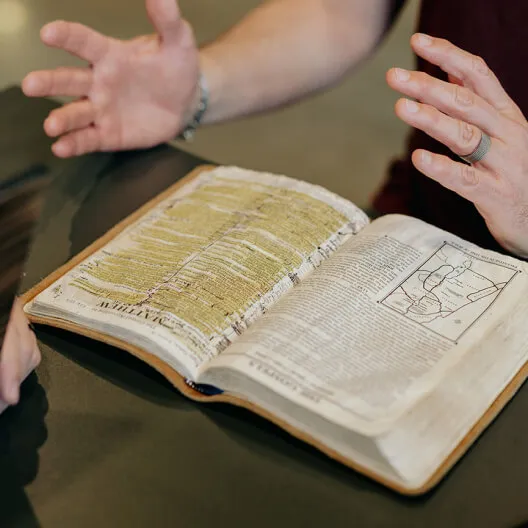


Daily Bible Devotionals


Zechariah 4
“So he answered me, ‘This is the Word of the Lord to Zerubbabel: Not by strength or by might, but by My Spirit, says the Lord of Hosts. What are you, great mountain? Before Zerubbabel, you will become a plain. And he will bring out the capstone accompanied by shouts of: Grace, grace to it!’ Then the Word of the Lord came to me: Zerubbabel’s hands have laid the foundation of this house, and his hands will complete it. Then you will know that the Lord of Hosts has sent me to you. For who scorns the day of small things? These seven eyes of the Lord, which scan throughout the earth, will rejoice when they see a plumb line in Zerubbabel’s hand.” Zechariah 4:6-10 (HCSB)
When I was in college, I ran cross-country and long-distance track. I had a guilty pleasure back in those days. I used to laugh when the young runners would compete in their first college races. They would always start out in first place, but most of them would be rounding out the last place by the race’s end. That is because they had not developed a significant mileage “base,” which is essential for enduring long races at fast paces. Long-distance runners cannot have sprinters’ strategies. Otherwise, they burn out too fast.
As briefly mentioned in yesterday’s devotional, Zerubbabel was the uncrowned heir of David’s line. It was his job to rebuild the Temple in Jerusalem. Solomon, another son of David’s, had built the original Temple. Yet another, known as the “Son of David,” Jesus, would come later and, indeed, He has gone ahead of us, not just to build another Temple, but to prepare a whole New Jerusalem for those who faithfully believe in Him. Zerubbabel was a building contractor. As such, he had a long-distance runner’s mindset. To finish his task, he took a step-by-faithful-step strategy.
If you have ever been on a large-scale construction site toward the end of construction, you have probably noticed it was pretty impressive. But construction is unimpressive for the first 2/3 of the build. That is because any good contractor knows the importance of building a proper foundation. Wise contractors don’t get over-excited about getting the walls & roof built. They level the ground, wait for it to settle, steamroll it, grate it, wait…then pour the foundation. After that, everything seems to go quite quickly.
The same is true with our spiritual growth. Often, we are too concerned with producing the “fruit” of evangelism that we neglect to lay a strong Biblical foundation. We ask, ‘Where’s the fruit?” but whoever asks about the foundation? That is why many talented young believers have successful ministry experiences and then quickly crash & burn. Sadly, the whole Messianic community suffers unnecessarily simply because people would rather be sprinters than long-distance runners!
God tells us that we should not scorn the day of “small things.” There is power in doing simple things diligently: Bible study, prayer, seeking His will above ours. You may not be a huge “fruit producer” initially. But foundational disciplines are “root builders,” growing seeds of readiness & righteousness. The Lord, in His timing, provides the might & strength needed for spiritual success, according to His will, which we have learned from reading His Word and experiencing His faithfulness when we obey Him.
Zechariah 8
“The Lord of Hosts says this: ‘Though it may seem incredible to the remnant of this people in those days, should it also seem incredible to Me?’ – the declaration of the Lord of hosts. The Lord of Hosts says this: ‘I will save My people from the land of the East and the land of the West. I will bring them back to live in Jerusalem. They will be My people, and I will be their faithful and righteous God.’ The Lord of Host says this: ‘Let your hands be strong, you who now hear these words that the prophets spoke when the foundations were laid for the rebuilding of the Temple, the house of the Lord of Hosts. For prior to those days neither man nor beast had wages. There was no safety from the enemy for anyone who came or went, for I turned everyone against his neighbor. But now I will not treat the remnant of this people as in the former days’ – this is the declaration of the Lord of Hosts.” Zechariah 8:6-11 (HCSB)
Today’s chapter is another one of those incredibly encouraging, exhorting, and uplifting sections of Scripture. Yet, we will only focus on a small portion of it. But what a portion it is!
Have you ever thought to pray for something yet paused and said to yourself, “That would be asking too much of the Lord.”? I have. But God’s statement to Israel conveys precisely the opposite sentiment. He tells Israel that what may seem incredible to them is commonplace to Him. Split a sea in two? No problem. Speak the cosmos into existence with a single word? Easy. We begin to take on His character when we align ourselves with His Word. We want the things He wants and seek His will over ours (or the world’s will). Then, we know what to pray for. Therefore, if you are pursuing such Godly Biblical “alignment,” pray away! Through His Spirit, God will guide you and teach you that some of the things we used to pray for were Worldly and trivial, and He will direct you toward His heart. It is amazing when our prayers are God-led because that is when we see what is humanly impossible materialize before our eyes.
This is what God is telling the remnant of Israel: He is saying that a day will come when Jerusalem will be rebuilt, restored, and re-populated. It seemed impossible to the Babylonian remnant, standing amidst the dirt & rubble of their destroyed city. It seemed impossible in 1948, just before Israel was again reformed, seemingly overnight, and it will seem impossible in the days of the Antichrist, when evil will dominate the world, threatening to annihilate all who follow the Lord. More than simply rebuilding the city, the Lord will literally lower the “New Jerusalem” from Heaven. Seems far-fetched? It is not for God, especially in light of all the other “miracles” documented in the Bible.
God will save His people from the West and East. The West, with its “Liberty without accountability” mindset, and the East, with its “Discipline without personal relationship” ideals, will be laid to waste; out from the East and West will come true accountable disciples with freedom in their personal relationship with Messiah Jesus. We must take in the words of the prophets that everything we need will be eternally provided in God’s timing & wisdom. It is planned. The Lord has declared it.
Zechariah 6
“The word of the Lord came to me: “Take an offering from the exiles, from Heldai, Tobijah, and Jedaiah, who have arrived from Babylon, and go that same day to the house of Josiah son of Zephaniah. Take silver and gold, make crowns and place them on the head of Joshua son of Jehozadak, the high priest. You are to tell him: This is what the Lord of Hosts says: Here is a man whose name is Branch; He will branch out from His place and build the Lord’s temple. Yes, He will build the Lord’s temple; He will be clothed in splendor and will sit on His throne and rule. There will also be a priest on His throne, and there will be peaceful counsel between the two of them.” Zechariah 6:9-13 (HCSB)
After eight visions, the Lord directs Zechariah to carry out a symbolic act with significant Messianic implications. Zechariah was told to take silver and gold from the relatively small number of exiles who had returned to Jerusalem and fashion a crown to be placed on the head of the high priest. It was to encourage them and demonstrate that God had a plan, and their return was part of a greater deliverance.
But there is a problem. High priests are not to be crowned kings. The kingship was exclusively given to the family of David from the tribe of Judah, and the priesthood went to Aaron’s descendants from the tribe of Levi. So, why would the Lord tell Zechariah to crown a high priest as King? God is sending a message concerning Messiah, Who will be both High Priest and King forever. We know this because God tells Zechariah this Priest/King will be named “the Branch,” specifically, a name given to Messiah throughout history.
“In that day the Branch of the Lord will be beautiful and glorious, and the fruit of the land will be the pride and glory of the survivors in Israel.” Isaiah 4:2 (NIV)
“A shoot will come up from the stump of Jesse; from his roots a Branch will bear fruit.” Isaiah 11:1 (NIV)
“‘The days are coming,’ declares the Lord, ‘when I will raise up to David a righteous Branch, a King who will reign wisely and do what is just and right in the land.’” Jeremiah 23:5 (NIV)
“In those days and at that time I will make a righteous Branch sprout from David’s line; He will do what is just and right in the land.” Jeremiah 33:15 (NIV)
Interestingly, God says, “Here is THE MAN whose Name is the Branch,” the same words Pilate used to present Jesus: “Behold the man” (John 19:5)
Thus, we get another clear picture that Jesus’ advent, some 2000 years ago, was not arbitrary but had been planned since before time began. (Micah 5:2; Revelation 13:8; John 1:1-14)
Zechariah 5
“I looked up and saw a flying scroll. ‘What do you see’ he asked me. ‘I see a flying scroll,’ I replied, ’30 feet long and 15 feet wide.’ Then he said to me, ‘This is the curse that is going out over the whole land, for every thief will be removed according to what is written on one side, and everyone who swears falsely will be removed according to what is written on the other side. I will send it out,’ – the declaration of the Lord of Hosts – ‘and it will enter the house of the thief and the house of the one who swears falsely by My name. It will stay inside his house and destroy it with its timbers and stones.’” Zechariah 5:1-4 (HCSB)
In Sikeston, Missouri, there is a famous restaurant called Lambert’s Cafe. Lambert’s is known as “The home of the throwed roll.” That is, whenever the dinner rolls are baked and just hot from the oven, the cook steps just outside the kitchen and yells, “Who wants a roll?” If you want a roll (and everyone wants a roll), you raise your hand, and the cook proceeds to throw your roll across the room to your table! Better yet, bring a catcher’s mitt!
Today’s chapter in the King James Bible is titled “The Flying Roll.”. My Bible titles the chapter “The Flying Scroll,” which is more accurate to the prophecy. Having left the Angel of the Lord, Zechariah is back with his “interpreting angel,” who explains the meaning of the scroll and its curse on all who steal and swear falsely by the Name of the Lord. Everyone knows what a thief is, but what does it mean to “swear falsely” by the Lord’s Name? Let’s start with what it does not mean. It does not mean to use the Lord’s Name as a swear word or as a curse. The offense is much deeper than that. To swear by the name of the Lord is more closely related to the third commandment: Do not take the Lord’s Name in vain. To understand taking (or using) the Lord’s name in vain, it helps to think of our relationship with Him in terms of a marriage. When two people get married, the bride generally takes the husband’s last name as her own. Anyone seriously studying the Bible knows that God often describes His relationship with Israel as that of a husband and wife. Furthermore, the New Testament refers to Jesus as the “groom” and The Church as His “bride.” It also commands men to love their wives as Messiah loves the Church.
Now, imagine a man and a woman getting married, and (as is the cultural norm) the woman takes the man’s last name as her own. But what if the woman refuses to live faithfully to her husband and flaunts her adulterous lifestyle? She would have received her husband’s name but in vain because she had rejected the essence of marriage: faithfulness. Now, imagine if she went around town telling people that her “husband” was saying things he never said, nor would he ever intend to say? This was Israel in Zechariah’s day. Israel wanted the benefits of being God’s “bride” and would swear to be faithful to Him. Still, all the while, she was practicing idolatry, serving other gods, all the while claiming that her “husband” had authorized such behavior. Just as an unfaithful woman will eventually face the wrath of a jealous husband, Israel was about to face the wrath God was storing–up for her punishment. 80% of American households have a Bible in them. On average, they have 2 Bibles. Far from a “flying scroll,” there is a “lying scroll,” i.e., a Bible lying around most American homes that testifies against all who refuse to read and obey it.
Zechariah 3
“Then he showed me Joshua the high priest standing before the Angel of the Lord, and Satan standing at his right hand to oppose him. And the Lord said to Satan, ‘The Lord rebuke you, Satan! The Lord who has chosen Jerusalem rebuke you! Is this not a brand plucked from the fire?’ Now Joshua was clothed with filthy garments, and was standing before the Angel. Then He answered and spoke to those who stood before Him, saying, ‘Take away the filthy garments from him.’ And to him He said, ‘See, I have removed your iniquity from you, and I will clothe you with rich robes.’” Zechariah 3:1-4 (NKJV)
Today’s chapter is so full of theological “gold” that it seems shameful to limit the exposition to one aspect. Still, we have our limits with these daily devotionals. I always recommend you dig further into a good commentary to help you “mine” all the gold there is.
There were three significant “Joshuas” in the Bible. First, there is Joshua, son of Nun, who led Israel into the Promised Land. There is, of course, “Yeshua” (a form of the name Joshua), known by most of the world as “Jesus,” the Messiah. And there is today’s “Joshua,” high priest and associate of Zerubbabel, and the uncrowned heir of David’s line. In essence, Jesus was a combination of the two “Joshuas.” He is our great High Priest who atones for our sins, and He is leading us to the New Jerusalem.
In today’s passage, the high priest, Joshua, stands before the Angel of the Lord as if for judgment. At his right hand stands Satan, the Accuser, the never-ceasing accuser of God’s people. We see this scene of Satan the Accuser at least three other places in Scripture:
“Then the Lord said to Satan, ‘Have you considered My servant Job, that there is none like him on the earth, a blameless and upright man, one who fears God and shuns evil?’ So Satan answered the Lord and said, ‘Does Job fear God for nothing?’” Job 1:6 (NKJV)
“Simon, Simon, Satan has asked to sift all of you as wheat. But I have prayed for you, Simon, that your faith may not fail. And when you have turned back, strengthen your brothers.” Luke 22:31-32 (NIV)
“My little children, I am writing you these things so that you may not sin. But if anyone does sin, we have an advocate with the Father—Jesus Christ the Righteous One. He Himself is the propitiation for our sins, and not only for ours, but also for those of the whole world.” 1 John 2:1-2 (HCSB)
God’s great grace and mercy is that, even though Joshua was standing next to Satan the Accuser and was wearing filthy clothes (instead of the usual spotless garments of the priesthood), God rebuked Satan before he could speak. And He gave Joshua new clothes. As the high priest, whose job was to atone for the sins of the community, new clothes for Joshua meant forgiveness for the community. Who could ask for more? Satan is silenced, and righteousness is extended by grace. Sounds like Jesus to me!
Zechariah 2
“‘Daughter Zion, shout for joy and be glad for I am coming to dwell among you’ – the Lord’s declaration. ‘Many nations will join themselves to the Lord on that day and become My people. I will dwell among you, and you will know that the Lord of Hosts has sent Me to you. The Lord will take possession of Judah as His portion in the Holy Land, and He will once again choose Jerusalem. Let all the people be silent before the Lord, for He is coming from His holy dwelling.’” Zechariah 2:10-13 (HCSB)
Today’s chapter contains only one vision – a man with a measuring line in his hand. Upon seeing him, Zechariah asks where he is going. The man replies, “To measure Jerusalem, to see what is its width and length.” At this, the interpreting angel left the prophet’s side and met another angel coming toward him. The latter cried, “Run, speak to this young man, saying Jerusalem will be inhabited as towns without walls for the multitude of men and cattle inside her; for I, says the Lord, will be unto her a wall of fire around her, and will be the glory in the midst of her.”
Important to note is that the Mormons foolishly believe the young man with the measuring line to be Joseph Smith (the false prophet) and the angel to be Moroni, who is fabled to have revealed to him the golden plates of the Book of Mormon. I point this out simply to illustrate that people fall into such cults primarily because they are Biblically illiterate. Even the most casual reading of today’s chapter would make clear that it has no reference to a “Zion” in America but is ultimately connected to what has gone before and follows after, as to Jerusalem and the land of Israel.
Now, onward to today’s passage. Many theologians believe the angel that the “interpreting angel” left Zechariah to speak with was the Angel of the Lord, a specific title for pre-advent Messiah (Jesus). That is Jesus, in the glory He had with the Father before he came to earth as a baby. (Micah 5:2) The reason for this belief is the language the Angel used: “Many nations will join themselves to the Lord on that day and become My people. I will dwell among you, and you will know that the Lord of Hosts has sent Me to you”. The idea that Gentiles would be accepted by the Lord as His people is not a New Testament invention. God’s redemption of Gentiles is firmly rooted in the Prophets. Notice the similarities in today’s passage with Isaiah’s and Jesus’s words.
“‘And the foreigners who join themselves to the Lord minister to Him, love the name of Yahweh and become His servants, all who keep the Sabbath without desecrating it and who hold firmly to My covenant— I will bring them to My holy mountain and let them rejoice in My house of prayer. Their burnt offerings and sacrifices will be acceptable on My altar, for My house will be called a house of prayer for all nations.’ This is the declaration of the Lord God, who gathers the dispersed of Israel: ‘I will gather to them still others besides those already gathered.” Isaiah 56:6-8 (HCSB)
“Then He went into the temple and began to drive out those who bought and sold in it, saying to them, ‘It is written, “My house is a house of prayer,” but you have made it a den of thieves.’” Luke 19:45-46 (NKJV)
Haggai 1
“The Lord of Hosts says this: ‘Think carefully about your ways. Go up into the hills, bring down lumber, and build the house (of the Lord). Then I will be pleased with it and be glorified,’ says the Lord. “You expected much, but then it amounted to little. When you brought the harvest to your house, I ruined it. Why?’ This is the declaration of the Lord of Hosts. Because My house still lies in ruins, while each of you is busy with his own house.” Haggai 1:7-9 (HCSB)
The Bible has much to say about giving. My personal tendency is to give only when I have ample access to money. It reminds me of the Bob Dylan song, “Like A Rolling Stone.”
“Once upon a time, you dressed so fine. You threw the bums a dime in your prime, didn’t you?” Bob Dylan
It is harder to be generous when you are the bum begging for a dime when times are lean. Still, the Bible commands and exhorts us to give (regardless of the abundance of our wealth), so I do. God is more concerned with the abundance of your faith than the size of your offering. (Mark 12:41-44)
“If anyone has material possessions and sees his brother in need but has no pity on him, how can the love of God be in him? Dear children, let us not love with words or tongue but with actions and in truth.” 1 John 3:17-18 (NIV)
Somehow, the Lord has always provided abundantly when I have been obedient. When I have withheld my giving, it was as if He withheld His blessing because I would begin sinking financially. However, many followers of Jesus can say “Amen!” to what I have shared; how and when God provides for us is still a great mystery for many others. I do not believe God’s faithfulness can be truly understood until we faithfully obey God in this matter.
“One person gives freely, yet gains even more; another withholds unduly, but comes to poverty. A generous person will prosper; whoever refreshes others will be refreshed.” Proverbs 11:24-25 (NIV)
Today’s passage is not just a story about ancient Israel. The Lord is using Haggai to speak to us, as well. On average, 20% of church attendees provide 80% of the finances needed for their local ministry. Does that mean 80% of all Christians live below the poverty level? Absolutely not! It means 80% of church attendees are more concerned with building their own houses than God’s Kingdom! (See also: Luke 21:1-4)
Where do you fit into that 80/20 split? As we move toward finishing the TANAKH (Old Testament), let’s remember to faithfully worship the God Who provides instead of worshipping the provision of God.
Zechariah 1
“In the eighth month of the second year of Darius, the Word of the Lord came to the prophet, Zechariah son of Berechiah, son of Iddo: ‘The Lord was extremely angry with your ancestors. So tell the people: This is what the Lord of Hosts says: “Return to Me”’ – this is the declaration of the Lord of Hosts – ‘and I will return to you, says the Lord of hosts. Don’t be like your ancestors; the earlier prophets proclaimed to them: This is what the Lord of Hosts says: Turn from your evil ways and your evil deeds. But they did not listen or pay attention to Me’ – the Lord’s declaration. ‘Where are your ancestors now? And do the prophets live forever? But didn’t My words and My statutes that I commanded My servants the prophets overtake your ancestors? They repented and said: ‘As surely as the Lord of Hosts proposed to deal with us for our ways and deeds, so He has dealt with us.’” Zechariah 1:1-7 (HCSB)
From the opening words of Zechariah’s prophecy, we notice that Zechariah and Haggai prophesied within two months of each other. Haggai had aroused the people’s consciences, and as a result, they began the work of rebuilding the Temple. Furthermore, Haggai encouraged the now-awakened people by directing their attention to the coming day of Messiah’s glory. In the following month, Zechariah was called by the Lord to prophesy: first, in a rousing call to self-judgment and repentance, then, later on, to a remarkable description of Messiah that Haggai had only briefly outlined.
Interesting to note is Zechariah’s genealogy. “Zechariah” means “YHWH remembers”; “Berechiah” is “YHWH blesses,” and “Iddo” is “the appointed time.” So, when read through Hebrew understanding, we have: YHWH remembers, YHWH blesses at the appointed time.” Thus, when the set time to favor Zion has come, all the promises of the Lord will be fulfilled and carried out in blessing. That’s an encouragement for us, too!
Given such an encouraging pedigree, one would think the returning Babylonian exiles would have graciously received Zechariah’s exhortation/prophecy/encouragement…not so. Like so many of his predecessors, Zechariah died a violent death at the hands of his countrymen when spiritual decline had, once again, set in. Jesus mentioned this:
“So all the righteous bloodshed on the earth will be charged to you, from the blood of the righteous Abel to the blood of Zechariah, son of Berechiah, whom you murdered between the sanctuary and the altar. I assure you: All these things will come on this generation! Jerusalem, Jerusalem! The city who kills the prophets and stones those who are sent to her. How often I wanted to gather your children together, as a hen gathers her chicks under her wings, yet you were not willing! See your house is left to you desolate. For I tell you, you will not see Me again until you say, ‘Blessed is He who comes in the Name of the Lord!” Matthew 23:35-38 (CSB)
Jesus’ words are the “mirror image” of Zechariah’s prophecy: Indictment, prediction of Judgment, and restoration through repentance. Its message is still relevant for our generation: A reckoning is forthcoming – grab the grace and mercy while it’s extended.
Zephaniah 3
“Woe to the city that is rebellious and defiled, the oppressive city! She has not obeyed; she has not accepted discipline. She has not trusted in the Lord; she has not drawn near to her God. The princes within her are roaring lions; her judges are wolves of the night, which leave nothing for the morning. Her prophets are reckless – treacherous men. Her priests profane the sanctuary; they do violence to instruction. The righteous Lord is in her; He does no wrong. He applies His justice morning by morning; He does not fail at dawn, yet the one who does wrong knows no shame.” Zephaniah 3:1-5 (HCSB)
Today’s passage delivers a picture of a religious culture that has utterly rejected the truth. At the same time, within that religious culture stands a remnant that, even in weakness, has held fast to the Word and the Name of God. Princes are lions, Judges are wolves, prophets are reckless, and priests are profaners. But God dwells among His faithful followers within the community. It was an accurate picture of Jerusalem in Zephaniah’s day, and it pretty much describes the Messianic community (the Church-at-large) of our generation.
Jerusalem, the most highly privileged of all cities, is described in verse one as “rebellious, oppressive and defiled.” Here, we find a four-fold indictment in verse two: She has not obeyed or accepted discipline. She has not trusted in the Lord; she has not drawn near to her God. These are intensely solemn statements, to say the least. But in them, we are forced to search ourselves to detect (in our lives) any departure that may lead us to a state similar to what Jerusalem is charged with.
Ask yourself, “Have I obeyed the voice of the Lord?” What does that mean? It means, “Have you read God’s Word and allowed it to affect you to the point that you would be willing to apply it?”
Ask yourself, “Have I accepted discipline from God’s Word?” Based on what God has revealed through His Word, have you taken active steps to change your way of living and thinking to align yourself with His will?
Ask yourself, “Do I truly trust in the Lord?” Even though He may not work on the timetable of your personal expectations, are you willing to walk by faith?
Ask yourself, “Do I really draw near to the Lord?” Do you confide in Him, bringing your requests and confessions, knowing He cares and is faithful and just to forgive us if we confess our sins?
You see, God is showing us a consistent pattern of discipleship. If we seek God’s Word with the intent to know and live according to it, He will reveal its truth to us. In return, we discipline ourselves to obey His revealed will. When we faithfully follow Him, we experience His faithfulness extended to those committed to following Him. When He proves Himself faithful, it builds our trust, so we reciprocate by drawing nearer to Him, making confessions and petitions, and experiencing Him more personally. If we refuse to seek His Word, the whole equation unravels exactly in the reverse process.
Zephaniah 2
“Gather yourselves together, yes, gather together, O undesirable nation, before the decree is issued, or the day passes like chaff, before the Lord’s fierce anger comes upon you, before the day of the Lord’s anger comes upon you! Seek the Lord, all you meek of the earth, who have upheld His justice. Seek righteousness; seek humility. It may be that you will be hidden in the day of the Lord’s anger.” Zephaniah 2:1-3 (NKJV)
Of the little information we have about the prophet Zephaniah, we are certain that he prophesied during the era of the divided kingdom at the time of Judah’s darkest days. Zephaniah commented during the reigns of Judah’s most wicked kings, Manasseh and Amon, and he was around toward the beginning of the reign of the young righteous king, Josiah. Given the evil culture that had taken over Jerusalem, it is easy to see why Zephaniah’s primary message focused on God’s impending judgment. Zephaniah speaks more about the “day of the Lord” than any other Old Testament book.
Yet, the purpose of prophecy is to reveal the ending BEFORE the story unfolds. Every good storyteller knows that a story is not a legend until it ends. Therefore, the prophet’s message tells of TWO endings, one of the unrepentant hearer and another for the repentant. We must understand that God desires all people everywhere to repent.
“Therefore, having overlooked the times of ignorance, God now commands all people everywhere to repent, because He has set a day when He is going to judge the world in righteousness by the Man He has appointed. He has provided proof of this to everyone by raising Him from the dead.” When they heard about the resurrection of the dead, some began to ridicule him. But others said, “We’d like to hear from you again about this.” Acts 17:30-32 (HCSB)
This idea of God’s grace and mercy is not solely a New Testament “Christian” idea. It is inconsistent with God’s character throughout Scripture. We see it in God’s sending of Jonah to preach to Nineveh, and we also see God’s heart in Ezekiel’s message.
“‘Do I take any pleasure in the death of the wicked?’ This is the declaration of the Lord God. ‘Instead, don’t I take pleasure when he turns from his ways and lives?’” Ezekiel 18:23 (HCSB)
There is a judgment, a “reckoning” forthcoming for our generation, just as sure as there was a reckoning for Zephaniah’s generation. And your response to that message of impending judgment will be one of the two responses to Zephaniah’s prophecy. I plead with you to turn to Messiah Jesus! He is our only refuge and salvation, yet His atonement is offered liberally to anyone who would turn from their sin and receive it. Invite Him into your heart and surrender your life to His Lordship today. You WILL be hidden in the coming day of the Lord’s anger.
Habakkuk 3
“Though the fig tree does not bud and there is no fruit on the vines, though the olive crop fails and the fields produce no food, though there are no sheep in the pen and no cattle in the stalls, yet I will triumph in the Lord; I will rejoice in the God of my salvation! YHWH, my Lord is my strength; He makes my feet like those of a deer and enables me to walk on mountain heights! For the choir director: on stringed instruments.” Habakkuk 3:17-20 (HCSB)
I don’t like to go work out at the gym. But I know I need to go in order to be healthy. I have experienced that while I never like to start a workout, I always feel revived when it’s through. Presently, many of us are facing tough “workouts.” Some are facing job loss, health loss, loss of a loved one, loss of a home, or the loss of a relationship. If I have learned anything in my walk with the Lord, it is simply to trust Him and cling to His character. This, He has revealed in His Word. That’s not to say I have mastered faith! I’m just saying I know my Master is faithful.
The last three verses of Habakkuk’s prophecy are the expression of a truly revived man who has learned to find all his “springs” in the Lord. You almost have to live in a desert region (as I have) to appreciate water that emerges from the least likely sources. But if we change the backdrop to finances, don’t we all appreciate when money or opportunity shows up seemingly out of nowhere? Paul surely had Habakkuk in mind when he encouraged the Philippians through a season of bitterness & strife:
“Rejoice in the Lord always. I will say it again: Rejoice! Let your graciousness be known to everyone. The Lord is near. Don’t worry about anything, but in everything, through prayer and petition with thanksgiving, let your requests be made known to God. And the peace of God, which surpasses every thought, will guard your hearts and minds in Messiah Jesus. Finally brothers, whatever is true, honorable, whatever is just, whatever is pure, whatever is lovely, whatever is commendable – if there is any praise – dwell on these received and heard and seen in me, and the God of peace will be with you.” Philippians 4:4-9 (HCSB)
There is such a difference in the spirit of Habakkuk from beginning to end. He begins bewildered and confused, full of questions and perplexities. And Habakkuk ends as one who has found the answers to all his questions, whose soul has found satisfaction in the Lord God Himself. We can all identify with his questions and confusion, and in Habakkuk’s patient endurance, we find encouragement to hold fast in faith.
Habakkuk is such a short book; if we blink, we will miss the major lessons: Even the most pious men have questions. Nobody fully understands God or knows His plans, although He has revealed enough of Himself (clearly articulated in His Word) for us to follow Him rightly. Therefore, no man is without excuse on the day He comes to test (or ultimately judge) us. We all have doubts, and God constantly allows situations in our lives that weigh our personal theologies against His Biblical truth. And when He has tested us, given we hold faithfully, we shall emerge rejoicing.
Zephaniah 1
“I will bring distress on mankind and they will walk like the blind because they have sinned against the Lord. Their blood will be poured out like dust and their flesh like dung. Their silver and their gold will not be able to rescue them on the day of the Lord’s wrath. The whole earth will be consumed by the fire of His jealousy. For, He will make a complete, yes, a horrifying end of all the inhabitants of the earth.” Zephaniah 1:17-18 (HCSB)
We don’t know much about the prophet Zephaniah beyond what he tells us of himself in the first verse. His pedigree is traced back four generations, and the date of his ministry is given as “in the days of Josiah, the son of Amon, king of Judah.” Those were days of blessing and revival for a “remnant” of Judah, but obviously, the vast multitude of Judeans, though outwardly reformed, were in the sad spiritual state described in this book (a message echoed in the early chapters of Jeremiah). Lesson: Having a reputation of holiness is not the same as being holy. And there is a time when the Lord will search throughout the earth, looking for half-hearted men, to separate them from His people, intending to destroy them. The object of Zephaniah’s prophecy was to warn those clinging to a “form of godliness” of the coming judgment. The apostle Peter also echoed Zephaniah’s sentiments:
“But there were also false prophets among the people, just as there will be false teachers among you. They will secretly bring in destructive heresies, even denying the Master who bought them and will bring swift destruction on themselves. Many will follow their unrestrained ways, and because of them the truth will be blasphemed. In their greed they will exploit you with deceptive words. Their condemnation, pronounced long ago, is not idle, and their destruction does not sleep.” 2 Peter 2:1-3 (HCSB)
Besides clinging to a distorted version of the truth (a half-truth is no truth), the Judeans were counting on their stored-up wealth to help them ride out any seasons of a market downturn. Whenever people turn away from the invisible God, revealed only in Scripture, their only refuge is to cling to tangible things. We see this even in our present-day culture. People are still looking towards modern versions of “gold and silver” to sustain them through turbulent times. I am not against wise investments, but if it were possible to pinpoint that the source of a specific market and natural disasters was the Holy God, what other refuge would there be for the unrepentant?
God has determined a Day when He will completely sweep mankind from the earth. For those who do not believe in a literal rapture, you may find it hard to get around this statement! He is doing business in Jerusalem, just as He is cleansing the other nations. While this prophecy is in advance of Babylon’s invasion, its totality of destruction must also be extended to that “Day of the Lord,” which is yet to come. In this knowledge, we have an advantage (and higher degree of accountability) over God’s people in Zephaniah’s day. Because we know how God’s prophecy was fulfilled – to the letter – we can only expect it will likewise be fulfilled in the end to come. Therefore, let’s take Zephaniah’s prophecy to heart; let’s repent from our sinfulness and wholeheartedly follow the Messiah, our only Hope.
Habakkuk 2
“I will stand at My guard post and station myself on the lookout tower. I will watch to see what He will say to me and what He should reply about My complaint. The Lord answered me: Write down this vision; clearly inscribe it on tablets so one may easily read it. For the vision is yet for an appointed time; it testifies about the end and will not lie. Though it delays, wait for it, since it will certainly come and not be late.” Habakkuk 2:1-3 (HCSB)
When I was in college, I had a fraternity brother whose Labrador retriever could do all kinds of tricks. To me, the most impressive trick had nothing to do with fetching a beer from the fridge or catching a Frisbee. This guy’s dog would allow his master to put a treat on the dog’s own nose. Then, the dog would sit there for long periods, treat resting upon his snout. Then, the master would snap his finger, and the dog would finally devour the treat. Impressive for a beast. Not many humans display such control of their fleshly desires.
There is nothing harder for mankind to do than wait on God. The restlessness of our flesh will not stand delayed gratification. We count the time we spend waiting as lost time. It was the opposite for Habakkuk. Habakkuk had sought the Lord eagerly and anxiously. Then, he took the attitude of a patient learner who remains silent until the master is ready to make his thoughts known. The apostle Peter had a similar exhortation:
“The Lord is not slow in keeping his promise, as some understand slowness. Instead he is patient with you, not wanting anyone to perish, but everyone to come to repentance.” 2 Peter 3:9 (NIV)
Adding to Peter’s words, the Apostle Paul underscored that God’s delay has a sense of urgency attached to it. Like those “Limited offer” commercials we have become so familiar with.
“Do this, knowing the time, that it is already the hour for you to awaken from sleep; for now salvation is nearer to us than when we believed.” Romans 13:11 (NASB)
While God may take His time, the time of His visitation will certainly arrive. And when it comes, like an expired coupon, the grace extended today will have been reeled back in.
“I gave her time to repent, and she does not want to repent of her immorality.” Revelation 2:21 (NASB)
I say it often, but I believe it bears repeating: Two things confound a fool: How slow God is to judge sin and how quickly He shows up! Commit to follow Him while it is still daytime because no one can imagine how terribly black the night will be.
Nahum 3
“Because of the continual prostitution of the prostitute, the attractive mistress of sorcery, who betrays nations by her prostitution and clans by her witchcraft, I am against you. This is the declaration of the Lord of Hosts.” Nahum 3:4-5 (HCSB)
The book of Nahum has been doubly valuable for us. It has shown us how prophecy has been completely fulfilled in the past. In doing so, Nahum has assured our hearts that all prophecy, yet to be fulfilled, will come to pass exactly as the prophets have spoken.
“And He said to me, ‘Son of man, eat what is before you, eat this scroll; then go and speak to the people of Israel.’” Ezekiel 3:1 (NIV)
As Ezekiel was commanded to eat the scroll of the Lord and share its words, so we are encouraged by the apostle Paul (1 Corinthians 14:1) to prophesy - literally, to consume God’s Word and seek His revelation, with the expressed purpose of sharing it to a generation that faces an Assyrian-style ultimate end. The more we read God’s Word, the more we learn His character, the more we see the same scenarios of redemption and judgment mounting around us, and the more faithfully we respond to life’s ever-changing social, economic, and religious climates. The Bible reveals attitudes and actions we once considered acceptable to a holy God as dangerously offensive.
I have seen several world dictators come and go in my time: Manuel Noriega, Idi Amin, Sadam Hussein, Pol Pot, Kim Il Sung, Augusto Pinochet, Papa Doc Duvalier, Efrain Rios Montt, Slobodan Milosevic, Foday Sankoh…and many more. They were all men of lies and violence. And they led bloodthirsty regimes that kept whole nations in terror but only for a season. This describes the Assyrians, the fiercest nation of their day. And they bore the filthiness of the flesh and spirit. Prostitution and sorcery were openly accepted as they worshipped their demonic gods. Therefore, God’s face was against them.
Today’s chapter tells of the inevitable end of such nations, along with all who follow in their corruption. When I lived in California, two blocks from where I used to study the Bible in the mornings, there was a “palm reader.” The palm reading establishment was a well-kept residence; it had a nicely manicured lawn, and the neon sign read “open.” Sorcery. Three miles away, women were walking the streets, sauntering up to cars, negotiating their bodies for sale. A mile in the other direction, at a local shopping center, I recall being handed a brochure urging me to vote to protect “marital equality,” which was code for “gay marriage.” And we think our country’s present economic and political downturn is simply the natural response to market and geopolitical conditions? In the words of Nahum: WAKE UP!!
We, too, must “eat” The Book! Read the Bible. Savor its sweetness. Our eyes must be opened to God and (ultimately) to our sinful selves. Yes, it will sour our stomachs, but the restoration that comes from its knowledge is something for which we will be eternally grateful. Hence, we are compelled to share it with others so that they, too, might escape the certain coming judgment.
Nahum 2
“The shields of his warriors are dyed red; the valiant men are dressed in scarlet. The fittings of the chariot flash like fire on the day of its battle preparations, and the spears are brandished. The chariots dash madly through the streets; they rush around in the plazas. They look like torches; they dart back and forth like lightning. He gives his orders to his officers; they stumble as they advance. They race to its wall; the protective shield is set in place. The river gates are opened, and the palace erodes away.” Nahum 2:3-6 (HCSB)
For many years, it was speculated that the stories of Jonah and Nahum were merely metaphors, moral stories not based on real occurrences. The thought was that there was no archaeological evidence for the existence of Nineveh. But in the late 1800s, the deliberation was silenced. A pair of explorers named Layard and Rawlinson made excavations and discoveries that brought to life a “metropolis” so vast that no serious mind could doubt what Jonah and Nahum prophesied concerning Nineveh’s splendor and the destruction at the peak of its glory.
Furthermore, the ancient Greek historian, Diodorus Siculus, describes Nineveh’s end in the following language: “There was an old prophecy that Nineveh should not be taken till the river became an enemy to the city. And in the third year of the siege, the river became so swollen with continual rains, overflowed every part of the city, and broke down the wall for twenty furlongs; then the king, thinking that the oracle was fulfilled, and the river became an enemy to the city, built a large funeral pile in the palace, and collected together all his wealth and his concubines and eunuchs, burnt himself and the palace with them all; and the enemy entered at the breach that the waters had made and took the city.”
So the prophecy was true, down to the details. With violence, Nineveh’s pride was laid low, and the “established” people were led away captive. Nineveh had proudly thought herself so established that she would live forever, but her end came suddenly because she exalted herself above God’s Word.
An interesting detail to note in Diodorus Siculus’ account is how the king of Nineveh knew of Nahum’s prophecy yet failed to repent! God, in His grace, had sent Jonah. And when the people repented, in His mercy, God spared them. In His grace, He also sent Nahum, and when the people refused to repent, in His justice, He destroyed them. Nahum had spoken of Nineveh’s destruction 100 years before it fell. Plenty of time for a generation to leave their idolatry and embrace the Lord!
So, how are you going to respond to the Gospel? Are you going to seek the Lord and His mercy or turn away and test His justice?
Nahum 1
“The burden against Nineveh. The book of the vision of Nahum the Elkoshite: God is jealous, and the Lord avenges; the Lord avenges and is furious. The Lord will take vengeance on His adversaries, and He reserves wrath for His enemies; the Lord is slow to anger and great in power, and will not at all acquit the wicked. The Lord has His way in the whirlwind and in the storm, and the clouds are the dust of His feet. He rebukes the sea and makes it dry, and dries up all the rivers. Bashan and Carmel wither, and the flower of Lebanon wilts. The mountains quake before Him, the hills melt, and the earth heaves at His presence, yes, the world and all who dwell in it. Who can stand before His indignation? And who can endure the fierceness of His anger? His fury is poured out like fire, and the rocks are thrown down by Him.” Nahum 1:1-6 (NKJV)
Before Messiah Jesus was taken into custody through the betrayal of Judas, there were several attempts made by Jewish religious authorities to apprehend Him. One such failed attempt is recorded in John’s gospel. Take note of the Pharisees’ rationale of “Biblical ignorance” for why anyone would believe in Jesus…also, Nicodemus’ (the Teacher of Israel – John 3:10) defense of Him!
“Then the officers came to the chief priests and Pharisees, who said to them, ‘Why have you not brought Him?’ The officers answered, ‘No man ever spoke like this Man!’ Then the Pharisees answered them, ‘Are you also deceived? Have any of the rulers or the Pharisees believed in Him? But this crowd that does not know the law is accursed.’ Nicodemus (he who came to Jesus by night, being one of them) said to them, ‘Does our law judge a man before it hears him and knows what he is doing?’ They answered and said to him, ‘Are you also from Galilee? Search and look, for no prophet has arisen out of Galilee.’” John 7:45-52 (NKJV)
I mention this because of the comical (albeit tragic) rationale of the Pharisees that “no prophet has arisen out of Galilee,” and anyone who would think otherwise was ignorant of God’s Word. In fact, there were TWO Old Testament prophets from Galilee: Jonah & Nahum. And BOTH were called to preach to Nineveh. Jonah was called to preach GRACE, and Nahum preached JUDGMENT, both to lead the Gentiles to repentance! So, the Pharisee’s indictment toward Christians as being Biblically illiterate actually proved their personal Biblical illiteracy. By this time, Nicodemus had most likely become a Christian. (John 19:39)
Getting to today’s passage, it is easy to read the Old Testament and feel that God hates Gentiles. Nothing is further from the truth! He is God “of the world and all who dwell in it.” As such, His heart has always been that all men, everywhere, would repent. (Acts 17:30) Have you received His offer of peace through faith in Jesus?
“The Lord is good, a stronghold in the day of trouble; and He knows those who trust in Him. But with an overflowing flood He will make an utter end of its place, and darkness will pursue His enemies.” Nahum 1:7-8 (NKJV)
Micah 6
“What should I bring before the Lord when I come to bow before God on high? Should I come before Him with burnt offerings, with year-old calves? Would the Lord be pleased with thousands of rams or with 10,000 streams of oil? Should I give my firstborn for my transgression, the child of my body for my own sin?" Micah 6:6-7 (CSB)
During Christmastime, you will probably hear the term “immaculate conception.” Most people believe the phrase means “virgin conceived.” While a virgin named Miriam (Mary) did, in fact, conceive and give birth to Jesus, that’s not what the term “immaculate conception” means. The term refers to the Catholic notion that “Mary” was without sin when she conceived by the Holy Spirit that Mary herself was immaculate. That is simply false. (See: Romans 3:23) Miriam was an otherwise normal Jewish girl whom the Lord chose, by His infinite wisdom, to bear & raise His Son. She conceived not by virtue of her perfection but because of the perfection of the Holy Spirit, who worked despite Miriam’s sinful nature. Miriam’s conception of Jesus, whose “origin is from antiquity, from eternity” (Micah 5:2), was determined by God’s miracle and not by human merit/achievement. We may relate to Jesus’ humanity, but it is His Divinity that we need, the divinity that atoned for sin and secured our salvation.
Micah spoke of the impossibility of anything purely earthly or fleshly atoning for sin. Notice Micah’s examples: Hanukkah is recorded in John, chapter 10, as the “Feast of Dedication.” Hanukkah is the remembrance of a miracle where God allowed one day’s supply of oil to last eight days. This was so the Menorah could stay lit in the temple while new oil could be consecrated. That said, Micah exhorts that 10,000 streams of oil could not fully please God. Religious Jews await the modern rebuilding of the Jerusalem temple so they may resume sacrifices. Micah indicates that animal sacrifices cannot sufficiently atone for sin. What of the notion that an average “fully human” Jewish firstborn child could substitute for a father’s sin? Sin begets sin.
Consider the words of Jesus, to the Levite Scribes & Pharisees: “…and you say, ‘If we had lived in the days of our fathers, we wouldn’t have taken part with them in shedding the prophets’ blood.’ You, therefore, testify against yourselves that you are sons of those who murdered the prophets. Fill up, then, the measure of your fathers’ sins!” Matthew 23:30-32 (HCSB)
So, what does the Lord require?
“Mankind, he has told each of you what is good and what it is the Lord requires of you: to act justly, to love faithfulness, and to walk humbly with your God.” Micah 6:8 (CSB)
Only Jesus has accomplished this directive by virtue of His divinity. And only through a personal saving relationship with Him can we stand justified before God.
In short, Jesus didn’t need Mary’s righteousness. She needed His.
Micah 7
“Who is a God like You, removing iniquity and passing over rebellion for the remnant of His inheritance? He does not hold on to His anger forever, because He delights in faithful love. He will again have compassion on us; He will vanquish our iniquities. He will cast all our sins into the depths of the sea. You will show loyalty to Jacob and faithful love to Abraham, as You swore to our fathers from days long ago.” Micah 7:18-20 (HCSB)
Someone once said the difference between “Sympathy” and “Compassion” is that a sympathetic person sees and feels but does nothing. A compassionate person sees, feels, and gets to work amending the situation.
I thank God that He didn’t simply “sympathize” with our sin struggle. He has compassion and puts His love into action. That’s what the Biblical idea of Messiah is all about. God provided redemption to the spiritually bankrupt because of His great compassion. He set into motion His plan to remove our iniquity by vanquishing it, and He cast our sin into a “sea of forgetfulness,” as it were.
“But God demonstrated His love toward us, in that while we were yet sinners, Messiah died for us.” Romans 5:8 (NKJV)
“For the Son of Man has come to seek and save the lost.” Luke 19:10 (HCSB)
Anyone holding to the opinion that the “Old Testament God” was always angry, smiting, and purely a God of wrath should heed Micah’s message. There is no “Old” and “New” God. There is only God because His character never changes. That is why His promises are always trustworthy. He promises to 1) Judge & rebuke sin and 2) Show grace & mercy to all who humble themselves, wholeheartedly turning to Him.
When Micah speaks of “Jacob,” he is referring to “Israel,” i.e., “Hebrews.” When he says of “Abraham,” he is including anyone who, like Abraham, believes in the Lord by faith and is counted righteous by God’s grace. We must remember that Abraham was a Gentile (from Ur of the Chaldees) when he responded to the call of God. Matthew 1:1 describes Messiah Jesus as “Son of David, Son of Abraham” for this very reason. Salvation is (and has always been) offered to both Jew and Gentile, by God’s grace, through faith in Him.
It has always been God’s heart to honor true repentance, regardless of a person’s ethnicity. Israel does not hold exclusive rights to the Lord. That Jesus would be the Savior of the world (John 3:16-17) is not an exclusively “New Testament” idea.
“He says, ‘It is too small a thing that you should be my servant to raise up the tribes of Jacob and to restore the preserved ones of Israel; I will also make you a light of the nations, so that my salvation (Yeshua) may reach to the end of the earth.’” Isaiah 49:6 (NASB)
Amos 9
“Look, the eyes of the Lord God are on the sinful kingdom and I will destroy it from the face of the earth. However, I will not totally destroy the house of Jacob – the Lord’s declaration – for I am about to give the command, and I will shake the house of Israel among the nations, as one shakes a sieve, but not a grain will fall to the ground. All the sinners from among My people, who say, ‘Disaster will not overtake or confront us,’ will die by the sword.’” Amos 9:8-10 (HCSB)
This final chapter of Amos’ prophecy divides into two parts. Verses 1-10 give the last of the five visions and the Lord’s telling of the afflictions awaiting Israel in the lands of their wanderings, but with the assurance that not a grain of his wheat will be lost. Then, in verses 11-15, as is customary with the prophets, Amos looks toward Israel’s restoration to glory and blessing in the last days when their tribulations will pass forever, and the nation will be saved in the recovered remnant.
For today’s passage, I focused on the “sifting” of God’s people. The reason being that it is essential to remember that Amos was prophesying to Israel. And that means that within the community of Israel - the chosen people - were those who chose God and those who didn’t. God was communicating that His massive “shakedown” of the Jewish community had a revealing and redemptive purpose: To separate the devotion of Israel from those who were born of Jewish families yet rejected the Lord. Jesus warned Peter of a similar “sifting”:
“Simon, Simon, Satan has asked to sift you as wheat. But I have prayed for you, Simon, that your faith may not fail. And when you have turned back, strengthen your brothers.” Luke 22:31-32 (HCSB)
The Apostle Paul spoke of the division within the Jewish community:
“But it is not as though the Word of God has failed. For not all who are descended from Israel are Israel.” Romans 9:6 (HCSB)
Paul’s point was that there had been a long-standing delusion among the Jewish community that salvation was automatic simply because they were Jewish. That so-called “theology” leads to complacency and, ultimately, idolatry. Yes, latter generations profited from their forefathers’ faithfulness to God, but faith in Messiah brings salvation, not Jewish DNA or works of the law.
This is not exclusively a New Testament idea. It is rooted in the prophets. God is not sifting the nations and keeping the Jews in this instance. He is sifting Jerusalem and keeping those who believe in Him rightly. Furthermore, there is a “sifting” yet awaiting the greater Messianic community (The Church). Just because a person does good works does not ensure their salvation. They must first believe in their hearts that Jesus is the Messiah. When the sifting comes, true believers stand on faith instead of retreating to the World. As we learned from Job: FAITH isn’t FACT until it’s tested…i.e., “sifted.”
Micah 5
“Bethlehem Ephrathah, you are small among the clans of Judah; One will come from you to be ruler over Israel for Me. His origin is from antiquity, from eternity. Therefore, He will abandon them until the time when she who is in labor has given birth; then the rest of His brothers will return to the people of Israel. He will stand and shepherd them in the strength of Yahweh, in the majestic name of Yahweh His God.” Micah 5:2-4a (HCSB)
Some would say that the culture we live in is “postmodern.” Perhaps you have heard that term and wonder exactly what it means. A quick tutorial may be in order since “postmodern” has become a generational catch-all term in many respects.
Let’s say the height of the “modern era” was the WWII generation. This was a generation where the big “isms” flourished: Industrialism, Communism, Capitalism, Fascism… The general belief was that there were “absolutes” worth dying for, non-negotiable rights and wrongs. Each movement had its own literary manifestos.
Moving beyond the political realm, “modernism” stretched into all facets of culture, including religion. Every religious patron declared theirs was the ONLY way.
In response to the failures of many modern “isms,” postmodernism rejects absolute truth altogether. A postmodern attitude toward religion holds to the notion that every religion may own a piece of a larger puzzle, but no one religion is the “only” way. This philosophy is, of course, a lie. Declaring “no absolutes” is itself an absolute statement.
Perhaps the most observable method of determining whether the Lord is the only God is through Biblical prophecy. If God alone can call His prophets from such varied social, economic, and educational backgrounds to predict the future of such various events as wars, the rise and fall of kingdoms, famines, the weather, etc., then surely He is absolutely the ONLY true God. Furthermore, His Word should be considered the ONLY source of Spiritual truth. The Bethlehem birth of Messiah Jesus was predicted in Micah chapter 5. In addition, the deity of Messiah is clearly stated. Jesus’ human birthplace may be Bethlehem, but His “origin” is “from antiquity, from eternity.” Also, the 400-year silence of Israel’s prophets is predicted, its silence broken with the birth of Messiah.
Is there absolute truth? Absolutely. As every pool shark knows, Any fool can knock a few balls into the pockets. Only a pro can call his shots. Only God can call His shots thousands of years in advance and make everyone! After all, if what God has predicted has come true, what logical person would assume the rest of the prophecy would not unfold as the Lord has determined? It’s not a question of pre-modern, modern, or postmodern philosophy. It’s simply an acknowledgment of prophecy, combined with the faith that God is able & willing to accomplish His purposes.
“Now all this took place to fulfill what was spoken by the Lord through the prophet…” Matthew 1:22 (HCSB)
Micah 3
“This is what the Lord says concerning the prophets who lead my people astray, who proclaim peace when they have food to sink their teeth into but declare war against the one who puts nothing in their mouths. Therefore, it will be night for you— without visions; it will grow dark for you— without divination. The sun will set on these prophets, and the daylight will turn black over them.” Micah 3:5-6 (HCSB)
When I was 20 years old, I humbled myself before the Lord. With my whole heart, I confessed my sin to God and professed that I believe Jesus is the Messiah. I told Him I believe Jesus rose from the dead and is alive, offering salvation to all who would turn from their sin and follow Him. At that moment, I received salvation by God’s grace.
In addition to that prayer of salvation, I asked the Lord to teach me what it means to be a disciple or “disciplined follower” of Him. Shortly afterward, someone handed me a copy of the New Testament. At the time, I figured Christians believed in the New Testament, and the Jews believed in the TANAKH (Old Testament). Thus, I began my early journey of discipleship, reading the New Testament and disregarding the Old. But before that “New Testament only” philosophy took deep roots, the Lord “hid” me, as it were, by placing me in a great Bible study group that stressed reading the entire Bible, not just the New Testament. Over time, I grew in Scriptural knowledge to the point where I could discern between sound doctrinal teaching and destructive/heretical teachings present among the church at large.
What if I had found myself, as a young believer, in a group of heretics - men who appeared to teach God’s Word but were perverting the truth for their own profit? This was the case with Israel at the time of Micah. Israel was full of “for-profit” prophets & priests.
Eventually, for the good of His Kingdom, the Lord afflicted Israel, first by war with Assyria and later by the Babylonians and eventually the Romans. These “afflictions’ caused them to be scattered throughout the nations. God was rebuking them for their sin. But for redemptive reasons, He also acted as a “gang-buster,” protecting the greater community from centralized heretical teaching.
The reason there is a “New Testament” and an “Old Testament,” per se, is because God silenced significant prophetic vision among Israel for 400 years. This was to “cleanse the palate,” so to speak. Micah (and other righteous prophets) prophesied this would happen.
When we recognize the reason for the “silence” or “black-out” period, we view the Old & New Testaments from a different perspective. Put into perspective, the Bible, in its entirety, is one completely connected and continuous message. And what is that message? It is the story of the Messiah, the redeemer of creation from before creation (Micah 5:2; Revelation 13:8), continuing throughout history (1 Corinthians 10:3-4) and extending into eternity (Revelation 11:15). (See also: John 3:16-17)
Micah 2
“‘Quit your preaching,’ they preach. ‘They should not preach these things; shame will not overtake us.’ House of Jacob, should it be asked, ‘Is the Spirit of the Lord impatient? Are these the things He does?’ Don’t My words bring good to the one who walks uprightly?" Micah 2:6-7 (HCSB)
There is a serious debate within the Church at large. The argument is over how to present the gospel: Should we focus on God’s forgiving love or on His standard by which mankind will be judged?
I believe we should present both equally. To me, that is what sharing the whole gospel is about. It’s what the Bible would call “not straying from the path.”
“Watch the path of your feet, and all your ways will be established. Do not turn to the right or to the left; turn your foot from evil.” Proverbs 4:27 (NASB)
God has given us the Bible to show us how we should live. In the Bible, we understand God’s Holiness, man’s sinfulness, Jesus’ gracefulness, and the believer’s thankfulness.
When we stray to the “left” of the Bible’s instruction, we abuse God’s liberty by rebelling against accountability. Swing too far to the “right,” and we worship the discipline of religion while denying ourselves God’s gracious gift of a personal relationship with Him.
A healthy “walk” with Jesus is a balance of freedom with accountability and discipline with a personal relationship.
In the days of Micah, the liberal “left,” so to speak, had taken the Lord’s grace for granted to the point that they worshipped idols. Understand, they had not completely abandoned the Lord. They simply presented the “positive” aspects of God’s loving provision while denying the reality of His hatred of sin, which leads to judgment.
This approach to worship led to spiritual compromise: the Lord + idolatry. They sought a religion that allowed them to retain a primary identity with the Lord yet didn’t isolate them from their sinful desires or profitable political relationships with other nations. Does this sound familiar?
Whenever the prophets would preach of the true standard of God, Israel would reject their message. It would be very confusing for anyone on the outside because both parties claimed to be God-honoring Jews. Given the options, the average person would probably go with the religion that asked “least” of their devotion while promising the most liberty. We read God’s Word to know the truth and walk according to it.
Lord, grant us the opportunity (along with the boldness) to share the “whole gospel” with others. We want to walk in Your ways, neither adding to nor taking away from your Word.
Micah 1
“Because of this, I will lament and wail; I will walk barefoot and naked. I will howl like the jackals and mourn like daughters of the desert. For her wounds are incurable and has reached even Judah; it has approached the gate of my people, as far as Jerusalem.” Micah 1:8-9 (HCSB)
Have you ever been upset over sin? I’m not talking about your personal sin, which you may have suffered rebuke. Have you ever grieved over sin’s presence in the world and its effects on the Church at large?
I am an artist, but I’m not the stereotypical artist. That is, I’m not an extremely emotional person. It’s not to say that I don’t have feelings. I don’t have incredibly high “highs” or extremely low “lows.” I’m pretty even-keeled. So, as a young believer, I was perplexed when I read the Bible’s accounts of men like Jeremiah, aka the weeping prophet. I wondered how men could be moved to tears and dramatic expressions of sorrow over other people’s sins. I simply could not relate to that level of emotion. It would upset me that I couldn’t seem to “empathize” at the level of the prophets.
As I spoke with others, I found that I am not alone. Most of the believers I have asked about this subject admit that they focus very little energy lamenting over sin, personal or corporate. Bottom line: They either think God doesn’t care or that their sin isn’t “sinful enough” to warrant judgment.
As for myself, my attitude toward sin began to change when I decided to take the Bible seriously, and I read it consistently. Everything trustworthy that I know about God, I have learned from His Word. I suppose that is why the Bible says that our knowledge of God’s Word determines our level of faith.
“So faith comes from hearing, and hearing comes through the Word of God.” Romans 10:17 (NKJV)
These days, my life is viewed through the lens of Scripture, and experience is weighed on the scale of God’s character, as defined by the Bible. As I read the Bible, He replaces my old thoughts & attitudes with the mind & heart of Messiah. By the power of His Spirit, the Lord enables His children to love what He loves, hate what He hates, and feel as He feels. Consequently, my heart now breaks over my sin and sin in the world.
As we read God’s Word together, I pray that He will balance our knowledge of His Grace toward sinners with an understanding of His impending judgment. I pray that we will all learn to grieve, lament over sin, and intercede on behalf of the lost.
Jonah 4
“So Jonah went out of the city and sat on the east side of the city. There he made himself a shelter and sat under it in the shade, till he might see what would become of the city. And the Lord God prepared a plant and made it come up over Jonah, that it might be shade for his head to deliver him from his misery. So Jonah was very grateful for the plant. But as morning dawned the next day God prepared a worm, and it so damaged the plant that it withered. And it happened, when the sun arose, that God prepared a vehement east wind; and the sun beat on Jonah’s head, so that he grew faint. Then he wished death for himself, and said, ‘It is better for me to die than to live.’ Then God said to Jonah, ‘Is it right for you to be angry about the plant?’ And he said, ‘It is right for me to be angry, even to death!’ But the Lord said, ‘You have had pity on the plant for which you have not labored, nor made it grow, which came up in a night and perished in a night. And should I not pity Nineveh, that great city, in which are more than one hundred and twenty thousand persons who cannot discern between their right hand and their left—and much livestock?’” Jonah 4:5-11 (NKJV)
To understand the tension between the Lord and Jonah, it helps to review God’s purpose for the Jewish people. God’s plan was never to quarantine a nation of “chosen” people apart from everyone else. God’s purpose for the Jews was to be a nation of “priests,” through which all the other nations of the world would see how God can transform & sustain a people. Gentiles were to observe God’s interaction with the Jews, hear their testimony about the Lord, and, in turn, worship Him alone.
“And Moses went up to God, and the Lord called to him from the mountain, saying, ‘Thus you shall say to the house of Jacob, and tell the children of Israel: “You have seen what I did to the Egyptians, and how I bore you on eagles’ wings and brought you to Myself. Now, therefore, if you will indeed obey My voice and keep My covenant, then you shall be a special treasure to Me above all people; for all the earth is Mine. And you shall be to Me a kingdom of priests and a holy nation.” These are the words which you shall speak to the children of Israel.” Exodus 19:3-6 (NKJV)
The vine, which grew up over Jonah, was symbolic of the Lord’s promise of blessing to Israel, but the vine dried up because sin had “wormed” its way onto Jonah’s (and Israel’s) theology, to the point where he had forsaken God’s true calling of being a ‘priest to the nations.’
“But everyone shall sit under his vine and his fig tree, And no one shall make them afraid; for the mouth of the Lord of hosts has spoken. For all people walk each in the name of his god, but we will walk in the name of the Lord our God forever and ever.” Micah 4:4-5 (NKJV)
“Jonah” is not only a story of how a man forgot his true calling. It is also a warning and a challenge to us Christians who have received the same calling!
“But you are a chosen generation, a royal priesthood, a holy nation, His own special people, that you may proclaim the praises of Him who called you out of darkness into His marvelous light; who once were not a people but are now the people of God, who had not obtained mercy but now have obtained mercy.” 1 Peter 2:9-10 (NKJV)
No results found.
Join Our Mailing List
Stay current with what's happening at Groundworks Ministries.
