
Daily Bible Devotionals
written by
Pastor Steve Wiggins
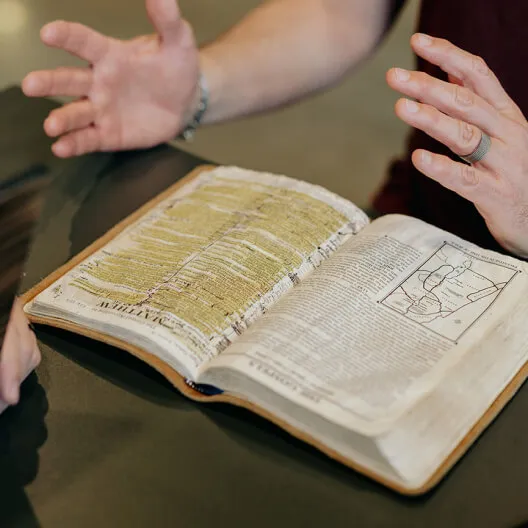


Daily Bible Devotionals


Exodus 6
“Then the Lord spoke to Moses, ‘Go and tell Pharaoh king of Egypt to let the Israelites go from his land.’ But Moses said in the Lord’s presence: ‘If the Israelites will not listen to me, then how will Pharaoh listen to me, since I am such a poor speaker?’” Exodus 6: 10-12 (HCSB)
Often, listening to sermons, I have heard it taught that Moses had a speech impediment. The reason many give for this assumption is from Moses’ own admission, “I am such a poor speaker.” In other Bible translations, the verse is interpreted as “I am a man of faltering lips.” It is easy to see why theologians conclude that Moses couldn’t speak well. Perhaps Moses was not a great orator at that point.
In actuality, the verse literally interprets, “I have uncircumcised lips.” Moses’ argument wasn’t that he had a speech impediment. It was that he had a “righteousness” impediment. He didn’t believe he was righteous enough to minister effectively. He didn’t think he was good enough. As I have said before, Moses had a confidence problem.
We also know that there was nothing wrong with Moses’ speech, based on Stephen’s testimony before his martyrdom.
“So Moses was educated in all the wisdom of the Egyptians and was powerful in his speech and actions.” Acts 7: 22 (HCSB)
Yet, ultimately, the greatest testimony of Moses’ assured success came from God.
“Therefore, go. I am sending you to Pharaoh so that you may lead my people, the Israelites, out of Egypt.” Exodus 3:10 (HCSB)
Why must we be confident in ourselves before placing confidence in God? Faith works the other way around. We are first called to do the thing we are uncertain of. Then, once God has accomplished His will through our obedience, we grow in faith.
God’s calling is our equipping. He gives us all we need to accomplish what He calls us to achieve. We may not have all the supplies we need at the outset, but He will provide them as needed along the way.
As we continue through the book of Exodus, watch as Moses becomes bolder. His confidence builds as he experiences God’s faithfulness. Don’t be afraid of what God is calling you to do. Be afraid of not following.
Exodus 5
“Don’t continue to supply the people with straw for making bricks, as before. They must go and gather straw for themselves. But require the same quota of bricks from them as they were making before and do not reduce it. For they are slackers – that is why they are crying out, ‘Let us go and sacrifice to our God.’” Exodus 5:7-8 (HCSB)
The world is out for itself. Make no doubt about it. To the world (and worldly leaders), people are nothing more than resources. They are merely a means to a selfish end.
Pharaoh had one thing on his mind, and that was productivity. Because he was solely focused on the product of their labor, Pharaoh failed to recognize a key factor in the Israelites’ productivity: their spiritual well-being.
In that sense, Pharaoh is not very different from many employers in today’s workforce. This “slave mentality” towards employees was especially true of the Big Bosses of generations past, in the era of the Great Depression. Theirs was the generation of workers fighting against the industrialist giants and forming labor laws to protect work environments.
For such employers, you and I are expendable assets. We are like gasoline in a car’s tank or an air filter in a home HVAC. When the tank runs dry, or the filter gets soiled, you just have to refill and replace it. Most important to the heartless machine operator is that the car runs and the air flows. Who cares about the well-being of “expendable parts”? But isn’t a machine comprised of the sum of its parts? Therefore, every piece is integral to the performance of the machine.
The truth is, YOU are not expendable. You are EXPENSIVE! You are of such great worth to the Lord! In the eyes of God, people are not disposable resources to robotically do His bidding. God loves us, not for what we can do for Him. To Him, we have a value beyond our productivity. He doesn’t need us, but He WANTS us. And His desire to use us is simply because of His great affection for us.
How much does God love us? He gave His life for us. (Micah 5:2, John 3:16)
We don’t cry out and worship God because we are “weak slackers,” as Pharaoh alleged. We cry out because God created us with the expressed intent that we worship Him! He designed us to worship, and He invites us to enter into adoption as Sons and Daughters through our belief in His “Son,” Messiah Jesus. Worship is not a weakness; it is the height of performance when we reach our most productive potential.
Bob Dylan once sang, “You gotta serve somebody.” Given a choice between the “Pharaohs” of this world and the Lord God, should we even have to think twice?
Exodus 4
“Moses said, ‘Please, Lord, send someone else.’ Then the Lord’s anger burned against Moses, and He said, ‘Isn’t Aaron the Levite your brother? I know that he can speak well. And also, he is on his way now to meet you. When he sees you, his heart will rejoice. You will speak to him and tell him what to say. I will help both you and him to speak and will teach you both what to do. He will speak to the people for you. He will be your spokesman, and you will serve as God to him. And take this staff in your hand that you will perform signs with.’” Exodus 4:13-17 (HCSB)
Has the Lord ever asked you to do something, and your reply to him was, “Could you send someone else?” It seems ridiculous, but we do it all the time. Perhaps you have felt that internal nudge, that whispering “heart voice” urging you to share the gospel with a stranger. “Oh no!” you reply. “That’s a preacher’s job…someone more eloquent and knowledgeable than me!” This is precisely what Moses was doing.
I have heard preachers go on & on about Moses having some kind of speech impediment. But that is simply NOT true. Check out the testimony about Moses, given by the early Church martyr, Stephen:
“So Moses was educated in all the wisdom of the Egyptians, and was POWERFUL in his speech and actions.” (emphasis mine) Acts 7:22 (HCSB)
Moses didn’t have a speech problem; he had a confidence problem!! As we continue reading in Exodus, notice how Aaron’s role as “spokesman” diminishes as Moses’ confidence grows. Eventually, Moses does all the talking.
Consequences. Whenever we disobey the Lord and fail to heed his Word by faith, there are consequences. One of the consequences of Moses’ lack of faith in this instance remains to this day. God designed a situation where He would speak to Moses, and then Moses spoke to the people. When Aaron was added to the equation, God was left out. Notice:
“He will speak to the people for you. He will be your spokesman, and you will serve as God to him.” Exodus 4:16 (HCSB)
To this day, in essence, “Moses” (the Torah of God) still seems to occupy a more centric place in Judaism than Adonai, the God of the Torah. And in many respects, the Talmud (rabbinic opinion) is even more centric than the Torah. Are you allowing something to come between you and God’s calling? Doing so may add an unnecessary link between your unbelieving friends and the Lord. What is it you lack which keeps you from being bolder? Like Moses, do you simply lack experience with God’s faithfulness? That is exactly why we are reading God’s Word. Over and over, we experience God’s faithfulness in Scripture…and in turn, our confidence in Him builds.
“Faith comes by hearing, and hearing by the Word of God.” Romans 10:17 (NKJV)
Exodus 3
“God replied to Moses, ‘I AM WHO I AM.’ This is what you are to say to the Israelites: I AM has sent me to you.” Exodus 3:14 (HCSB)
I AM WHO I AM. In Hebrew, Ehyeh Asher Ehyeh – the self-existent and eternal God; a declaration of the unity and spirituality of the Divine Nature, the exact opposite of all the forms of idolatry, human, animal, and celestial, that prevailed anywhere else.
I AM WHO I AM is not merely a philosophical phrase. To the Israelites in bondage, the meaning would most likely be received as, “Although He has not yet displayed His power towards you, He will do so. He is eternal, and He will redeem you.”
Another way to translate God’s statement is, “I AM WHO I WILL BE.” No words can sum up ALL that He will be to His people. Furthermore, His everlasting faithfulness and unchanging mercy will continually manifest themselves in the guidance of those who follow Him.
The answer He gives Moses is the equivalent of, “I will save in the way that I will save.” It assures the Israelites of the FACT of deliverance but does not disclose the MANNER of deliverance.
How does this apply to us today? Perhaps you are going through a difficult season of life and looking for a way out for deliverance. Find comfort in knowing that HE IS WHO HE IS (His character never changes), HE WILL BE WHO HE WILL BE (He has a plan, even though He has not revealed it to you), and HE WILL SAVE IN THE WAY THAT HE WILL SAVE (He has the power to save, and WILL at His appointed time).
To followers of Jesus: He gives the power to become sons and daughters. (John 1:12)
For those who place their faith in Him, He promises “never to leave or forsake you.” (Hebrews 13:5).
Our hope is in God’s promise to His children of every generation, backed up by His unchanging character, in that He cannot lie. While we cannot predict HOW we will be delivered, that should not deter us from the fact that we WILL be delivered. Therefore, simply TRUST and OBEY, leaving the future up to Him.
“For God so loved the world that He gave His only begotten Son, that whoever believes in Him should not perish but have everlasting life.” John 3:16 (NKJV)
Exodus 2
“Then his sister said to Pharaoh’s daughter, ‘Should I go and call a woman from the Hebrews to nurse the boy for you?’ ‘Go.’ Pharaoh’s daughter told her. The girl went and called the boy’s mother. The Pharaoh’s daughter said to her, ‘Take this child and nurse him for me, and I will pay your wages.’ So the woman took the baby and nursed him.” Exodus 2:7-9 (HCSB)
At a time when Egyptian men were killing Hebrew babies, God used a force unstoppable by men to save Moses. He used women!
God drew from the innate nurturing tendencies that He naturally instills in females. Soldiers could kill a baby out of duty, but women would have to betray their natures, go against their very souls, to let a baby perish. To that end, I am utterly dumbfounded about how any woman could work at an abortion clinic. The whole process goes against the nature of a woman at her deepest core.
In the words of one rabbinic commentary, “Pharaoh’s plans for the annihilation of the Israelite children are defeated by women: the human feelings of the midwives, the tender sympathy of a woman of royal birth, and a sister’s watchful resourcefulness in the face of extremity. It was to the merit of pious women that Israel owed its redemption in Egypt.”
I would add that God directed those women's hearts to respond in the way He created them to, naturally.
Do you struggle beneath the weight of this World? Do you find it more & more difficult to honor God in your thoughts and actions because of the “enemy’s” intimidation? Perhaps it will help to remember the simple Proverb that we teach our children:
“Trust in the Lord with all your heart, and do not rely on your understanding; acknowledge Him in all your ways, and He will guide you on the right paths.” Proverbs 3:5-6 (HCSB)
Sometimes, when it seems the Lord has allowed us to drift into the enemy’s hands, it is there that He provides our shelter and eventual deliverance. It is comforting to know we don’t have to save ourselves. Salvation does not depend on our resourcefulness, strength, or piety. We need only to trust and obey the Lord with all we have and let Him guide our “basket” downstream into the arms of His deliverance.
Exodus 1
“A new king who had not known Joseph came to power in Egypt. He said to his people, ‘Look, the Israelite people are more numerous and powerful than we are. Let us deal shrewdly with them; otherwise they will multiply further, and if war breaks out, they may join our enemies, fight against us, and leave the country.’” Exodus 1:8-10 (HCSB)
I find it interesting that the Pharaoh stated no specific fault with the Israelites. In fact, there is no accusation of wrongdoing, only suspicion. Pharaoh’s suspicion seems to be evidence of the guilty conscience of a viciously ambitious man. He was hard-hearted.
There are two well-known Biblical times when Hebrew infants were murdered: Pre Exodus-Egypt and Pre-advent Bethlehem. Both Herod and (this particular) Pharaoh shared similar climbs to power. They took their positions by force and dirty politics.
The monarch of this new Egyptian dynasty was probably Rameses II. Joseph served one of the Hyskos (Shepherd) kings, an Asian dynasty whose rule in Egypt began in Egypt centuries before him. The Hyskos rule came to an end not long after the death of Joseph. The Hyskos were driven back into Asia, and a descendant of a native Egyptian dynasty regained the throne.
This new Pharaoh undoubtedly was raised on nationalistic pride, fueled by generations of hatred and mistrust of foreigners.
I grew up in the Southern United States. In those days, there were intense race struggles between Americans of African and European descent. Most often, the hatred had nothing to do with the character or actions of any particular individual. It was rooted in base fear and ambitious competition for power and control of an uncertain future.
Similarly, Pharaoh’s prejudice against the Hebrews was completely unfounded and irrational, as was Herod’s in Jesus’ day. Pharaoh simply loved power more than people. Because his power was secured through violence, he believed that any shift in that power must surely come through violent means.
So, what great lesson can we learn from this injustice? Several, but let’s focus on this notion: In the times immediately preceding God’s deliverance of Israel, The Lord began simultaneously preparing Egypt to expel the Hebrews and Israel’s desire to leave.
Take a moment and reflect on your present life situation. Has the Lord given you a vision and begun a “calling” for you toward which you are to start moving? Do you sense He wants you in a particular place or position? What factors is He allowing to develop in your life in preparation for your release from your present situation to ensure your reception into His place of deliverance or mission?
Genesis 49
“Then Jacob called his sons and said, ‘Gather around, and I will tell you what will happen to you in the days to come.’” Genesis 49:1 (HCSB)
Before giving attention to the details of the prophecies in Genesis 49, it would be good to look at the passage as a whole.
First of all, these are Jacob’s last words. The prophecy is literally the final word of Jacob, spoken with his dying breath. The dying words of any man should not be taken lightly, much less those spoken by a patriarch and recorded under the inspiration of the Holy Spirit.
Secondly, this is poetry. We might tend to think that a man’s last words, spoken with great effort, should be disorganized and difficult to follow. There are numerous indications that these final words of Jacob were thought out carefully in advance.
Thirdly, more than poetry, it is prophecy. While the form is poetry, the substance is prophecy. Jacob’s words reveal “things to come” for his descendants. The future foretold is the nation’s future as manifested in the twelve tribes, not necessarily predictions for the individual sons being blessed.
Fourthly, the words spoken by Jacob are a blessing. All the sons of Jacob were blessed in that they were to be a part of the nation of Israel. All would enter the land of Canaan and receive an inheritance there. Some would certainly receive a greater blessing than others. Even those rebuked by Jacob and whose futures were portrayed as dismal were blessed.
Fifthly, the prophecy is not independent of the past but an extension of it. Moses (who penned Genesis) told us that every one of the sons was given “the blessing appropriate to him.” As we think through these blessings of Jacob, we find that each of them is related to the past. Prophecy, then, is not necessarily detached from history but an extension of it into the future.
Whatever path you choose, if you continue in it, the outcome of your life (as well as those who follow after you) will be highly predictable. Choose the way that leads to life…the only true life offered…through faith in Jesus. (Deuteronomy 30:19)
“This is what the Lord says: Stand by the roadways and look. Ask about the ancient paths: Which way is good? Then take it and find rest for yourselves. But they protested, ‘We won’t!’” Jeremiah 6:16 (HCSB)
“There is a path which seems right to a man, but the end of its way leads to death.” Proverbs 14:12 (HCSB)
“If serving the Lord seems undesirable to you, then choose for yourselves this day whom you will serve - But as for me and my house, we will serve the Lord.” Joshua 24:15 (NIV)
Genesis 48
“So he blessed them that day with these words: The nation Israel will invoke blessings by you, saying, ‘May God make you like Ephraim and Manasseh,’ putting Ephraim before Manasseh. Then Israel said to Joseph, ‘Look, I am about to die, but God will be with you and will bring you back to the land of your fathers. Over and above what I am giving your brothers, I am giving you the one mountain slope that I took from the hand of the Amorites with my sword and bow.’” Genesis 48:20-22 (HCSB)
This blessing is significant for several reasons.
First of all, it is an adoption, or more precisely, a declaration that Joseph’s two sons (born to him in Egypt by an Egyptian bride) are legitimate descendants of Israel. This is a foreshadowing that all spiritual offspring between Jesus and His Church are considered “grafted into” the covenant of Abraham. Jew or Gentile believers, it makes no difference with respect to salvation. (Romans 11:17-24) We have all received a spirit of adoption, whereby we cry out, “Abba Father!” (Romans 8:15) That is to say, all of us who believe, by faith, that Jesus is Messiah.
Secondly, to this day, every pious Jewish father on Erev Shabbat (The day before Shabbat) places his hands on the head of his son and blesses him with the words: “God make you as Ephraim and Manasseh.” Ephraim and Manasseh would not barter away their Jewish identity for social or political power in Egypt.
These twins voluntarily gave up their place in Egyptian aristocracy and openly identified themselves with their “alien” kinsmen, who were despised for being shepherds. While “in the World,” they chose not to be “of it.” Similarly, when we have genuinely received spiritual adoption, we should no longer desire worldly privilege over the eternal honor of being co-inheritors with the Messiah.
Finally, at the end of this chapter, there is a reference to a plot of ground purchased by Jacob in Genesis 33. It seems this plot of land had (at one time) fallen into the hands of the Amorites and had to be retaken by force. This military exploit is not mentioned elsewhere in the Bible. The statement could also be a prophetic reminder of how Israel will have to retake and maintain Canaan by force and struggle, perhaps several times. The taking and holding of Canaan are ultimately determined by the power and will of God because of His promise alone. And it is not necessarily dependent upon Israel’s collective righteousness.
“You are not going to take possession of their land because of your righteousness or your integrity. Instead, the Lord your God will drive out these nations before you because of their wickedness, in order to keep the promise He swore to your fathers, Abraham, Isaac and Jacob.” Deuteronomy 9:5 (HCSB)
Genesis 47
“Then Pharaoh asked his brothers, ‘What is your occupation?’ And they said to Pharaoh, ‘Your servants, both we and our fathers, are shepherds.’ Then they said to Pharaoh, ‘We have to live in the land for a while because there is no grazing land for your servants’ sheep, since the famine in the land of Canaan has been severe. So now, please let your servants settle in the land of Goshen.’ Then Pharaoh said to Joseph, ‘Now that your father and brothers have come to you, the land of Egypt is open before you; settle your father and brothers in the best part of the land. They can live in the land of Goshen. If you know of any capable men among them, put them in charge of my livestock.” Genesis 47:3-6 (HCSB)
Today’s passage doesn’t seem to pack much of a punch. It’s more of a formal conversation between a few of Joseph’s brothers and Pharaoh. It’s like the “handshake” that concludes a business deal. There isn’t much drama here, but when placed with its preceding verses in chapter 46, the conversation takes on more of a clever sense:
“Joseph said to his brothers and to his father’s household, ‘I will go up and inform Pharaoh, telling him: My brothers and my father’s household, who were in the land of Canaan, have come to me. The men are shepherds; indeed they raise livestock. They have brought their sheep and cattle and all that they have. When Pharaoh addresses you and asks, “What is your occupation?” you are to say, “Your servants, both we and our fathers, have raised livestock from our youth until now.” Then you will be allowed to settle in the land of Goshen, since all shepherds are abhorrent to Egyptians.’” Genesis 46:31-34 (HCSB)
Joseph knew his brothers. These were the men who beat him and sold him into slavery. He knew that for Israel to prosper long term, they needed to be separate from Egypt! That is a good lesson for us. Seriously, we all know how our proximity to the World negatively affects our spiritual walk. That is why we are commanded not to be “of” the World, even though we are in it. Not only did God lead Israel into Egypt, but He also led them to a place where they could be separate from the Egyptians!!
Joseph also knew the Egyptians. Funny, by this time, Joseph was literally “shepherding” Egypt. He was the most powerful man in Egypt. Pharaoh told him that, aside from the title “pharaoh,” Joseph was in charge of Egypt. Still, the Egyptians could not make the abstract connection between “sheepherder” and “shepherd/overseer.” They despised people who herded sheep, but they did not see themselves as “sheep.” Isn’t that interesting? Because God honors shepherds. David was a shepherd. Moses was shepherding when God called him. Shepherds were the first to worship the Messiah. Jesus called Himself “the Good Shepherd.”
Bottom line: The Egyptians were more interested in image than goodness. They wanted to be considered “somebody” but didn’t care about anybody. No, Joseph didn’t want that attitude saturating the mindset of Israel. So, with one handshake, Joseph ensured Israel would be separate from Egypt, and Egypt would not want to be close to Israel. Have you determined to live your life “in but not of” the World?
Genesis 46
“Israel set out with all he had and came to Beer-sheba, and he offered sacrifices to the God of his father Isaac. That night God spoke to Israel in a vision: ‘Jacob! Jacob!’ He said. And Jacob replied, ‘Here I am.’ God said, ‘I am God, the God of your father. Do not be afraid to go down to Egypt for I will make you a great nation there. I will go down with you to Egypt, and I will bring you back. Joseph will put his hands on your eyes.’” Genesis 46:1-4 (HCSB)
I always liked this verbal exchange between Jacob and the Lord. First off, Jacob seems to be learning his lessons. Having set out on his journey, Jacob realized the gravity of his travel and offered a sacrifice to “the God of his father Isaac.” He had experienced significant moments of Divine deliverance, but given his recent family history, Jacob must have been wondering if the Lord had abandoned him. The “heel catcher” (That was the meaning of his name, Jacob) was wondering if he was setting himself up for another fall.
It’s interesting how God called him by his former name, “Jacob,” and not the name He had bestowed upon him earlier: Israel. As long as Jacob perceived a distance from himself and the Lord, he would most likely fall back into his old ways. I believe God reminded him of where he had been before assuring him where he was going.
God’s reference to His association with Isaac was a sober reminder that God’s PROMISE is the sustaining factor in Israel’s blessing…not Jacob’s righteousness.
Once that is established, God articulates His grace toward Jacob and all of Israel. His blessing is not “I’ll be here holding down the fort in Canaan. Hope you write often….” No, God promised to accompany Israel personally. God’s promise is enough, but His presence is even better!! God would make Israel a great nation during their stay in Egypt. Notice that “great” does not mean “righteous” but simply “large.” Righteousness would come much later, during the children of Israel’s time in the desert. Israel’s deliverance from Egypt was quick. It took 40 years to purge “Egypt” from Israel.
It is remarkable how God told all of this to Abraham everything, even down to the 400 years of Egyptian slavery. And it all came true. Now, God was making promises to Jacob. In a few days, we will read of the fulfillment of some of those promises. Here is a sneak peek:
“So Jacob’s sons did for him what he had commanded them. They carried him to the land of Canaan and buried him in the cave at Machpelah in the field near Mamre, which Abraham had purchased as a burial site from Ephron the Hittite. After Joseph buried his father, he returned to Egypt with his brothers and all who had gone with him to bury his father.” Genesis 50:12-14 (HCSB)
God keeps His promises. He can be trusted, and He has the power to accomplish His will despite even His own children’s sinful ignorance. So, what promises of His are you trusting in?
Genesis 45
“God sent me ahead of you to establish you as a remnant within the land and to keep you alive by a great deliverance. Therefore, it was not you who sent me here, but God. He has made me a father to Pharaoh, lord of his entire household, and ruler over the land of Egypt.” Genesis 45:7-8 (HCSB)
With incredible generosity, Joseph reassures his brothers by pointing out God’s purpose and plan, which has overruled their crime. This event foreshadows Jesus’ first statement from the cross:
“Father, forgive them for they know not what they do.” Luke 23:34 (HCSB)
Was it a crime for Jacob’s brothers to abuse and sell him into slavery? Yes. Did they suffer the consequences of their sin? Of course, they did. But was their consequence as great as it “should” have been had it been reviewed by an impartial judge? No.
Here, we see, perhaps, the most significant similarity between Joseph and Jesus. Biblically, this combination of Grace and Mercy was completely without precedence until Joseph revealed his intentions to his brothers. Here was a man who had undergone severe physical, social, emotional, and financial hardships…completely undeserved. Yet, Joseph’s response was based solely on his belief in God’s promise.
Jesus, in the garden of Gethsemane, prayed, “Not My will, but Yours be done!” Jesus had faith that the grave could not hold down those to whom the Lord would summon, “Arise!” His faith in God’s Word and character allowed Messiah to endure the cross, free of any entanglements this World might otherwise hold. Jesus held no malice to compel Him to keep “souvenirs of hate” towards those who crucified Him.
Who could be offended by so great a love shown towards us? I can identify with Joseph’s brothers in that I once had difficulty coping with the reality that I was REALLY forgiven!
As God told Abraham to leave his father’s house and go to the place He would show him, Joseph also told his brothers to leave everything in Canaan to quickly receive the fullness of their deliverance.
Likewise, Jesus charges all who would follow Him: “Leave everything and follow me.” Have you partially followed Jesus? That is, have you enjoyed proximity to Him without actually committing to know Him in a saving way? Until you do so, you are not “fully delivered.” And nobody wants to be left outside of salvation: Matthew 7:21-29 If you haven’t already, I urge you to fully receive Jesus today!
Genesis 44
“Your servant became accountable to my father for the boy, saying, 'If I do not return him to you, I will always bear the guilt for sinning against you, my father.' Now please let your servant remain here as my lord’s slave in place of the boy. Let him go back with his brothers.” Genesis 44:32-33 (HCSB)
After all the talk of Joseph being a “type” of Messiah, maybe we should give Judah a closer look.
The spirit of self-sacrifice, which Judah’s speech reveals, holds parallels to the life story of Moses. Judah offered to remain as a slave in Benjamin’s place, while Moses sought God to blot out his name from the Book of Life unless his people, Israel, were saved along with him.
The same spirit was displayed in the Apostle Paul, who called himself a voluntary “slave of Messiah.” He made himself a slave (servant) to all so that by all means, he might win some for Messiah. (1 Corinthians 9:19-23) Paul also said he wished that he could be cut off from the Lord so that others could take his place in the kingdom. (Romans 9:3)
Of course, the greatest display of self-sacrifice was Jesus upon the cross. He gave himself completely so our sin debt would be laid upon Him, that His righteousness could then be imputed to us. As Judah voluntarily offered himself completely accountable for the life of his brother, Jesus held Himself accountable for the disciples the Lord had given to Him.
Jesus prayed to the Lord before His crucifixion: “I have lost NONE of all that You have given to me” John 18:9 (HCSB)
For those who have accepted the Grace of God through faithful belief in the resurrected Messiah, our names have been added to the Book of Life. We become sons and daughters of God, hence, brothers and sisters of Jesus as co-inheritors of the kingdom of heaven.
Lastly, the Bible even calls Jesus the “Lion of Judah.”
“Then one of the elders said to me, ‘Stop crying. Look! The Lion from the tribe of Judah, the Root of David, has been victorious so that He may open the scroll and its seven seals.’” Revelation 5:5 (HCSB)
How much more significant than Judah is Jesus, author of creation, who stands in your place of punishment just to save you?
Genesis 42
“Then they said to each other, ‘Obviously, we are being punished for what we did to our brother. We saw his deep distress when he pleaded with us, but we would not listen. That is why this trouble has come to us.’ But Reuben replied: ‘Didn’t I tell you not to harm the boy? But you wouldn’t listen. Now we must account for his blood!’” Genesis 42:21-22
Drawing again from the “Messiah imagery” in the Joseph story, there are two hauntingly familiar statements in the gospels.
The first words are those of Pilate recorded by the apostle Matthew, “When Pilate saw that he was getting nowhere, but that a riot was starting instead, he took some water, washed his hands in front of the crowd, and said, ‘I am innocent of this man’s blood. See to it yourselves!” Matthew 27:24 (HCSB)
Reuben, as firstborn, had the birthright to spiritually lead his brothers. Just as Pilate caved into the pressure of the religious leaders, Reuben caved into the pressure of his brothers. Instead of protecting Joseph, based on what was right before the Lord, Reuben chose to stop defending Joseph…perhaps believing his defense would jeopardize his own life.
The second haunting image is the Jewish leaders responding to Pilate’s plea to set Jesus free. “All the people answered, ‘His blood be on us and on our children!” In the heat of the moment, Israel’s sons’ viciously envious attitudes (towards Joseph) foretold the attitude their descendants would have towards Messiah Jesus.
Blinded by hatred, both groups (Joseph’s and Jesus’ “brothers”) sought to kill the one/One whom God had anointed to save them. Sadly, as was the case with Joseph’s brothers, so it will be for all whose sinful actions against Messiah meet their logical end…both Jew and Gentile. (In essence, all our sins have played a role in Jesus’ suffering.) They must eventually take ownership of and bear great shame for their attitudes and actions against Him.
We will all face the Lord someday, and we must recognize just how much Jesus’ suffering provided our way out. The Bible states that “every knee will bow and tongue will confess that Jesus, Messiah, is Lord.” Like Joseph’s brothers in Egypt, we are given a choice to accept the grace and forgiveness offered by the Messiah and follow His leading. But first, we must acknowledge our sin and humble ourselves before Him.
Now that the greatness of our sin (and the certainty of our judgment) has been brought to light, who could reject so gracious a gift of salvation? (Hebrews 2:2-3)
Genesis 41
“Pharaoh said to Joseph, ‘I have had a dream, and no one can interpret it. But I have heard it said about you that you can hear a dream and interpret it.’ ‘I am not able to,’ Joseph answered Pharaoh. ‘It is God who will give Pharaoh a favorable answer.’” Genesis 41:15-16 (HCSB)
I believe some clarification may be needed to help us appreciate the dynamics of this verbal exchange between Joseph and Pharaoh. First, in Egyptian culture, Pharaoh was considered to be a god. Not only was he thought to be a god among gods, but it was also assumed he was the central deity, the “God of gods,” so to speak.
It was uncommon for a prisoner/slave to exchange words with this “man/deity” yet notice Joseph’s casual banter. He is essentially schooling Pharaoh. Joseph’s message that God would provide the interpretation of Pharaoh’s dream indirectly exposed something maybe only Pharaoh himself knew: Pharaoh was no god. If Pharaoh was “God above all gods,” why couldn’t he interpret his own dreams? Furthermore, wouldn’t any other “god” whom Pharaoh consulted immediately assume authority over him…proving he wasn’t the “God of gods”?
We live in an era where image is everything. The basic celebrity promotions game is summed up like this: Spotlight the good and conceal the bad. Joseph deflected praise that would have elevated his image in the eyes of the Egyptians. Perhaps he learned a lesson from his brother’s response to the coat of many colors. Joseph understood that image only gets you so far. But the Lord can exalt and sustain a man beyond human circumstances.
Eventually, all men must produce results to back up their images, and it is possible for a man’s charisma to garner them access to places where his character cannot keep him. Put another way: talk is cheap. Joseph knew that men were unable to interpret prophetic dreams. Only God can explain the prophecy because only God gives true prophetic messages.
What can we learn from Joseph today? 1) God has a plan for you, which may involve unjust opposition and suffering. 2) Despite our circumstances, we are still required to act with humility, wisdom, and integrity. 3) Never assume that God will respond to your requests in any particular way, even when you entreat Him wholeheartedly.
We can only assume the facts: God is Omnipotent, Omniscient, Omnipresent, and His character never changes. When we commit to putting that knowledge into our operational theology, only then will we learn the secret of contentment.
“I know both how to have a little, and I know how to have a lot. In any and all circumstances, I have learned the secret of being content—whether well fed or hungry, whether in abundance or in need. I am able to do all things through Him who strengthens me.” Philippians 4:12-13 (HCSB)
Genesis 40
“Pharaoh was angry with his two officers, the chief cupbearer and the chief baker, and put them in custody in the house of the captain of the guard, in the prison where Joseph was confined.” Genesis 40:2-3 (HCSB)
At the beginning of Genesis 39, Joseph rose to the head of Potiphar’s household. Potiphar was the captain of Pharaoh’s guard. The middle of chapter 39 details a false sexual harassment accusation, landing Joseph in prison. But by the end of chapter 39, Joseph rises again to a position of leadership. He is still in prison but a leader, nonetheless.
Having said all that, the beginning of chapter 40 indicates that the prison where Joseph was held was Potiphar’s own home…“the house of the captain of the guard.”
If somebody made a pass at my wife, the last thing I would want is to keep him in my basement at home! Compound that with the knowledge that Joseph’s former boss was the captain of the guard! It would have been nothing for Potiphar to kill Joseph, yet he allowed Joseph to stay. Why?
There are many answers. The obvious answer is that God’s providence protected, preserved, and prospered Joseph. But what would Potiphar’s logic have been? Maybe Potiphar needed a sharp man running his prison, no matter how soiled his character may have been. Perhaps Potiphar knew his wife was unfaithful but didn’t want to publicly accuse Joseph or his wife. That would cause a scandal that might damage his reputation. It could have been that Joseph had charisma and an indispensable way with money!
God probably used a myriad of factors to get Joseph to Potiphar’s home and keep him there. Why? For the simple reason that God had redemption plans for His people, Israel. Obviously, Joseph was a leadership triple threat: Great looks, shrewd stewardship skills, and the gifts of prophecy & interpretation. They were all gifts from God, which, in some circumstances, led Joseph into trouble. Joseph may have even cursed them all at specific points in his life. But since they were gifts from the Lord, they ultimately had a Kingdom purpose, and Joseph discovered that he NEEDED them all.
Joseph needed to be a slave to prove himself a good steward in Potiphar’s home. He needed to be attractive so that he could be accused and imprisoned. He needed to be imprisoned to interpret dreams… and the list goes. Our directive is not to figure out God’s plan but to honor His Name in all circumstances He places us in, trusting His leading. (Proverbs 3: 5-6)
Every step of our journeys is a destination of sorts, yet God leads us onward. Wherever God led, Joseph glorified Him. Don’t waste your time focusing on “arriving.” Find joy in the journey of trusting God. He is with you, knows everything you are going through, has the power to affect change, and has the wisdom to know when & how. And He has an unchanging character. (Jeremiah 29:11-13 Romans 8:28)
Genesis 39
“Now Joseph was well-built and handsome. After some time his master’s wife looked longingly at Joseph and said, ‘Sleep with me.’ But he refused and said to his master’s wife, ‘Look, my master does not concern himself with anything in his house, and he has put all that he owns under my authority. No one in this house is greater than I am. He has withheld nothing from me except you, because you are his wife. So how could I do such an evil and sin against God?’” Genesis 39:6b-9 (HCSB)
Like the “tree of Knowledge” was to Adam & Eve in the Garden of Eden, so was Potiphar’s wife to Joseph in Potifer’s house. (If Joseph can be considered a “Type of Messiah,” his response to temptation surely passed the test!
Joseph had everything going for him. He was handsome and brilliant. Despite difficult circumstances, he (again) rose to a position of authority. If it seemed unnatural for a 17-year-old to supervise his ten elder shepherd brothers, imagine the same youth running the household of the 2nd most powerful man in Egypt. Some guys seem destined for success, but success can have unforeseen downsides. Joseph knew this all too well.
I have been around many successful people in my career, and I generally sort them into two piles: Humble and self-absorbed. There doesn’t seem to be much middle ground, and sadly, the humble variety is in very short supply. Joseph was humble, while Potiphar’s wife was utterly self-absorbed.
If there were ever a “stud,” it would have been Joseph. Perhaps his experience with his brothers taught him to restrain his tongue. Perhaps those early days in slavery taught him to be thankful for even the lowliest position of authority. I believe his faith in God (and his response to God’s faithfulness) gave Joseph his resolve.
Perhaps that is the lesson of today’s passage. Joseph faithfully served Potiphar because Joseph served God. He worked as unto the Lord. On the other hand, Potiphar’s wife did not have the Lord’s moral compass. Potiphar’s wife could not honor her husband because she had no relationship with the Lord. She simply lived to serve herself. And the types of gods she served were, most likely, those whose only reason for existence was to serve her.
But we cannot escape the reality that there is only one true God and only one salvation, found exclusively in Jesus.
“Jesus told him, ‘I am the way, the truth, and the life. No one comes to the Father except through Me.’” John 14:6 (HCSB)
If we reject Jesus, the only “god” we are left to serve is the one we see looking back at us in the mirror.
Genesis 38
“About three months later Judah was told, ‘Your daughter-in-law, Tamar, has been acting like a prostitute, and now she is pregnant.’ ‘Bring her out!’ Judah said. ‘Let her be burned to death!’ As she was brought out, she sent her father-in-law this message: ‘I am pregnant by the man to whom these items belong.’ And she added, ‘Examine them. Whose signet ring, cord, and staff are these?’ Judah recognized them and said, ‘She is more in the right than I, since I did not give her my own son Shelah.’ And he did not know her intimately again.” Genesis 38:24-26 (HCSB)
Three Biblical “women accused of adultery” stories come to my mind. First, Tamar is forced to lure Judah into fulfilling his duties as kinsman-redeemer…by making him believe he is committing adultery. Her actions ensured the birthline of the Messiah. Tamar is recognized by name in the genealogy of Jesus. (Matt 1:3) **Notice the other women in Jesus’ genealogy were either prostitutes, adulteresses, or accused of both…and all were Gentiles. (Tamar, Ruth, Uriah’s wife [Bathseba], Rahab).
The Jewish community should have considered those women unworthy, yet their characters earned them reputations of high regard…all except for Mary. Mary was the only woman in Jesus’ genealogy who was legitimately innocent: a nice, normal Hebrew girl. Yet, to this day, most Jewish community considers Mary a fornicator.
“The birth of Jesus Christ came about this way: After His mother Mary had been engaged to Joseph, it was discovered before they came together that she was pregnant by the Holy Spirit. So her husband Joseph, being a righteous man and not wanting to disgrace her publicly, decided to divorce her secretly. But after he had considered these things, an angel of the Lord suddenly appeared to him in a dream, saying, ‘Joseph, son of David, don’t be afraid to take Mary as your wife, because what has been conceived in her is by the Holy Spirit. She will give birth to a son, and you are to name Him Jesus, because He will save His people from their sins.’” Matthew 1:18-21 (HCSB)
Then, there is this story.
“Jesus stooped down and started writing on the ground with His finger. When they persisted in questioning Him, He stood up and said to them, ‘The one without sin among you should be the first to cast a stone at her.’ Then He stooped down again and continued writing on the ground. When they heard this, they left, one by one, starting with the older men. Only He was left with the woman in the center. When Jesus stood up, He said to her, ‘Woman where are they, has no one condemned you?’ ‘No one, Lord.’ she answered. ‘Neither do I condemn you,’ said Jesus. ‘Go, and from now on do not sin anymore.’” John 8:6b-11 (HCSB)
The first story involved a woman who faked adultery and thus ensured the line of Messiah. The second was unjustly accused of adultery because she bore Messiah. But the third should be closest to our hearts, for we have all committed spiritual adultery. Her story teaches us that Jesus is willing to FORGIVE adulterers with conditions.
Genesis 37
“Then they took him (Joseph) and threw him into the pit. The pit was empty; there was no water in it. Then they sat down to eat a meal. They looked up and there was a caravan of Ishmaelites coming from Gilead. Their camels were carrying aromatic gum, balm, and resin going down to Egypt.” Genesis 37:24-25 (HCSB)
The notion that Joseph did not work and was simply a young snitch in a pretty coat is off base. Joseph was wearing a coat given to those in authority. Joseph, though younger, was supervising his brothers.
At 17 years old, Joseph had already shown the giftedness of being a good steward. His stewardship giftedness, combined with his gift of prophecy and interpretation, eventually saved his life. It also saved the nation of Egypt and the seed of Israel. But at the time, those gifts stirred up envy among his brothers that grew to hatred and eventual violence.
Envy is pride, wounded in competition.
Question: Is there a brother or sister in your life against whom you are competing? Seize this moment to acknowledge your submission to the Lord’s plans for the person you are competing against. It may be that God will grant that person success you will never obtain. It is important that you understand God has not rejected you but simply has another path for you.
Perhaps you are successful and feel the pressure of someone else’s envy. I warn you that relational conflict will come, even when you completely follow the Lord…or even because you are following the Lord. Even among God’s children, envy arises. Dare I say hardship is part of God’s plan? It was for Joseph and his brothers.
The point: Remain faithful, even during unjust opposition. The true “shalom” of Jesus is not the absence of conflict for believers. Rather, it is the presence of peace in the midst of conflict that passes understanding.
“I have told you these things so that in Me you may have peace. You will have suffering in this World. Be courageous! I have conquered the World.” John 16:33 (HCSB)
God’s provision is somewhat hidden in the text concerning the Ishmaelites. These traders were coming from Gilead. The very Ishmaelite merchants Joseph was sold to, no doubt, carried that famous Gilead balm that would aid in Joseph’s healing from the wounds inflicted by his brothers.
Even when circumstances overwhelm us, Adonai Yir’eh, God provides.
Genesis 35
“They had set out for Bethel. When they were still some distance for Ephrath, Rachel began to give birth and her labor was difficult. The midwife said to her, ‘Don’t be afraid, for this is another son for you.’ With her last breath – for she was dying – she named him Ben-oni (son of my sorrow), but his father called him Benjamin (Son of the Right Hand).” Genesis 35:16-18 (HCSB)
What’s in a name? Obviously, Shakespeare didn’t know what God knows! Names mean something. At least in the Bible, they do. Studying the Bible from a Hebraic perspective, we learn that everyone’s name has a meaning aligned with their character.
For instance, “Jacob” meant “Heel catcher.” And that’s what he was: a deceiver, a tripper. But once he wrestled with the Lord, his name was changed to Israel: Contends with God. This is because he “wrestled with God and man and has overcome.” Divine intervention changed Jacob’s character; hence, a name change was in order.
Perhaps it was the wrestling experience that compelled Jacob to quickly change Ben-oni’s name to Benjamin. I believe there may be another idea to consider. When a father decides to be present and affirming in a son’s life, the boy’s confidence and self-worth are established. Imagine Tiger Woods without the presence of his father telling him, “You could be the greatest ever!” I believe Jacob’s interaction with Benjamin changed more than his name. Benjamin truly grew beyond “son of my sorrow” and into “son of the right hand.” Later in Scripture, we learn the tribe of Benjamin became the fiercest in all of Israel. The power of an affirming father is simply amazing.
Of course, the theme of “name change” is found throughout Scripture: Simon-to-Peter, Saul-to-Paul. Hosea’s children’s names were changed from “Not Pitied” to “She-was-pitied” and “Not My people” to “My people.” Abram became Abraham, and Sarai became Sarah…, and the list goes on.
But what of us? Just as Joshua gave Israel the choice of being called by God’s Name (choose you this day Whom you will serve), we believers in Messiah are given the choice of a new name through Jesus. By God’s Grace, we are enabled to transcend the curse of being born children of men to be adopted by God.
“When the time came to completion, God sent His Son, born of a woman, born under the law, to redeem those under the law, so that we might receive adoption as sons. And because you are sons, God has sent the Spirit of His Son into our hearts, crying, “Abba, Father!” So you are no longer a slave but a son, and if a son, then an heir through God.” Galatians 4:4-7 (HCSB)
Our names have been changed because of God’s intervention in our lives. We are adopted by the Lord by accepting the atonement provided by Jesus’ shed blood. We no longer carry our old names: Sinful. We now bear the Lord’s name: Perfect. Made so by Jesus’ atoning work on the cross. Now that’s paternal interaction & affirmation if I’ve ever seen it!
Genesis 34
“All the able-bodied men listened to Hamor and his son Shechem, and all the able-bodied men were circumcised. On the third day, when they were still in pain, two of Jacob’s sons, Simeon and Levi, Dinah’s brothers, took their swords, went to the unsuspecting city, and killed every male.” Genesis 34:24-25 (HCSB)
They say it takes a lifetime to build a reputation and a moment to ruin it. Among the otherwise peaceful history of the Patriarchs, this story of Dinah’s rape (and the subsequent slaughter) stands out as particularly damaging to Israel’s reputation. It, no doubt, birthed the perpetuated hatred and suspicion of the Jews among the Arab people that exists to this day. What was its resounding myth? “You can’t trust a Jew.”
In our litigious culture, people seek to assign blame whenever something repulsive happens. You gotta know who to sue! It seems there are several people at fault in this situation.
First, there’s Jacob, who allowed his daughter to roam the countryside un-chaperoned.
Next, Shechem commits the ultimate wrong by raping the young woman. That said, it is unclear whether this was a sin in his culture.
Back to Jacob: Jacob’s response to the initial news was way too passive, a recurring theme in his character.
Then, we see Dinah’s brothers enter the picture. Simeon and Levi’s devious zeal for the family’s reputation supplanted their respect for their father and the honor of the Lord’s name.
Again, Shechem seizes the opportunity to save his neck by undergoing the knife of circumcision. In addition, he convinces all his people to be circumcised, not based on an acknowledgment of Jacob’s God, but on the prospects of obtaining the Jews’ possessions by default.
Back to Simeon and Levi…seriously, it was a cunning slaughter.
Yes, it’s a case that celebrity attorney Johnny Cochran would have loved. But what’s the MORAL? The moral is: We are all human, and nobody is without sin. “All have sinned and come short of God’s glory.” (Romans 3:23) That is precisely why the world needs salvation.
Finally, the actions of Jacob’s sons draw an interesting parallel to the “Judaizers” in the early Church. I am speaking of those who replaced God’s grace and mercy with keeping the Torah’s requirements. By forcing the “knife” of the traditions of the elders, those “Judaizers” slaughtered the chances for many Gentile converts to flourish, unfettered, in their newfound personal relationships with Messiah Jesus.
Genesis 33
“So Esau said, ‘What do you mean by this whole procession I met?’ ‘To find favor with you, my lord,’ Jacob answered. ‘I have enough, my brother,’ Esau replied. ‘Keep what you have.’ But Jacob said, ‘No, please! If I have found favor with you, take this gift from my hand. For indeed, I have seen your face and it is like seeing God’s face since you have accepted me.’” Genesis 33:8-10 (HCSB)
It is a beautiful thing when brothers reconcile. Jacob rejoiced that the Lord had brought Esau and him back together, once estranged, and now “one.” Seeing Esau was like seeing God because only God could have accomplished such a reunion. Consider Jesus’ prayer.
“May they all be one, as You, Father, are in Me and I am in You. May they also be one in Us, so the world may believe you sent Me. I have given them the glory You have given Me. May they be one as We are one. I am in them and You are in Me. May they be made completely one, so the world may know You have sent Me and have loved them as You have loved Me.” John 17:21-23 (HCSB)
“Hear o Israel: The Lord our God, the Lord is “One.” (Heb., “Echad”) Deuteronomy 6:4 (NKJV)
The subject of Messiah’s prayer was “Echad,” unity among His Father, Himself, His Ruach (Spirit), His disciples, and all believers who would follow after. It was extremely important to Jesus to communicate that, as He is Echad with the other persons of the Trinity, His children are also to be “echad” with Him and each other.
It is speculated by certain rabbis that Esau came out in force to destroy his brother, but the Lord changed Esau’s heart. If that is so, it was not because of Esau’s goodness or Jacob’s ingratiating march home. Esau’s reaction was in accordance with God’s promise and directive to Jacob while he was still working for Laban, “Go back to the land of your fathers and to your family, and I will be with you.” Genesis 31:3 (HCSB)
Also, it is significant to note in this chapter the difference between the brothers’ definition of “blessing.” Esau’s notion of “blessing” was purely material. His anger over Jacob stealing Abraham’s blessing had more to do with his anxiety over the prospects of enduring a future void of wealth & lifestyle. Once he was rich, Esau could care less about the birthright or the land of Canaan.
Sadly, many within the Church solely equate God’s blessing with acquiring Worldly objects & amenities. This perspective often keeps them from leaving “stuff” to follow God’s call. They simply cannot imagine “blessing” without earthly possessions. Jacob’s biggest lesson is more closely linked to the “birthright” he purchased from Esau for that bowl of stew. The “birthright” was the right to lead the family spiritually. When Jacob experienced God’s miraculous promise fulfilled, he finally learned the differences between “blessing” and “wealth” and between “joy” and “happiness.”
Genesis 31
“Now Jacob heard what Laban’s sons were saying: ‘Jacob has taken all that was our father’s and has built his wealth from what belonged to our father.’ And Jacob saw from Laban’s face that his attitude toward him was not the same. Then the Lord said to him, ‘Go back to the land of your fathers and to your family and I will be with you.’” Genesis 31:1-3 (HCSB)
Six chapters in Genesis (this one and the 5 preceding it) tell the story of Jacob’s moral downfall. In his oft-misquoted poem, Marmion (generally attributed to Shakespeare), Sir Walter Scott once wrote, “What a tangled web we weave, when first we practice to deceive.” By chapter 31, Jacob has reached the pinnacle of his decline, wrapped up in the web of his own deceit, as it were. This is where we learn that cheaters never win and winners never cheat.
After the American Civil War, when slaves were supposed to be freed, many plantation owners found new ways to cheat their former slaves of their human rights. This “legal” form of slavery was called the Company Store. Here’s how it worked. The plantation owner would set up a store on his property to supply all the dry goods his servants would need. He would not pay his “employees” with US currency and devised a new monetary element called the “chit.” This was the only form of money accepted at the Company Store.
Since his field hands were uneducated, they had no idea they were being scammed. When the “chits” ran out, they would buy from the store on credit accounts. The account was tallied at the end of the month, and the crooked plantation owners would always find ways to keep the servants in debt. You couldn’t leave till you paid your debt…slavery.
According to ancient custom, Laban had a similar scam running on Jacob. Despite Jacob’s completed years of service, his wives and children were in the legal power of Laban, who could refuse to hand them over to Jacob. We see this in Laban’s statement in verse 43, “The daughters are my daughters, and the children are my children, and the flocks are my flocks, and all that you see is mine….”
So, what does this mean to us? Satan wants to own you. Every negotiation with Satan compromises God’s standard and leads you into further bondage and indebtedness.
God will allow us to feel the sting of our sin, to feel its consequence to rebuke and teach us. But when He knows our lessons have been learned, He extends mercy and grace, leading to our repentance. (Romans 2:4)
Genesis 28
“And he dreamed: A stairway was set on the ground with its top reaching heaven, and God’s angels were going up and down on it. Yahweh was standing there beside him, saying, ‘I am Yahweh, the God of your father Abraham and the God of Isaac. I will give you and your offspring the land that you are now sleeping on.’” Genesis 28:12-13 (HCSB)
Anyone who has been in a music store over the past 30 years is familiar with the opening melody of Led Zeppelin’s “Stairway to Heaven.” They have, no doubt, been privy to countless bad renditions of it as well! If they lived in the days of Jacob, perhaps the band would have written: “Ladder to Heaven.”
Interestingly, traditionally, the rabbis have taught the “certain place” Jacob stopped to rest was Mount Moriah. If so, it would most likely have been the location where Abraham intended to offer Isaac and where Solomon’s Temple stood.
The description of Jacob’s dream is one of the most vivid Biblical images of the Lord and His angels working on the face of the earth. It’s like being privy to the whereabouts of that door where Disney characters enter and exit the theme park! It should be noted that the angels are first mentioned as “ascending” the ladder. That observation has caused some scholars to speculate that the angels had been accompanying Jacob on his journey the whole time and only now were returning to the Lord. Maybe it was a shift change at Heaven & Co. Who knows? The Bible does not say.
It is safe to assume that Jacob was without any human friends, but unseen, angels had been by his side to protect and encourage him. Isn’t it comforting to know that the Lord has commanded His angels to watch over His children?
Abraham is mentioned as Jacob’s father because both Isaac’s blessing and Esau’s birthright now rested with Jacob. Jacob was the direct recipient and “conduit” of God’s promises to Abraham.
There is an excellent lesson concerning God’s faithfulness here. God’s guarantee of fulfilled promises depended on God’s character, not the patriarchs’. Jacob was a deceiver, and God would soon test Jacob’s mettle, but the Lord knew what kind of man Jacob would become once His work in Jacob’s life was completed.
I hope you are encouraged by this truth: God’s love for His children is great enough to lead them through hardships just to mold them into “inheritors” who would live up to the character of His name. If you are suffering through a time of molding and stretching, be encouraged! Asleep or awake, God Himself (and His angels) is ever-present and personally “there” for us, His children.
“…for God has said, ‘I will never leave you or forsake you.” Hebrews 13:5b (NIV)
Genesis 32
“Then Jacob said, ‘God of my father Abraham, and God of my father Isaac, the Lord who said to me, “Go back to your land and to your family, and I will cause you to prosper,” I am unworthy of all the kindness and faithfulness You have shown Your servant. Indeed, I crossed over this Jordan with my staff, and now I have become two camps.” Genesis 32:9-10 (HCSB)
There are many instances throughout the Tanakh (Old Testament) involving “staff” imagery. Perhaps the three significant instances are Moses, Jacob, and Judah.
In the days of the patriarchs, the staff was essential. It was both a sign of prominence and a defense in the wilderness. A man could lean on it when traveling on a long journey. In Biblical imagery, the staff represented man’s “support system” and how he got through life.
Take the story of Moses. God told him to throw his staff on the ground. Once it hit the ground, Moses’ staff became a snake. The snake represented that Moses’ way of getting through life was sin. God then asked Moses to pick up the snake, which exposed Moses’ fear of trusting the Lord. When Moses took hold of the snake, it became a staff again…but now it was God’s staff.
There is power in that kind of staff! Anyone who’s seen the “10 Commandments” movie knows God’s staff beats the best man-made staff any day!
When Jacob crossed the Jordan “with his own staff,” he became “two camps” spiritually and literally. He was double-minded. He wanted to follow the Lord but in his own way. Of course, that’s not following the Lord! And God was about to teach him that very lesson.
Elijah gave us a good definition of being double-minded.
“And Elijah came unto all the people, and said, ‘How long halt ye between two opinions? If the Lord be God, follow him: but if Baal [Lucifer], then follow him.’” 1 Kings 18:2 (KJV)
We must realize the battle is not over following the Lord’s way or ours. It is overheeding God’s voice or Satan’s.
Later that evening, Jacob wrestled with God. When the Bible says Jacob “overcame,” it doesn’t mean he defeated the Lord. That is impossible. The Lord was trying to shake Jacob loose, to see if Jacob would let go…forcing Jacob to choose Him through adversity. And Jacob WOULD NOT LET GO! Nor should we. Jacob decided to become single-minded and fully follow the Lord. Have you?
No results found.
Join Our Mailing List
Stay current with what's happening at Groundworks Ministries.
