
Daily Bible Devotionals
written by
Pastor Steve Wiggins
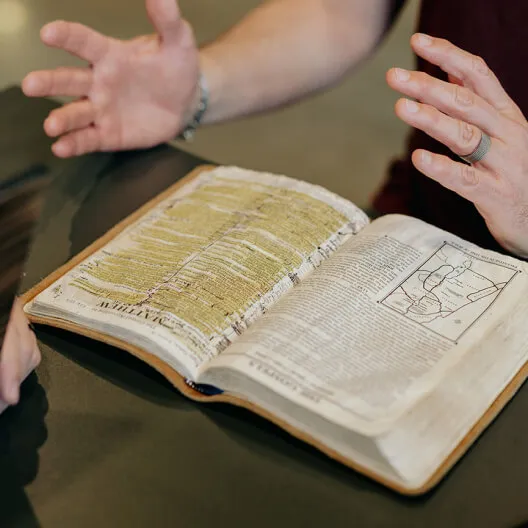


Daily Bible Devotionals


1 Kings 19
“Elijah left there and found Elisha son of Shaphat as he was plowing. Twelve teams of oxen were in front of him, and he was with the twelfth team. Elijah walked by him and threw his mantle over him. Elisha left the oxen, ran to follow Elijah, and said, ‘Please let me kiss my father and mother, and then, I will follow you.’ ‘Go on back,’ he replied, ‘for what have I done to you?’ So he turned back from following him, took the team of oxen, and slaughtered them. With the oxen’s wooden yoke and plow, he cooked the meal and gave it to the people, and they ate. Then he left, followed Elijah, and served him.” 1 Kings 19:19-21 (HCSB)
Howard Hamer had just taken off in his homemade plane from the airfield in Chiloquin, a high desert town in Oregon. Almost immediately, the plane lost power, and Hamer decided to attempt a landing on the local 97 highway. Filiberto Corona Ambriz was minding his own business this particular Thursday. He was driving a flatbed truck north on 97. Unknowingly, he drove his flatbed truck under Hamer’s plane at the very moment the latter was trying to land on the highway. The two never saw each other, had never met until there was a bump, and a loud bang! The Propeller caught on the truck’s sleeper, and the plane’s nose remained there while the tail dropped down on the flatbed trailer. The “landing” was successful, and neither man was injured.
I bet that usually doesn’t happen to most truck drivers! Mr. Ambriz did not say, “You know, I bet while I’m driving north on 97 today, some plane will use my flatbed as an aircraft carrier. He was simply doing what truckers normally do, and, literally, out of the blue, a plane landed on his truck.
This is precisely how Elisha must have remembered this day. He was simply doing what farm boys must regularly do, in his case, plowing his father’s field. How could he have guessed that Elijah the Tishbite would come walking across the field and throw his mantle on him? Elisha knew what that meant, but he hardly anticipated it when he awoke that morning.
Others have been so surprised: Moses while tending to his father-in-law’s flocks. (Exodus 3:1-2) Matthew was in the middle of collecting taxes (Matthew 9:9). I know that was MY story. The day I bowed my heart to Jesus, I didn’t wake up and say, “You know, after breakfast and a vigorous workout, I think I might just surrender my life to Jesus and follow Him all of my days!” I didn’t have any idea what awaited me later that day. But God did.
The kingdom of God is not a seat-of-your-pants operation. The Lord disclosed His decision concerning Elisha at Horeb (v. 16). So, what appeared sudden to Elisha (and to us) was already settled with God. Yes, Elisha had a decision to make concerning God’s call. Scripture does not indicate that God directly influenced Elisha’s decision (even when sending Elijah), but the point is God KNEW! Suddenness is the wrapping paper in which opportunity often arrives, giving us a chance to choose what God already knows because He knows us, and He knows the future as if it were the past.
1 Samuel 26
“But David said to Abishai, ‘Don’t destroy him, (Saul) for who can lift a hand against the Lord’s anointed and be blameless?’ David added, ‘As the Lord lives, the Lord will certainly strike him down: either his day will come and he will die, or he will go into battle and perish. However, because of the Lord, I will never lift up my hand against the Lord’s anointed. Instead, take the spear and the water jug by his head, and let’s go.’” 1 Samuel 26: 9-11 (HCSB)
The emphasis of today’s passage falls on the conversation between David and Abishai. It can be expected that Abishai assumed he was signing up for a commando raid, wherein Saul (and perhaps Abner as well) would be assassinated. In any case, in a scene reminiscent of the last time David spared Saul’s life, the soldier was convinced the Lord had led David to sleeping Saul for the express purpose of killing him. Abishai whispers theological advice to David, “Today God has shut your enemy up into your hand - and now let me nail him to the ground with my spear. I won’t need more than once.” David corrects Abishai’s theology, “Don’t destroy him, for who can put forth his hand against the Lord’s anointed and remain innocent?
David must have learned something back in chapter 25 with Nabal’s death. The Lord struck down David’s enemy when David relented from acting foolishly. David learned that the Lord can handle such matters when left into His hands. David suggests the Lord may operate in the same manner with Saul, or He may not. There are numerous possibilities for how the Lord may work. What David really needed to focus on was not the Lord’s method of punishing Saul but his own faithful obedience.
We would do well to learn a lesson here! Our primary goal in life should be to seek God’s Word and obey it. We must not run ahead of God’s timing. Rather, we should wait on The Lord to accomplish His purposes in and through our lives.
“Trust in the Lord with all your heart, and lean not on your own understanding; in all your ways acknowledge Him, and He shall direct your paths.” Proverbs 3:5-6 (NKJV)
David pondered the same thing: How did they sneak past those army guards? Surely, it was the Lord!
“So David took the spear and the jug of water from beside Saul’s head, and they went away, but no one saw or knew it, nor did any awake, for they were all asleep, because a sound sleep from the Lord had fallen on them.” 1 Sam 26:12 (NASB)
I believe David knew Who had allowed their stealth passage and that there was a high probability that God would have awoken every soldier in the camp if David and Co. had sinned by attempting to kill Saul! The practical life of a believer, complicated as it may seem at times, can be summed up into two simple components: Seek God’s Word and obey it. They are companions to the two principles of Scripture that Jesus said on which the Torah and the Prophets hang.
“He said to him, ‘Love the Lord your God with all your heart and with all your soul and with all your mind.’ This is the first and greatest commandment. And the second is like it: ‘Love your neighbor as yourself.’ All the Torah and the Prophets hang on these two commandments.” Matthew 22:37-40 (HCSB)
2 Samuel 23
“These are the last words of David: The declaration of David son of Jesse, the declaration of the man raised on high, the one anointed by the God of Jacob, the favorite singer of Israel...” 2 Samuel 23:1 (HCSB)
What are a redneck’s last words? “Hey y’all, watch this!”
What are his best friend’s last words? “Aw, I can do better than that!”
Today we are treated to a rarity in that David’s last words are less brief (and more profound) than others. It is important to note that there is no claim that these words were literally the last words David breathed. They are his last official words, “for the record.”
David’s last words on record are words with eyes, not to the past but the future. David’s “last words” might be compared to the blessings of Isaac (Genesis 27:2-4), Jacob (Genesis 49: 1, 28), and Moses (Deuteronomy 33:1) before their deaths. But this text does not exactly fit those molds.
David’s last words are not a blessing on persons but a prophecy about a kingdom. This passage, along with chapter 22, stands at the center of 2 Samuel 21-24. The psalm of chapter 22 looks back upon how the Lord established the kingdom; the prophecy of 23:1-7 looks forward to how the Lord will consummate the kingdom.
David is passing along (to us) his understanding that God’s Kingdom is:
Certain: (v.v.1-3a, 5) Our lives are filled with uncertainties. Don’t we all, at some time, wonder how our apparently senseless circumstances jibe with God’s wisdom? In many ways, we still have to encourage and convince each other that God is present, powerful, and Holy and that He cares about us in difficult seasons of life. We would never naturally ascribe Kingdom hope to our personal suffering. Therefore, David is speaking from Divine enabling. He is prophesying things we would not naturally assume: The coming Kingdom is not a political possibility but divine certainty.
Attractive: (3b-4) The Kingdom is attractive because the coming King (Messiah Jesus) is attractive. Not physically attractive, per se, but He does not crush or exploit His subjects. He refreshes and nourishes them. The King is attractive because we have seen so little of this kind of ruler. Given our current political climate, aren’t our hearts stirred to pray for the Kingdom of the “Final David” to come quickly?
Exclusive: (6-7) It is exclusive because not everyone wants the Kingdom to come. Some want no part of the Ruler’s reign. Jesus is the “Rose of Sharon.” The godless people in the garden are “like thorns;” He brings freshness while they inflict pain. And they will be excluded from the regime they despise, tossed away, and totally burned up on the spot (Matthew 13:41-42). So, what about you? Are you for or against Him?
Judges 9
“Remember that I am your own flesh and blood.’ His mother’s relatives spoke all these words about him in the presence of all the lords of Shechem, and they were favorable to Abimelech, for they said, ‘He is our brother.’ So they gave him 70 pieces of silver from the temple of Baal-berith. Abimelech hired worthless and reckless men with his money, and they followed him. He went to his father’s [Gideon’s] house in Ophrah and killed his 70 brothers, the sons of Jerubbaal [Gideon], on top of a large stone. But Jotham, the youngest son of Jerubbaal, survived because he hid himself.” Judges 9:2b-5 (HCSB)
Abimelech was the son Gideon fathered with his Shechemite concubine.
“Gideon had 70 sons, his own offspring, since he had many wives. His concubine who was in Shechem also bore him a son, and he named him Abimelech.” Judges 8:30-31 (HCSB)
In a story that could have been torn straight from Solomon’s book of Ecclesiastes, Gideon seemed to have gone a tad overboard with his fame and fortune. Upon reading Judges 7-9, it is clear that Gideon wanted to do the right thing, but at times he fell into the areas of sin, which are common to all men.
We’ll never know if it was Gideon’s humility or his fear that kept him from accepting the requests of Israel for him to be King. But in the end, Gideon’s compromise was that he chose to sire a child with a foreign woman. It’s not how you run the race. It’s whether you finish well.
Perhaps, the story of Gideon’s compromise is a strong reminder for us to be content with what the Lord has given us. We don’t need to court the World’s affections. As the hymnist once wrote, “All I have needed, Your hand hath provided. Great is THY faithfulness!”
Let’s not rest in past spiritual victories. Instead, ask the Lord to reveal those areas where we have compromised and supplemented the Lord’s provision with the World’s perversion.
The one area where Gideon compromised ended up destroying almost everything else that was legitimate.
Judges 10
"After Abimelech there arose to save Israel Tolah, the son of Puah, the son of Dodo, a man of Issachar; and he dwelt in Shamir in the mountains of Ephraim. He judged Israel twenty-three years; and he died and was buried in Shamir. After him arose Jair, a Gileadite; and he judged Israel twenty-two years. Now he had thirty sons who rode on thirty donkeys; they also had thirty towns, which are called “Havoth Jair” to this day, which are in the land of Gilead. And Jair died and was buried in Camon. Then the children of Israel again did evil in the sight of the Lord, and served the Baals and the Ashtoreths, the gods of Syria, the gods of Sidon, the gods of Moab, the gods of the people of Ammon, and the gods of the Philistines; and they forsook the Lord and did not serve Him." Judges 10:1-6 (NKJV)
Chances are that Tolah and Jair are not on your list of favorite Bible characters. We really don’t know much about them. Scholars refer to Tolah and Jair as “minor judges” – as opposed to “major judges” like Deborah or Gideon. The fact that Tolah and Jair receive less “ink” in the Bible does not mean they were of no importance. If we squint at the details, we can see how these men contributed to both the salvation and degradation of their generations.
Tolah: Verse 1 is clear to state that Tolah arose to save Israel. It speaks to the goodness of the Lord. We do not know whether Tolah established stability through administration or military victory. But his saving work (however it was displayed) came after Abimelech, the destroyer, had done serious damage. At the time of deepest darkness, the Lord appointed Tolah for a saving mission. And we expect that from the Lord. He does not go on rebuking forever, allowing His people to be trampled without hope, but after the Valley of the Shadow, He anoints our heads with oil - from sorrow and sighing to joy and gladness. God will never allow the “Abimelechs” of this World to be the last word for His people!
Jair: If in Tolah’s regime, we find a hint of the Lord’s goodness in Jair, we catch a glimpse of man’s potential for badness. Look carefully. The text only depicts Jair’s wide influence through his thirty sons. That does not necessarily imply any wrongdoing. In ancient Israel, numerous sons were a gift from the Lord and a means of protection from one’s enemies. However, the accounting of Jair’s thirty sons (not to mention numerous daughters he surely sired) implies multiple wives. The text records no displeasure about this. Yet, when we heard about Gideon’s seventy sons (chapter 8), the writer gave the explanation, “for he had many wives,” a circumstance which made the Abimelech fiasco possible. So, now we know why Israel fell back into moral disrepair after Jair’s reign as Judges ended. Jair sought the trappings of kingship despite official denials of it. He led Israel by bad example through serving himself and established a culture of compromise that endured.
Surely, we understand, Jair. Even in our service to God and community, in all our ways, there is the subtle urge to secure our position, display our status, extend our influence and guarantee our recognition. Yet, our plans to unseat the true “King” will always have a way of being exposed from behind, even our largest fig leaves.
Judges 11
“Jephthah the Gileadite was a great warrior, but he was the son of a prostitute, and Gilead was his father. Gilead’s wife bore him sons, and when they grew up, they drove Jephthah out and said to him, ‘You will have no inheritance in our father’s house, because you are the son of another woman.’ So Jephthah fled from his brothers and lived in the land of Tob. Then some lawless men joined Jephthah and traveled with him. Some time later, the Ammonites made war with Israel, the elders of Gilead went to get Jephthah from the land of Tob. They said to him, ‘Come be our commander, and let’s fight against the Ammonites.’ Judges 11:1-6 (HCSB)
The sin of “Prostitution” in the Bible is seen in two lights. First, there is the literal act of prostitution, obviously a sin. Then, there is spiritual prostitution, also known as “spiritual adultery.” In both cases, two parties are involved: The party selling themselves and the party that elicits the prostitute’s services. Judges 11 is the story of the sour fruits of both literal and spiritual prostitution. Gilead strayed from God’s path, and the generations that followed paid the biggest price.
Even in today’s secular culture, it is shameful (but by no means unforgivable) to have been born as the result of an act of prostitution. It doesn’t surprise me that Gilead’s “legitimate” sons would loathe the existence of Jephthah. In seeking to cover the family’s shame (and attempting to recover its reputation), they distanced themselves from the evidence of their father’s sin.
It is quite possible that Jephthah was his father’s firstborn simply because the story begins with his birth. That would mean the son of a prostitute would eventually lead the legitimate children. Interestingly is how even today, most non-Messianic Jews consider Jesus’ birth as “illegitimate.” That’s pretty much where the Jephthah/Jesus similarities end.
Perhaps it was the circumstances surrounding Jephthah’s illegitimate birth which denied him solid spiritual teaching. Maybe, the rebels he hung around with had a negative influence on his spiritual discernment. Whatever it was, Jephthah made an impetuous oath to the Lord, and it cost him his firstborn child.
The overall lesson of Judges 11 is that one compromise leads to another. Compromise builds upon compromise. Unless we commit ourselves to know the Lord, follow Him through a saving relationship with Jesus, and study His Word (the Bible), spiritual “true north” will always elude us. Even our best intentions, without the Lord, can lead us down destructive paths.
Judges 12
“The Gileadites seized the fords of the Jordan before the Ephraimites arrived. And when any Ephraimite who escaped said, ‘Let me cross over,’ the men of Gilead would say to him, ‘Are you an Ephraimite?’ If he said, ‘No,’ then they would say to him, ‘Then say, Shibboleth!’ And he would say, ‘Shibboleth,’ for he could not pronounce it right. Then they would take him and kill him at the fords of the Jordan. There fell at that time forty-two thousand Ephraimites.” Judges 12:5-6 (NKJV)
Some people are not content to sit at the right hand or the left of the Kingdom but insist on occupying the throne itself! That describes Ephraim perfectly. After having brushed-off Jephthah’s plea for help in the fight against Ammon, Ephraim has the nerve to charge Jephthah, “Why didn’t you call us to go with you?” In their pride, they are “somebodies,” and you don’t treat somebodies like that.
Jephthah (having been a nobody - 11:1-3) was not impressed with somebodies. Jephthah reminds Ephraim that he had, in fact, summoned Ephraim, and they had left him in the lurch. However, what Ephraim failed to do, the Lord did!
Perhaps, Ephraim was expecting the psychology of Gideon (8:1-3). What they got was the sword of Jephthah! The whole thing escalated when the Ephraimites began flinging racial slurs at Jephthah’s Gileadite men. Jephthah returns the gesture with a little prejudice of his own. All of a sudden, the “high classed” prideful Ephraimite dialect becomes a death signal. This is much the same way the genteel Virginia accent must have been detectable to the Pennsylvania Yankee soldier during the American Civil War, where privileged plantation owners might have tried to deny their allegiance when confronted by a Union soldier.
Basically, we have an indictment against pride. And it is not unique to ancient Ephraim. The human spirit that feels it must dominate, must control, and be recognized is alive and well in our culture. It flourishes in our Church culture; how we want to be the ones on Jesus’ varsity squad! How difficult it is for us to rejoice in God’s saving work when we are not a celebrity in the middle of it. We don’t like to play the game unless people will appropriately stroke our egos for doing so.
So, we must fight against taking credit for accomplishing what can only be accomplished by the Holy Spirit. We must remain humble and remind ourselves that, while we may be co-inheritors with Messiah, we are also “slaves” with a Master. And we are nothing apart from the redeeming atonement of Messiah Jesus.
Judges 13
“For behold, you shall conceive and bear a son. And no razor shall come upon his head, for the child shall be a Nazirite to God from the womb; and he shall begin to deliver Israel out of the hand of the Philistines.” Judges 13:5 (NKJV)
It is difficult to read today’s passage and not think of the Bible’s account of the conception and birth of the Messiah Jesus. We harken to the words of the Angel, spoken to Mary, as he announces not only the miracle of virgin conception but also the reason. “Messiah is resting in your womb, set apart not just from the womb, but also before time began!”
Jesus is the Messiah, whom the prophet Micah wrote about:
“But you, Bethlehem Ephrathah, though you are little among the thousands of Judah, yet out of you shall come forth to Me the One to be Ruler in Israel, whose goings forth are from of old, from everlasting.” Micah 5:2 (NKJV)
True, Jesus was a far greater “Samson,” but that fact should not cause us to take Samson lightly. He, too, was a savior (a messiah/anointed one). At Samson’s birth, a savior was born. As soon as Manoah’s wife is told she will bear a son, she hears of his mission: he will save Israel from the hand of the Philistines. Samson will only partially save, but even that constitutes him a savior.
Notice there is one particular danger. Samson is such a rollicking, entertaining, break-the-mold guy that we may become preoccupied with him. Try employing counter-culture thinking because our culture is fond of focusing on the SAVIORS whom God raises up. In doing so, we eclipse the GOD who saves by raising up saviors.
While we must hold our leaders in esteem because of their God-given positions of authority, we must also never lose sight of the fact that the same Spirit who works through great men and women of God resides in the heart of EVERY BELIEVER.
Perhaps, the greater focus should be on how we maximize the potential for greatness that God has entrusted to US when He conceived us in OUR mother’s wombs. Which “Philistines” were we created to destroy? Now that we have placed our faith in Messiah Jesus and been given the gift of the Holy Spirit pray the Lord will begin to reveal His plan as you read His Word daily. And commit to going wherever He leads, trusting that He will accomplish (through you) every task He has entrusted to you. And do not glory in yourself that you are being used by God. It is His calling, gifting/equipping, and Spirit that is working together through your obedience to accomplish His purposes. He is doing the heavy lifting. We simply respond, “Here I am, send me.” And we must faithfully go where He sends us, doing what He tells us to do with the gifts He has endowed us with in the manner He prescribes for us to use those gifts. Then, we will see the tasks (He calls us to) accomplished to the fullness of His desire.
Judges 15
“Then 3,000 men of Judah went to the cave at the rock of Etam, and they asked Samson, ‘Don’t you realize that the Philistines rule over us? What have you done to us?’ ‘I have done to them what they did to me,’ he answered.” Judges 15:11 (HCSB)
The men of Judah blurt out their mission; they have come to bind Samson and turn him over to the Philistines. Oddly enough, Samson offers no resistance, which apparently Judah expected, or they wouldn’t have sent out so many men. He only extracts an oath from them that they will not kill him themselves; they willingly accept this condition. No reader can miss the irony of their reply: Oh, Samson, we don’t want to kill you; we only want to bind you and give you over the Philistines, so they can kill you! Thanks.
Judah, (the tribe that had formerly waded into battle after battle) had become a collection of spineless wimps. They regarded the Philistines as their rulers and Samson as their enemy. In that sense, they remind me of many people in the “church” today. It seems Christians are increasingly afraid of offending non-believers with the gospel than they are concerned with offending God for not standing up and proclaiming His Word. The men of Judah didn’t even want to be the Lord’s “free people”; they didn’t even see that as a possibility. Are you willing to stand and be counted among His people today?
It is always a dark day in the history of God’s people when they are content to allow His enemies to control them. Something is wrong with us when we no longer despise our true enemies. Friendship with the world offends God. (Romans 8:7)
In the wake of our initial faithlessness, the Lord declared He was imposing “enmity” between the Serpent’s seed and the woman’s seed (Genesis 3:15). This divisiveness, this “hostility,” came from the Lord. He was not going to allow even His fallen creatures (Adam and Eve) to cuddle up in the bosom of evil. The Maker of heaven and earth refused to walk away from Eden, shrugging His shoulders and muttering, “You win some, and you lose some.” No, He is the stubborn God who will set all creation on fire with holy war in order to have a seed and a people for Himself. Jesus extends the same promise to never leave or forsake His followers as well.
That’s why redemption is an act of violence; that’s why Jesus came on a mission of violent destruction (1 John 3:8). That’s why lovers of God are commanded to “hate” evil (Psalm 97:10) and why compilers of Psalms did not edit out verses 19-22 from Psalm 139.
Whether it is the evil and sin within us or some form of it outside us, God does not call us to negotiate with sin and evil. That’s why we call it “spiritual WARFARE.” We are to wage war on sin and to maintain a holy hatred towards it in all its various forms. We are near hopeless when we begin to adopt Judah’s slogan: It has always been this way – how can we expect to change anything?
If we are truly a generation desperate for “change,” then we must fight for it!
Judges 16
“The temple was full of men and women; all the leaders of the Philistines were there, and about 3,000 men and women were on the roof watching Samson entertain them. He called out to the Lord: ‘Lord God, please remember me. Strengthen me, God, just once more. With one act of vengeance, let me pay back the Philistines for my two eyes.’ Samson took hold of the two middle pillars supporting the temple and leaned against them, one on his right and the other on his left. Samson said, ‘Let me die with the Philistines.’ He pushed with all his might, and the temple fell on the leaders and all the people in it. And the dead he killed at his death were more than those he had killed in his life.” Judges 16:27-30 (HCSB)
The Lord is the God who hears the cry of his servant in desperate circumstances. In today’s passage, the Lord’s answer comes not only in the midst of desperate need but also in the wake of miserable failure. This is the Samson who would rather play around with Delilah than protect the Lord’s gift. This is the Samson who faithlessly bartered away the Lord’s strength in order to court a treacherous lover. It is this Samson – this faithless, foolish, fallen…humbled Samson – who the Lord hears.
Samson is sort of an “Israel in concentrated form.” The Israelites who heard Samson’s story were supposed to see the pattern of their own unfaithfulness. That being so, how was Israel to receive this latter part of the Samson story? Were they not meant to hope? Were they not to understand that though the Lord’s hand may justly cast down His unfaithful servants, His ears are nevertheless open to their cries? Through it all, His arm is still ready to act on their behalf. Should Israel not see that even in her sinfulness, God was still encouraging her to call upon Him in her day of trouble?
Of course, there will be objections. Someone will argue that Israel (like Samson) does not deserve the Lord’s help. So what else is new? Those who champion such objections are frequently those who have little sense of their own sinfulness!
And what of the followers of Jesus who have stupidly and miserably failed the Lord? Shouldn’t they find hope in seeing that being cast down does not mean being cast off? Should we not rejoice that we may also call on the Lord, even from “Dagon’s temple”?
Finally, as we look back over the whole tragic story, we must mention the strangeness of the Lord’s choice. Why would He use a character like Samson as His servant? Here is a guy who shatters all our molds, conventions, and expectations about what a servant of God is to be. Worse yet, Samson is not only unconventional but also unfaithful. He seems to think his God-given strength was his plaything; he didn’t seem to realize that spiritual gifts are not given so we can toy with them as we please but to serve and care for the good of God’s people. But here is this Samson, a sort of “wild ass” of a man, entertaining yet unpredictable, so promising, and so tragic. He seems so unlike our image of an evangelical believer. God will not be confined by our respectabilities. He chose Samson, and He chooses us as well.
Judges 17
“There was a man from the hill country of Ephraim named Micah. He said to his mother, ‘The 1,100 pieces taken from you, and that I have heard you utter a curse about – here, I have the silver with me. I took it. So now I return it to you.’ Then his mother said, ‘My son, you are blessed by the Lord!’ He returned the 1,100 pieces of silver to his mother, and his mother said, ‘I personally consecrate the silver to the Lord for my son’s benefit to make a carved image overlaid with silver.” Judges 17:1-3 (NCSB)
Chronologically, the story of Samson in Judges 13-16 occurs after the events of Judges 17-18. As I mentioned yesterday, the story of Samson is the story of a real man’s exploits, as well as a metaphor for Israel’s idolatry and spiritual adultery. Samson was from the tribe of Dan. (Judges 13:2-3) The tribe of Dan’s moral decline begins with a woman of Ephraim’s worship confusion. She dedicates 1,100 pieces of silver to make an “image” and other objects for her son to worship the Lord. Interestingly, the pinnacle of Samson’s moral, physical, and spiritual decline is when Delilah sells him to the Philistines for 1,100 pieces of silver. In the person of Samson, God is sending a profound message to Dan and all Israel: Serve me as I have commanded you. Do not add or take away from my Torah (Law/teaching).
“This man Micah had a shrine, and he made an ephod and household idols, and installed one of his sons to be his priest. In those days, there was no king in Israel; everyone did whatever he wanted.” Judges 17:5-6 (HCSB)
The sin of one person can impact a whole nation. The apostle Paul said, “A little leaven spoils the whole lump.” Galatians 5:9 Jesus said, “Beware of the leaven of the Pharisees and of Herod.” Matthew 16:6. That is to say, beware of being unnecessarily legalistic or worldly. The woman of Ephraim’s lack of knowledge of how to worship the Lord was transferred to her son. Then we see how he transferred his idolatry to his own son and then a traveling young Levite priest, looking for people to minister to. “He answered him, ‘I am a Levite from Bethlehem in Judah, and I’m going to settle wherever I can find a place. Micah replied, ‘Stay with me and be my father and priest…’” (Judges 17:10a)
Finally, scouts from the tribe of Dan come to the home of Micah the Ephraimite and steal his Levite priest and his idols.
“The Danites set up the carved image for themselves. Jonathan, son of Gershom, son of Manasseh, and his sons were priests for the Danite tribe until the time of the exile from the land. So they set up themselves Micah’s carved image that he had made, and it was there as long as the house of Israel was in Shiloh.” Judges 18:30-31 (HCSB)
The lesson here is that we should seek ONLY God’s Word to know Him and rest within His Grace, Mercy, Requirements, and Love. Whenever we stray from the truth of the Bible, when we supplement the World’s philosophy for God’s Word, it always trends downward and leads us onto a path of destruction.
Judges 18
“In those days, there was no king in Israel.” Judges 18:1 (NKJV)
It is a dangerous thing when the people of God depart from the Word of God. It is dangerous because departing from God’s Word communicates rebellion and/or ignorance. The danger of rebellion is that it supposes we know better than God. It refuses the Lordship of the One, Who is “Lord of all,” regardless of our acceptance.
“Do not have other gods besides Me. Do not make an idol for yourself, whether in the shape of anything in the heavens above or on the earth below or in the waters under the earth. You must not bow down to them or worship them; for I, the Lord your God, am a jealous God, punishing the children for the father's sin, to the third and fourth generations of those who hate Me, but showing faithful love to a thousand generations of those who love Me and keep My commands.” Exodus 20:3-6 (HCSB)
Departing from His Word out of ignorance is dangerous because the ignorant person cannot perceive the downward moral trend, which leads to a horrible end.
“There is a way that seems right to a man, but its end is the way to death.” Proverbs 16:25 (HCSB)
God had clearly outlined the purposes and procedures of warfare for His people. Notice how His Word was ignored by the Danites (and the Levites) in today’s chapter.
“When you approach a city to fight against it, you must make an offer of peace. If it accepts your offer of peace and opens its gates to you, all the people found in it will become forced laborers for you and serve you. However, if it does not make peace with you but wages war against you, lay siege to it. When the Lord your God hands it over to you, you must strike down all its males with the sword. But you may take the women, children, animals, and whatever else is in the city—all its spoil—as plunder. You may enjoy the spoil of your enemies that the Lord your God has given you. This is how you are to treat all the cities that are far away from you and are not among the cities of these nations. However, you must not let any living thing survive among the cities of these people the Lord your God is giving you as an inheritance. You must completely destroy them—the Hittite, Amorite, Canaanite, Perizzite, Hivite, and Jebusite—as the Lord your God has commanded you, so that they won’t teach you to do all the detestable things they do for their gods, and you sin against the Lord your God.” Deuteronomy 20:10-18 (HCSB)
Contrary to secular opinion about God in the Old Testament, He was not against foreign people. (He is very gracious to foreigners like Ruth, Tamar, and Rahab) But He is against foreign gods! And He hates when we mingle idolatry with worshiping Him.
Judges 19
“And it came to pass in those days, when there was no king in Israel…” Judges 19:1a (NKJV)
I want to frame the happenings in Chapter 19 around a recurring statement in recent chapters, and we find it again at the end of the book of Judges.
“In those days, there was no king in Israel; everyone did whatever he wanted.” Judges 21:25 (HCSB)
The last three chapters in Judges have been given the titles “Outrage In Benjamin,” “War In Benjamin,” and “Brides For Benjamin.” There are profound lessons about the decline, judgment, and restoration of a people. It is important to view the end of Judges through the lens of Romans 11.
In chapter 19, there are two scenes that resemble tragic and shameful events in Scripture.
First, there is the image of the Levite and his entourage searching for a place to stay the night. It is a picture of Joseph and Mary looking for shelter the night Jesus was born.
“While they were there, the time came for her to give birth. Then she gave birth to her firstborn Son, and she wrapped Him snugly in cloth and laid Him in a feeding trough—because there was no room for them at the lodging place.” Luke 2:6-7 (HCSB)
Then, there is the Sodom and Gomorrah-esque image of the perverted men of Gibeah wanting to sleep with the Levite man. The story is almost an exact retelling of the Sodom story, down to the old man offering his virgin daughter. God was sending a message that the moral condition of Israel was as bad as it gets.
“The two angels entered Sodom in the evening as Lot sat at Sodom’s gate. When Lot saw them, he got up to meet them. He bowed with his face to the ground and said, ‘My lords, turn aside to your servant’s house, wash your feet, and spend the night. Then you can get up early and go on your way.’ ‘No,’ they said. “We would rather spend the night in the square.’ But he urged them so strongly that they followed him and went into his house. He prepared a feast and baked unleavened bread for them, and they ate. Before they went to bed, the men of the city of Sodom, both young and old, the whole population, surrounded the house. They called out to Lot and said, ‘Where are the men who came to you tonight? Send them out to us so we can have sex with them!’ Lot went out to them at the entrance and shut the door behind him. He said, ‘Don’t do this evil, my brothers. Look, I’ve got two daughters who haven’t had sexual relations with a man. I’ll bring them out to you, and you can do whatever you want to them. However, don’t do anything to these men, because they have come under the protection of my roof.’ ‘Get out of the way!’ they said, adding, ‘This one came here as a foreigner, but he’s acting like a judge! Now we’ll do more harm to you than to them.’ They put pressure on Lot and came up to break down the door. But the angels reached out, brought Lot into the house with them, and shut the door.’” Genesis 19:1-10 (HCSB)
By what standard do you measure our nation’s morality? If you measure it by society’s standards, then things that infuriate God probably don’t bother you, much. But if you measure our morality by God’s standard, then you should pray for our revival because we are on the verge of another of God’s reckonings!
Ruth 1
“Now it came to pass in those days when the judges ruled that there was a famine in the land. And a certain man of Bethlehem, Judah, went to dwell in the land of Moab, he and his wife and his two sons. The name of the man was Elimelech, the name of his wife was Naomi, and the names of his two sons were Mahlon and Chilion – Ephrathites of Bethlehem, Judah. And they went to the country of Moab and remained there.” Ruth 1:1-2 (NKJV)
So that we understand the message of Ruth’s story, its author emphasizes that the events depicted here occurred during the time of the Judges. It was a time after Joshua’s leadership when men did what was right in their own eyes. More than walking away from God’s Word, the generation that arose after Joshua’s generation did not even know God’s Word enough to have walked away from it! The generation after Joshua had not been taught God’s Word by their fathers (Judges 2:10), who had obviously mixed worldly, pagan ideas with God’s prescribed way of worshiping Him, believing it was kosher to do so.
The story of Ruth begins with a man and his family leaving Bethlehem, Ephratha (Micah 5:2). Shakespeare famously asked, “What’s in a name?” But names are very important in the book of Ruth! First, we have the father, Elimelech, whose name means “God is my king.” Next is Naomi, whose name means “Pleasant.” Their names denote that when God is King of your family, life is pleasant. But there was a problem. Elimelech abandoned God’s “promised” land because of famine in Israel, representing a spiritual famine among God’s people. Israel could not persevere faithfully. Elimelech sought refuge in worldly Moab. At this point, we are told the names of Elimelech’s sons: Mahlon and Chilion, whose names mean “Sick and Tired.” Lesson: When you forsake God as King, the fruit of your worldly pursuits leaves you sick and tired. As Naomi will say later, “Do not call me ‘Naomi’ (Pleasant), call me ‘Mara’ (Bitter). In contrast to the children of Israel disregarding God as King, we meet a Moabite girl, Ruth (her name means “friend”), who receives Him, by faith.
“But Ruth said: ‘Entreat me not to leave you, or to turn back from following after you; for wherever you go, I will go; and wherever you lodge, I will lodge; Your people will be my people, and your God will be my God. Where you die, I will die, and there I will be buried. The Lord do so to me more also, if anything but death parts you and me.’” Ruth 1:16-17 (NKJV)
Compare God’s acceptance of a penitent Moabite with Isaiah’s prophecy of the Messiah.
“And now the Lord says, Who formed Me from the womb to be His Servant, to bring Jacob back to Him, so that Israel is gathered to Him (For I shall be glorious in the eyes of the Lord, and My God shall be My strength); indeed He said, ‘It is too small a thing that You shall be My Servant to raise up the tribes of Jacob, and to restore the preserved ones of Israel: I will also give You as a light to the Gentiles, that You should be My Salvation to the ends of the earth.’” Isaiah 49:5-6 (NKJV)
Judges 20
“The whole Israelite army went to Bethel where they wept and sat before the Lord. They fasted that day until evening and offered burnt offerings and fellowship offerings to the Lord. Then the Israelites inquired of the Lord. In those days, the ark of the covenant of God was there, and Phinehas son of Eleazar, son of Aaron, was serving before it. The Israelites asked: ‘Should we again fight against our brothers the Benjaminites or should we stop?’ The Lord answered: ‘Fight, because I will hand them over to you tomorrow.’ So Israel set up an ambush around Gibeah. Judges 20:26-29 (HCSB)
Judges 20 is an example of “righteous indignation.” That is, once the Lord ordered Benjamin to be destroyed, the rest of Israel put family relations aside in pursuit of God’s will. This begs the question: Have you avoided holding a family member or someone close to you accountable because you don’t want to damage the relationship? Well, the truth is that the relationship is already damaged! Avoiding the “elephant in the room” will only prolong someone’s dysfunction. You should never value a relationship itself more than the well-being of the other person in the relationship. At that point, you’re only in the relationship for how it makes you feel. That’s not a relationship. That’s co-dependence.
We have learned over the past few chapters (because God has reinforced this idea daily) that the times of the Judges were times when people did what was right “in their own minds.” In Chapter 20, the “children of Israel” (Joshua 20:17) decided to unify and go to war against their brothers, the tribe of Benjamin. Before they went to war, they sought the Lord, Who directed them into battle. The problem arose when, after having sought the Lord and received His direction, Israel was soundly defeated by Benjamin. Men died. One may ask, “Is that fair? Why would God direct His people into battle and then allow them to lose?”
Perhaps, God was drawing Israel into a deeper relationship with Him. It is as if the people sought the Lord flippantly the first time and anxiously the second. When they approached Him from those postures, the Lord answered, “Of course, you should fight!” because it was the appropriate response to the offense. Yet, He did not promise Israel victory over Benjamin until they were truly broken and recognized their dependence upon Him. How do you approach the Lord? From a posture of scarcity (lack of resources) or abundance (recognizing God has more than enough resources to accomplish any task or situation He leads us to)?
One final thing to consider as we exit the “outrage in Benjamin” with respect to Gibeah is how the Lord chose a Benjamite from Gibeah to be king when the people asked. Beware of getting what you ask for.
“Samuel said to all the people, ‘Do you see the one the Lord has chosen? There is no one like him among the entire population.’ And all the people shouted, ‘Long live the king!’ Samuel proclaimed to the people the rights of kingship. He wrote them on a scroll, which he placed in the presence of the Lord. Then Samuel sent all the people away, each to his home. Saul also went to his home in Gibeah, and brave men whose hearts God had touched went with him.” 1 Samuel 10:24-26 (HCSB)
Ruth 2
“There was a relative of Naomi’s husband, a man of great wealth, of the family of Elimelech. His name was Boaz. So Ruth the Moabitess said to Naomi, ‘Please let me go to the field, and glean heads of grain after him in whose sight I may find favor.’ And she said to her, ‘Go, my daughter.” Then she left and went and gleaned in the field after the reapers. And she happened to come to the part of the field belonging to Boaz, who was of the family of Elimelech.” Ruth 2:1-3 (NKJV)
We live in a “Lottery” culture. I remember when there was no lottery in the US, except the military draft lottery. But today, there are many ways to gamble, from different “ball” lotteries to scratch-off tickets. The lottery is based on the concept of luck. Statistically, there is almost no chance of ever winning a lottery, yet people still play the lotto religiously. You hear them say, “I feel lucky,” or “I’m due for a stretch of good luck about now.”
On the other hand, many people feel they are stuck on the other side of the luck aisle. They superstitiously believe they are cursed with bad luck and that nothing they do can change their circumstances. As the song of old goes, “If it weren’t for bad luck, I’d have no luck at all…born under a bad sign”. If Naomi and Ruth had been superstitious, they might well have blamed luck. Their compounded misfortune had forced them into a hand-to-mouth existence. It also caused Naomi a great deal of embarrassment before her former neighbors when she returned to Bethlehem.
Interestingly, although Naomi does not try to explain her difficulties by the concept of “luck,” the writer of Ruth appears to do so at the beginning of Ruth 2. The writer uses the term: It happened. If we skip through the narrative, it could be assumed that God believes in luck, and He is personally uninvolved in our lives. The verse could be taken to mean: As luck would have it, she happened upon…” But, praise God, we have verse 12!
“The Lord repay your work, and a full reward be given you by the Lord God of Israel, under whose wings you have come for refuge.” Ruth 2:12 (NKJV)
When the dust settles on the story of Ruth (and on our personal stories), we are left with a sobering yet hopeful reminder that God is not a God of “luck.” He is the God of providence! And what seems like unrelated events leading us on is actually the providence of a God in control, despite the decisions of others and in harmony with faithful decisions at the same time. (Romans 8:28) So, make your choice to choose the God who has chosen you! And rest in the knowledge that while He is in control, we are responsible for seeking Him while He unfolds His plan, by His wisdom and in His timing.
Ruth 3
“Then Naomi her mother-in-law said to her, ‘My daughter, shall I not seek security for you, that it may be well with you? Now Boaz, whose young women you were with, is he not our relative? In fact, he is winnowing barley tonight at the threshing floor. Therefore wash yourself and anoint yourself, put on your best garment and go down to the threshing floor; but do not make yourself known to the man until he has finished eating and drinking.’” Ruth 3:1-3 (NKJV)
Anyone who has seen Fiddler On The Roof must remember the song, Matchmaker. “Matchmaker, Matchmaker, make me a match, find me a find, catch me a catch…make me a perfect match.” But in the play, the young girl, Leitel’s dream, was shattered when her best shot turned out to be the financial security of marrying a prosperous local businessman old enough to be her father. All the while, Leitel loved an impoverished young man.
On the surface, we might be tempted to think that the matchmaker in “Fiddler” was modeled after Naomi and her search for security for her widowed daughter-in-law by matching her with the older landowner in Bethlehem. But two factors indicate that Ruth’s and Leitel’s “matches” are very different: 1) Much more than marrying for money was involved because Naomi undoubtedly knew Boaz’s character well and respected and trusted him completely. 2) Ruth was not at all interested in any younger men, no matter what their social status was, and that was already apparent to Boaz.
So, to whatever extent Naomi played the matchmaker, she was eminently successful. Despite the obvious massive differences in their backgrounds, Boaz and Ruth were well-matched. They were two-of-a-kind regarding excellent moral character. Having recently finished the book of Judges, we know that moral character was in low supply in the days of Ruth and Boaz.
That is a crucial principle that can be “gleaned” (pun intended) from that middle-of-the-night encounter between Ruth and Boaz and needs to be trumpeted in our day: Personal integrity commands at least as much respect and admiration under cover of darkness as in broad daylight.
Ruth 4
“And I thought to inform you, saying, ‘Buy it back in the presence of the inhabitants and the elders of my people. If you will redeem it, redeem it; but if you will not redeem it, then tell me, that I may know; for there is no one but you to redeem it, and I am next after you.’ And he said ‘I will redeem it.’ Then Boaz said, ‘On the day you buy the field from the hand of Naomi, you must also buy it from Ruth the Moabitess, the wife of the dead, to perpetuate the name of the dead through the inheritance.’ And the close relative said, ‘I cannot redeem it for myself, lest I ruin my own inheritance. You redeem the right of redemption for yourself, for I cannot redeem it.’” Ruth 4:4-6 (NKJV)
There are right and wrong ways to do things. And the difficulty of successful decision-making is more a question of chemistry than decisiveness. Being successful often lies in the blend of “right and wrong ways,” with respect to “right and wrong places” and “right and wrong timing.” For instance, when you get a speeding ticket, it is an unhealthy combination of doing the wrong thing (breaking the speed law), at the wrong place (where a cop was waiting), and at the wrong time (When the donut shop was closed). A joke for my cop friends!
Boaz knew that the negotiation for Ruth would involve all three “right and wrongs” perfectly balanced. It is a beautiful picture and example for us of the balance of God’s graceful, merciful providence and our responsibility to act according to his Word and resist the temptation to be “Worldly” just long enough to get the job done. It is possible to be shrewd and faithful at the same time, to ethically negotiate with an expectation of succeeding against the most Worldly of opponents across the table.
I like how the writer chooses to refer to the other kinsman as “Mr. So-and-so.” He almost certainly knew the man’s name but deleted it to not further embarrass him and his descendants. If this were the old TV show, Dragnet, the announcer would “change the names to protect the innocent.” And though Boaz did not use a net, he most assuredly would have been an expert fly fisherman!
Notice how Boaz did not hide any detail concerning the land of Naomi and Elimelech, valuable land, indeed, and free for the taker. And the kinsman immediately took the hook. But what about the back taxes? Notice how Boaz refers to Ruth as a “Moabitess,” a despised people. And the reference to Mahlon and Chilion (whose names meant “sick” and “wasting away”) was equally disgusting. As impetuously as the kinsman said, “I will redeem,” he says, “I cannot redeem.”
The kinsman-redeemer failed to see that the land was not the prize of great value…it was RUTH! And this is how the Lord sees us! Formerly despised in our sin, Jesus, our Kinsman Redeemer, chooses to love and save us, including the Gentiles who esteem Him above anything this world could offer. Choose Him! He has chosen you!
1 Samuel 1
“And whenever the time came for Elkanah to make an offering, he would give portions to Peninnah his wife and to all her sons and daughters. But to Hannah he would give a double portion, for he loved Hannah, although the Lord had closed her womb. And her rival provoked her severely, to make her miserable, because the Lord had closed her womb. So it was, year by year, when she went up to the house of the Lord, that she provoked her; therefore, she wept and did not eat.” 1 Samuel 1:4-7 (NKJV)
Though it would probably not comfort Hannah, it helps us to remember that Hannah is not the first barren woman noted in scripture. We remember Sarai/Sarah and how Genesis 11:30 hangs like a dark cloud over the next 10 chapters of Genesis. Rebekah had no children for the first 20 years of marriage, and we find a soap-opera turmoil swirling around the barrenness of Rachel.
God raised up mighty Samson from the fruitless womb of Manoah’s wife. And who would have guessed that old, childless Elizabeth would give birth to John the Baptist? Barren women seem to be God’s instruments in raising-up key figures in the history of redemption, whether preservers of Israel (Joseph, Samson, Samuel) or the forerunner of the King of kings Jesus (John the Baptist).
Hannah, therefore, shares in a “fellowship of barrenness.” And it is frequently in this fellowship that new chapters in God’s history with His people begin – with nothing. God’s tendency is to make our total inability His starting point. Our hopelessness and our helplessness are no barriers to His work. Indeed, our utter incapacity is often the prop He delights to use for His next act.
This matter goes beyond the particular situations of Biblical barren women. We are facing one of the principles of the Lord’s modus operandi. When His people are without strength, without resources, without hope, and without human gimmicks – then He loves to stretch forth His hand from Heaven.
Once we see where God often begins, we will understand how we may be encouraged in the Hope of God’s Word and unchanging character.
1 Samuel 2
“Elkanah went home to Ramah, but the boy served the Lord in the presence of Eli the priest. Eli’s sons were wicked men; they had no regard for the Lord or for the priest’s share of the sacrifices from the people.” 1 Samuel 2:11-13a (HCSB)
A spiritual resurgence looked out of the question for the American colonies in 1740. Samuel Blair wrote, “Religion lay as it were a-dying and ready to expire its last breath of life in this part of the visible church.” This was the setting before the Great Awakening, where America’s soul was born again, so to speak. The Church-at-large had become corrupt, yet the Lord did not abandon His plan for America. He set into motion a chain of events, which led to America’s spiritual revival and their fight for independence from British tyranny. America could use that kind of revival today!
We can expect opposition from the secular world, but what can we do when the creeping death seeps inside the Church? How should we respond when religious leaders are lacking in faith and unholy in lifestyle? What happens when purveyors of the “light of the world” are themselves full of darkness? Hophni and Phinehas were such men, yet the Lord did not abandon His people, Israel. God was there – in both judgment and grace – when judgment began at the house of God.
There are many leaders in the Church today who are purveyors of darkness. They add to and take away from the Gospel as suits their personal agendas. Furthermore, they lead people along heretical paths on which the Lord has never intended His children to travel.
Reading today’s chapter, it may be easy for us to separate ourselves from these characters. After all, most of us do not hold the office of “priest”...or do we?
“But you are a chosen people, a royal priesthood, a holy nation, a people to be His very own and to proclaim the wonderful deeds of the One who called you out of darkness into His marvelous light.” 1 Peter 2:9 (ISV)
The truth is that God considers EVERY believer to be a priest. Maybe we never join a church staff, but the calling remains for each of us.
Setting aside, for a moment, the time you spend in church worship services, how well are you doing at representing Jesus in the World? In a church culture littered with “Hophni and Phinehas,” the Lord has called us to be “Samuels.” Consider this pattern as a challenge for us to faithfully serve the Lord in the midst of Worldly self-servers:
Samuel serving (2:11), Liturgical sins (2:12-17), Samuel serving (2:18-21), Moral sins (2:22-25), Samuel growing (2:26), Prophecy of judgment (2:27-36), Samuel serving (3:1a)
1 Samuel 5
“After the Philistines had captured the ark of God, they took it from Ebenezer to Ashdod, brought it into the temple of Dagon and placed it next to his statue. When the people of Ashdod got up early the next morning, there was Dagon, fallen with his face to the ground before the ark of the Lord. So they took Dagon and returned him to his place. But when they got up early the next morning, there was Dagon, fallen with his face to the ground before the ark of the Lord. This time, both Dagon’s head and the palms of his hands were broken off and lying on the threshold. Only Dagon’s torso remained.” 1 Samuel 5:1-4 (HCSB)
In my lifetime, I have watched several major “Christian” leaders fall into sin, which led to public scandal and the downfall of the large ministries built on their vision and charisma. Every time this has happened, skeptics of Christianity don a coy grin and announce that God is either dead or dying in our culture. This was surely the mindset of the Philistines toward Israel when they introduced the “defeated” God of Israel (the Ark) to His “conqueror,” Dagon.
What the Philistines were about to learn was that “the God of Israel” is actually the God of all creation! And apart from Him, there is no god. Furthermore, His power and agenda being accomplished are not dependent upon the worship of His followers. It is not as if we are the “batteries” that empower the Lord. He is not waiting on us to surge Him with worship before He can act. He is completely independent and self-sustained.
I believe it was Oswald Chambers who said, pertaining to Kingdom work, “God has given us a limited participation in something He doesn’t need us to do.”
Here is our big takeaway from today’s chapter: Don’t begin to think that you can manipulate God like a lucky charm for your own convenience, and don’t think He needs you to support and carry Him. He doesn’t need our worship. His holiness demands it, and His loving kindness accepts it. He existed before creation, and He can take care of Himself. The only community He needs is His own tri-unity. And in that notion is our understanding of His great love towards us, in that while we were yet sinners, He sent Messiah Jesus to die for us. Still, if any carrying is to be done, He will carry us!
“Bel bows down, Nebo stoops; their idols were on the beasts and on the cattle. Your carriages were heavily loaded, a burden to the weary beast. They stoop, they bow down together; they could not deliver the burden, but have themselves gone into captivity. “Listen to Me, O house of Jacob, and all the remnant of the house of Israel, who have been upheld by Me from birth, who have been carried from the womb: even to your old age, I am He, and even to gray hairs I will carry you! I have made, and I will bear; even I will carry, and will deliver you.” Isaiah 46:1-4 (NKJV)
By the way, despite the moral defeat of those high-profile Christian leaders, God is very much alive and has not diminished in power and authority, holiness, or praiseworthiness! There is no panic in Heaven, only planning. And with that knowledge, we trust and worship Him.
1 Samuel 4
“When the troops returned to the camp, the elders of Israel asked, “Why did the Lord let us be defeated today by the Philistines? Let’s bring the ark of the Lord’s covenant from Shiloh. Then it will go with us and save us from the hand of our enemies.” 1 Samuel 4:3 (HCSB)
Last week, I noticed my cologne had run out. When I went to a department store fragrance counter, I noticed a small cup of coffee beans. The person at the counter told me I should smell the beans in-between fragrances because the smell of the coffee helps “cleanse the nose’s pallet,” allowing one to differentiate between scents.
The opening statement of 1 Samuel 4, “And Samuel’s words came to all Israel,” sounds more like the closing thought of chapter 3. We don’t hear any more from Samuel until chapter 7. His absence is intended to “cleanse the reader’s pallet.” The Lord is drawing a distinction between the sweet aroma of Samuel’s personal worship and the stench of Israel’s national worship under the direction of Eli, Hophni, and Phinehas.
Today’s passage begins with a question: Why did the Lord let us be defeated? Perhaps, you have faced that question in your own life. Israel would have done well to let that question linger awhile. Then, maybe the Lord’s threats in Leviticus 26 would have come to mind.
“But if you do not obey Me and observe My commands – if you reject My statutes and despise My ordinances, and do not observe all My commands – and break My covenant, then I will do all this to you – wasting disease and fever that will cause your eyes to fail (Eli) and your life to ebb away (Phinehas’ wife). You will sow your seed in vain, because your enemies will eat it. (Hophni and Phinehas were Eli’s “seed” or offspring) I will turn against you, so that you will be defeated by your enemies” Leviticus 26:14-17 (HCSB)
Sadly, in haste, Israel resorted to “Rabbit’s foot” theology. They should have remembered God’s Word, repented, and drawn close to the God of the Covenant. Instead, Israel made an impetuous decision (based on their ignorance of God’s Word) to bring the Ark of the Covenant of God to them. The assumption was that God would be forced to protect His reputation, despite His children’s obvious rebellion. As they say in Jerusalem, “Yahweh don’t play that!”
The Lord will suffer shame rather than allow us to carry on a false relationship with him, and He will allow us to be disappointed with Him if that will awaken our understanding of what kind of God He is. Have you observed that things go better with prayer? Let’s make sure our delight is in aligning ourselves with God’s will rather than trying to coerce Him to align with ours! When the church stops confessing, “Thou art worthy” in exchange for “Thou art useful,” we know the ark of God has been captured again!
Then again, the Lord may be cleansing the pallet for Revival once more. Let’s seek God as a Samuel so that “Ichabod” (the glory of the Lord has departed) would not be written over the doorposts of our hearts, churches, and nation.
1 Samuel 6
“The Philistines summoned the priests and the diviners and pleaded, ‘What should we do with the ark of the Lord? Tell us how we can send it back to its place.’ They replied, ‘If you send the ark of Israel’s God away, you must not send it without an offering. You must send back a restitution offering to Him, and you will be healed. Then the reason His hand hasn’t been removed from you will be revealed.’” 1 Samuel 6:2-3 (HCSB)
Israel was in a season of its history where personal relationships with the Lord had been replaced with rote devotional elements, offering sacrifices at the appointed times and in the prescribed ways. As a result, their understanding of the Lord (and His national relationship with Israel) had become distorted. This led to Israel’s defeat by the Philistines and resulted in the Philistines capturing the Ark of the Covenant.
With the Ark in “captivity,” the Philistines became aware that the Lord was stronger than all their gods. In the narrative is a glint of God’s great plan of salvation, for the God of Israel stooped to reveal Himself to the enemies of Israel, to non-Hebrew people. He gave a pre-Messianic glimpse of His willingness to bring the nations to repentance. In this account (like that of Jonah), God was inferring that He would someday bring near many who are far off through the blood of Messiah Jesus. (Ephesians 2:13)
This is a moment of truth for the Philistines. Would they surrender their gods and worship the Lord alone? That was, no doubt, God’s desire. No, they decided to send Him away. Instead of tapping into His power, they sought to distance themselves from it.
Much later, in the New Testament, the Gerasenes will try the same solution. They will be afraid of the power of Jesus that restored people and destroyed pigs. The only option they will see is to beg Jesus to leave. (Mark 5:1-20) No self-examination. No searching of hearts. The Lord – and His power – must be removed.
By the end of chapter 6, Israel isn’t faring much better than the Philistines with the Ark’s return. Some of the men of Israel rejoiced while others were indifferent. These were those who sought the Lord’s proximity purely for what it could do for them. Once Israel had been defeated and the Ark captured, God ceased to be of use to them. For their attitude and lack of repentance, they were stricken. **Some translations may vary, so read the fine print notes.
“God struck down the men of Beth-shemesh because they looked inside the ark of the Lord. He struck down 70 men out of 50,000 men. The people mourned because the Lord struck them with a great slaughter. The men of Beth-shemesh asked, ‘Who is able to stand in the presence of this holy Lord God? Who should the ark go to from here?” I Samuel 6:19-20 (HCSB)
The absence of ‘Godly fear’ signifies an absence of the knowledge of God. We read the Bible to KNOW the Lord, so that we are neither indifferent, nor too afraid to draw close to Him. (Hebrews 4:16)
1 Samuel 7
“Time went by until 20 years had passed since the ark had been taken to Kiriath-jearim. Then the whole house of Israel began to seek the Lord. Samuel told them, ‘If you are returning to the Lord with all your heart, get rid of the foreign gods and the Ashteroths that are among you, dedicate yourselves to the Lord, and worship only Him. Then He will rescue you from the hand of the Philistines.’ So the Israelites removed the Baals and the Ashteroths and only worshiped the Lord.” 1 Samuel 7:2-4 (HCSB)
Perhaps, you have been so caught up in the story that you have forgotten the man whom this book is named! Having been absent since 4:1, Samuel reappears to restore the severely judged Israel to repentance.
It is therapeutic to have tears and sorrow over sin. Repentance often begins with signs of grief and consciousness of misery. But true repentance consists of something more substantial.
Genuine repentance is tangible. It does not stop with weeping over sin but moves to concrete action: The putting away of foreign gods. The Lord teaches this pattern several times in Scripture.
“So, Jacob said to his family and all who were with Him, ‘Get rid of your foreign gods that are among you. Purify yourselves and change your clothes. We must get up and go to Bethel. I will build an altar there to the God who answered me everywhere I have gone.’ Then they gave Jacob all their foreign gods and their earrings, and Jacob hid them under the oak near Shechem.” Genesis 35:2-4 (HCSB)
“Therefore, fear the Lord and worship Him in sincerity and truth. Get rid of the gods your fathers worshiped beyond the Euphrates River in Egypt, and worship Yahweh, choose for yourself today the one you will worship: the gods your fathers worshiped beyond the Euphrates River, or the gods of the Amorites in whose land you are living. As for me and my family, we will worship Yahweh.’” Joshua 24:14-15 (HCSB)
Is there something between you and the Lord which continues to cause you to fall? Get rid of it! Repentance is replacing sin-pursuance with the pursuit of righteousness. It is not simply saying, “I’m sorry,” or feeling remorse. It is harder than that! It took 20 years for Israel’s remorsefulness to become repentance. True repentance is spiritual warfare. It takes action, and God honors such actions with encouraging evidence of His presence. Consider the words of Jesus:
“If you love Me, keep My commandments. And I will pray the Father, and He will give you another Helper, that He may abide with you forever – the Spirit of truth, whom the world cannot receive, because it neither sees Him nor knows Him; but you know Him, for He dwells with you and will be in you. I will not leave you orphans; I will come to you.” John 14:15-18 (NKJV)
No results found.
Join Our Mailing List
Stay current with what's happening at Groundworks Ministries.
